USAID DEC
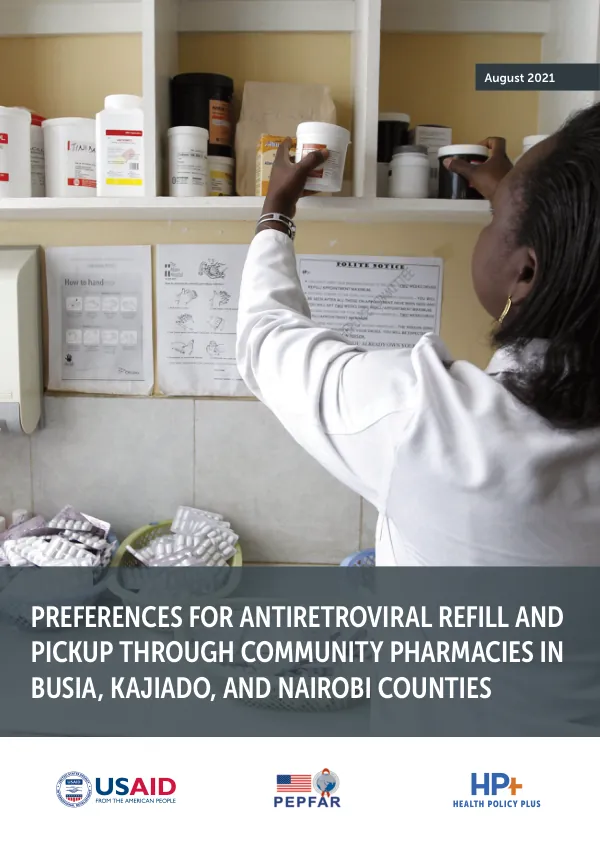
Preferences for Antiretroviral Refill and Pickup Through Community Pharmacies in Busia, Kajiado, and Nairobi Counties
Sign inAVENIR HEALTH
Preferences for Antiretroviral Refill and Pickup Through Community Pharmacies in Busia, Kajiado, and Nairobi Counties
The ARV refill and pickup model through community pharmacies in Kenya's Busia, Kajiado, and Nairobi counties aims to enhance the role of the private sector in HIV service delivery.
2021 · 32 pages
Sign in to readA free account is required to download.
Abstract
This model is an alternative differentiated service delivery (DSD) approach, where stable HIV clients can have their antiretrovirals (ARVs) refilled through community pharmacies. Participating clients will collect their ARVs from a community pharmacy every three months and then return to their parent antiretroviral therapy (ART) site for their clinical review every six months. The model is being piloted in Busia, Kajiado, and Nairobi counties, with the goal of scaling-up implementation across Kenya. To inform the design of this model, Health Policy Plus (HP+) mapped the geographic location of community pharmacies in the three pilot counties relative to ART sites supported by the U.S. President's Emergency Plan for AIDS Relief (PEPFAR). Facility-based surveys in each county established client and pharmacy preferences around ARV refill and pickup at community pharmacies, clients' willingness and ability to pay, and pharmacies' interest and willingness to accept the DSD model. The client survey sample was created by selecting five PEPFAR-supported ART sites in each county, with three publicly owned sites, one faith-based organization site, and one private site. The surveys were conducted in Busia, Kajiado, and Nairobi counties, with a total of 1,200 clients interviewed. The results showed that 62% of clients were willing to pay a dispensing fee for ARV refills, with an average willingness to pay of KSh 200 (approximately US$2). The majority of clients (71%) preferred to pick up their ARVs from community pharmacies, citing convenience and reduced travel time as the main reasons. Pharmacy surveys were also conducted in the three counties, with a total of 150 pharmacies participating. The results showed that 85% of pharmacies were willing to accept the DSD model, with 75% indicating that they had the capacity to dispense ARVs. The main reasons cited for accepting the model were the potential for increased revenue and the opportunity to provide a valuable service to the community. The intersection of client and pharmacy results suggests that there is a strong potential for the ARV refill and pickup model through community pharmacies to be successful in Busia, Kajiado, and Nairobi counties. The model has the potential to increase domestic resources for HIV service delivery, reduce the burden on public health facilities, and improve the overall efficiency of the HIV response in Kenya.