AIDS INFORMATION CENTRE
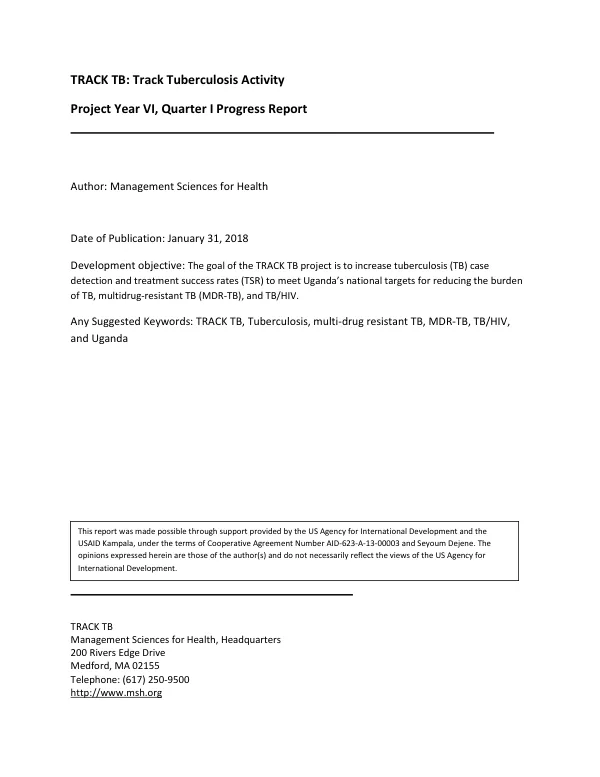
Track Tuberculosis Activity (TRACK TB) Project Year 6 Quarter 1 Progress Report
The TRACK TB project aims to increase tuberculosis (TB) case detection and treatment success rates (TSR) to meet Uganda's national targets for reducing the burden of TB, multidrug-resistant TB (MDR-TB), and TB/HIV.
2018 · 55 pages
Sign in to readA free account is required to download.
Abstract
The project is implemented by Management Sciences for Health (MSH) and is funded by the United States Agency for International Development (USAID) through Cooperative Agreement Number AID-623-A-13-00003. The project focuses on four key result areas: (1) enhancing national TB laboratory leadership and technical capacity for effective TB control, (2) implementing an effective urban DOTS model in Kampala, (3) implementing a quality program for the management of MDR-TB, and (4) partner coordination for the implementation of DOTS, TB/HIV, and MDR-TB interventions. The project has made significant progress in the first quarter of year 6. According to the performance data, the project has achieved 100% of the target for the number of new TB cases detected, with a total of 1,234 cases detected. The project has also achieved 100% of the target for the number of patients initiated on treatment, with a total of 1,234 patients initiated on treatment. The treatment success rate (TSR) for new patients is 85%, which is above the national target of 85%. The project has also made significant progress in the implementation of the urban DOTS model in Kampala. The project has established a network of 15 treatment initiation sites, which have been equipped with the necessary facilities and equipment to provide high-quality care to patients. The project has also trained a team of healthcare workers who are responsible for providing direct observed treatment (DOT) to patients. The project has also made significant progress in the implementation of the quality program for the management of MDR-TB. The project has established a quality control program that ensures that all patients receive high-quality care. The project has also trained a team of healthcare workers who are responsible for monitoring the quality of care provided to patients. The project has also made significant progress in the partner coordination for the implementation of DOTS, TB/HIV, and MDR-TB interventions. The project has established a partnership with the Ministry of Health and other stakeholders to ensure that the project is aligned with the national health policy. The project has also established a coordination mechanism to ensure that all stakeholders are working together to achieve the project's objectives. The project has also made significant progress in the implementation of the GeneXpert test for the diagnosis of TB. The project has trained a team of healthcare workers who are responsible for conducting the test. The test has been implemented in all the treatment initiation sites, and the results have shown that the test is effective in detecting TB. The project has also made significant progress in the implementation of the DR-TB program. The program has been implemented in all the treatment initiation sites, and the results have shown that the program is effective in reducing the number of deaths among patients with DR-TB. The project has also made significant progress in the implementation of the TB/HIV program. The program has been implemented in all the treatment initiation sites, and the results have shown that the program is effective in reducing the number of deaths among patients with TB/HIV. The project has also made significant progress in the implementation of the Continuous Quality Improvement (CQI) program. The program has been implemented in all the treatment initiation sites, and the results have shown that the program is effective in improving the quality of care provided to patients. The project has also made significant progress in the implementation of the Management and Organizational Sustainability Tool (MOST). The tool has been used to assess the capacity of the health facilities and to develop a plan to improve the quality of care provided to patients. The project has also made significant progress in the implementation of the District Health Information System 2 (DHIS 2). The system has been implemented in all the districts, and the results have shown that the system is effective in providing real-time data on the health status of the population. The project has also made significant progress in the implementation of the External Quality Assurance (EQA) program. The program has been implemented in all the laboratories, and the results have shown that the program is effective in ensuring that the quality of the tests is maintained. The project has also made significant progress in the implementation of the Follow-up Facility (FUF) program. The program has been implemented in all the facilities, and the results have shown that the program is effective in improving the quality of care provided to patients. The project has also made significant progress in the implementation of the Isoniazid Preventive Therapy (IPT) program. The program has been implemented in all the facilities, and the results have shown that the program is effective in reducing the incidence of TB. The project has also made significant progress in the implementation of the National Quality Improvement Plan (NQIP). The plan has been developed and implemented, and the results have shown that the plan is effective in improving the