DEPARTMENT FOR INTERNATIONAL DEVELOPMENT
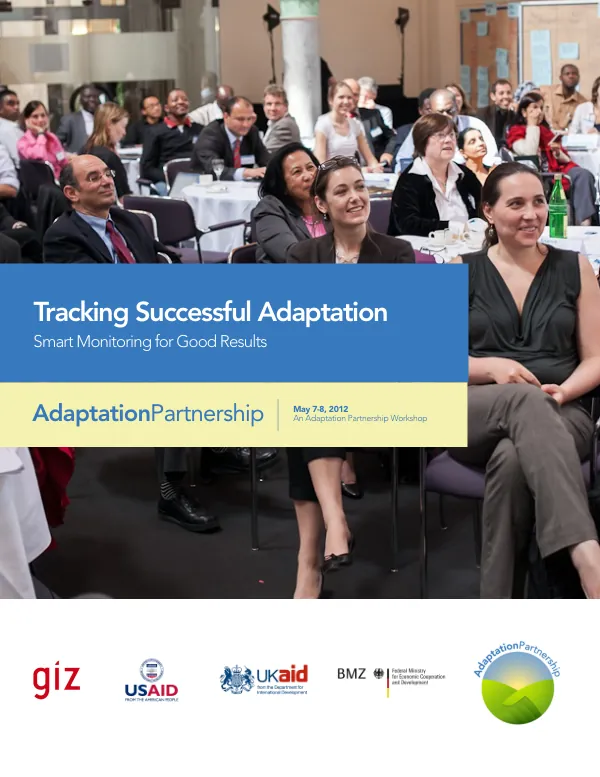
Tracking Successful Adaptation: Smart Monitoring for Good Results
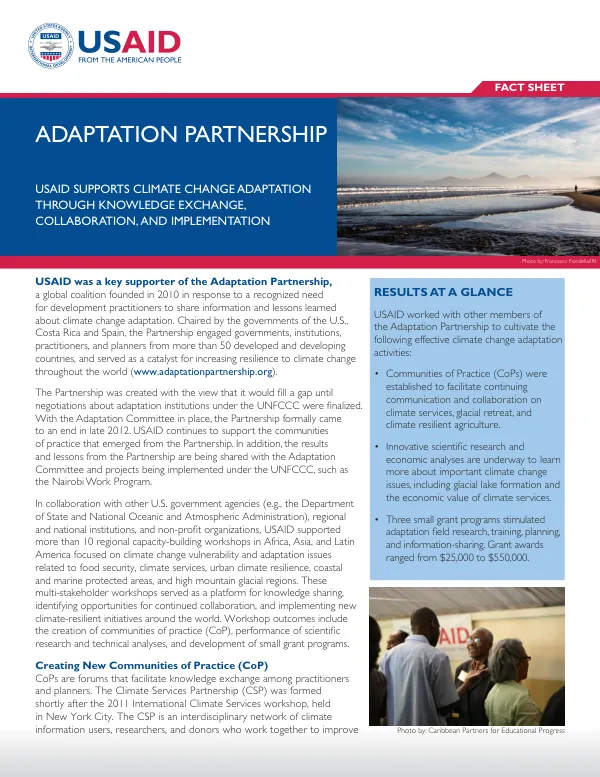
The Adaptation Partnership was established in 2010 by Costa Rica, Spain, and the United States to facilitate the sharing of information and lessons on adaptation efforts among developing and developed countries.
2012 · 21 pages
Sign in to readA free account is required to download.
Abstract
The partnership has since grown to include over 50 countries, with a focus on identifying common adaptation priorities and improving coordination of efforts to scale up action and financing for adaptation. The workshop "Tracking Successful Adaptation: Smart Monitoring for Good Results" was held on May 7-8, 2012, in Bonn, Germany, and was attended by over 100 experts from 30 different countries. The workshop aimed to contribute to the international discussion on monitoring and evaluation (M&E) of climate change adaptation and to advance the application of good practices. The workshop consisted of five main sessions, including an opening session, a session on why and how M&E adaptation, a session on experiences and application, a session on validation and application, and a session on synthesis and roadmap. The sessions included plenary presentations, panels, discussions in a fishbowl format, working group sessions, and guided table discussions. The workshop highlighted several key messages, including the importance of simplicity in M&E, the need to think beyond projects to conduct adaptation impact evaluations, and the need for capacity building for adaptation M&E at various scales. The workshop also emphasized the importance of utilizing a robust theory of change and monitoring assumptions along with results. The opening session of the workshop was led by Frank Fass-Metz, Head of the Division Climate Policy and Climate Financing of the Ministry for Economic Cooperation and Development, who welcomed participants and set the scene for the workshop. Sabine Tröger, Professor at the University of Bonn and Horn of Africa Regional Environment Center, Addis Ababa University, presented an example of climate impacts and the challenges of adaptation from southwest Ethiopia. The Nyangatom area in southwest Ethiopia is experiencing significant climate change, with droughts and changing environmental conditions affecting the livelihoods of the people. The area's traditional calendar, which was used to guide agricultural and livestock management, is no longer effective due to the changing climate. The stressors are exacerbated by cultural changes, the spread of invasive plants, and the construction of a new dam, which will have unknown consequences on the area. The workshop highlighted the challenges of adaptation in the Nyangatom area, including the need for adaptation to new circumstances to maintain people's livelihoods. The example demonstrates the combination of climatic and social change that is leading to an unprecedented situation, making adaptation planning and M&E critical to account for a complex change process and possible, unforeseen developments. The workshop's key messages and recommendations for adaptation M&E at the project-, national-, and portfolio-level were emphasized throughout the sessions. The workshop aimed to advance the application of good practices in M&E and to contribute to the international discussion on monitoring and evaluation of climate change adaptation.