USAID DEC
Trade Project: Customs Warehousing and Free Zones Compliance Assessment for Pakistan
Sign inDELOITTE INC.
Trade Project: Customs Warehousing and Free Zones Compliance Assessment for Pakistan
Customs Warehousing in Pakistan is governed by Chapter 1 of Specific Annex D, which contains 12 standards and 4 recommended practices.
2014 · 45 pages
Sign in to readA free account is required to download.
Abstract
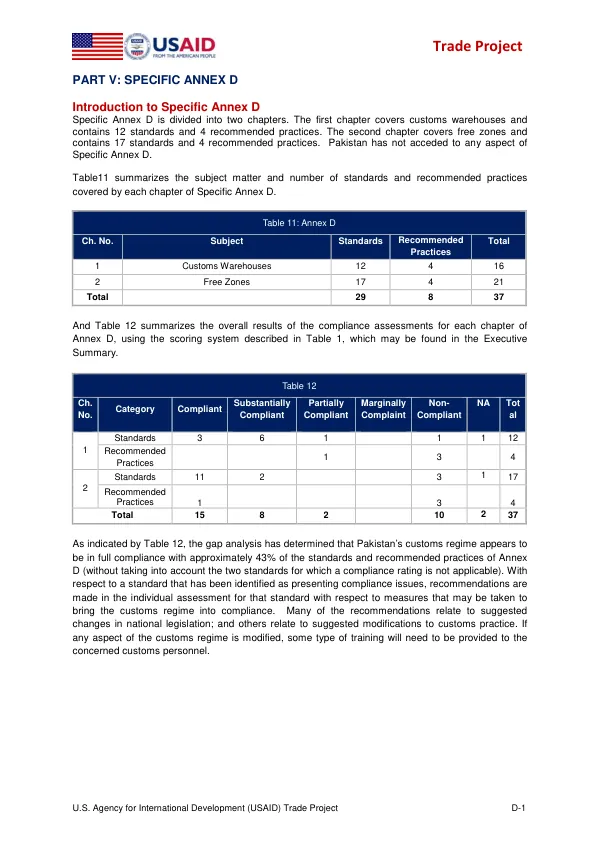
The chapter is divided into two main sections: customs warehouses and free zones. Pakistan has not acceded to any aspect of Specific Annex D. The chapter on customs warehouses provides for the establishment, suitability, and management of customs warehouses, as well as the arrangements for customs control. Standard 4 requires the Customs to lay down the requirements for the establishment, suitability, and management of customs warehouses and the arrangements for customs control. The overall assessment for this standard is compliant, with relevant laws including the Customs Act and the Customs Rules. Standard 3 requires national legislation to provide for customs warehouses to be used solely by specified persons when necessary to meet the special requirements of the trade. The overall assessment for this standard is substantially compliant, with relevant laws including the Customs Act and the Customs Rules. However, the wording "Customs warehouses to be used solely by specified persons" does not appear in the Act or the rules, and the law needs to be amended to make it fully compliant with the RKC. Standard 2 requires national legislation to provide for customs warehouses open to any person having the right to dispose of the goods. The overall assessment for this standard is compliant, with relevant laws including the Customs Act and the Customs Rules. The law and practice are in compliance with the standard, and no recommendations are deemed necessary at this stage. Standard 1 provides that the customs warehousing procedure shall be governed by the provisions of Chapter 1 and, insofar as applicable, by the provisions of the General Annex. The overall assessment for this standard is not applicable, as it only provides that customs warehousing is to be governed by Chapter 1 and the applicable provisions of the General Annex. The gap analysis has determined that Pakistan's customs regime appears to be in full compliance with approximately 43% of the standards and recommended practices of Annex D. With respect to a standard that has been identified as presenting compliance issues, recommendations are made in the individual assessment for that standard with respect to measures that may be taken to bring the customs regime into compliance. Many of the recommendations relate to suggested changes in national legislation, and others relate to suggested modifications to customs practice. If any aspect of the customs regime is modified, some type of training will need to be provided to the concerned customs personnel. The defined term "customs warehousing procedure" is provided in Chapter 1 of Specific Annex D, and it means the Customs procedure under which imported goods are stored under Customs control in a designated place (a Customs warehouse) without payment of import duties and taxes. The Customs Act does not use this term, but the terms "warehouse" and "warehousing station" are defined in Section 2 of the Customs Act, and the Customs Act does provide for a Customs warehousing procedure that is consistent with the meaning of this term.