USDA
Training and Quality Seeds Produce Immense Benefits for Horticulture Farmers
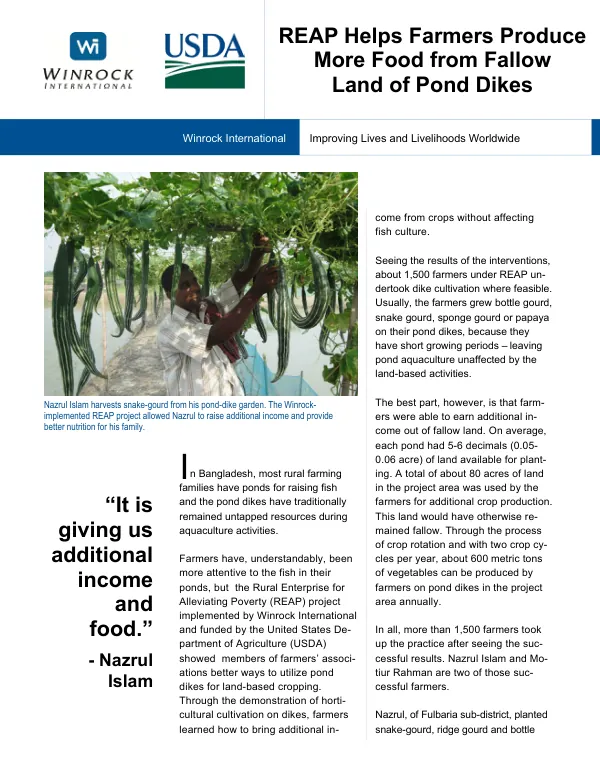
The Rural Enterprise for Alleviating Poverty (REAP) project in Bangladesh aims to improve the lives of poor, marginal, and small farming families in the 11 sub-districts of Mymensingh, Gazipur, and Tangail districts.
2011 · 2 pages
Sign in to readA free account is required to download.
Abstract
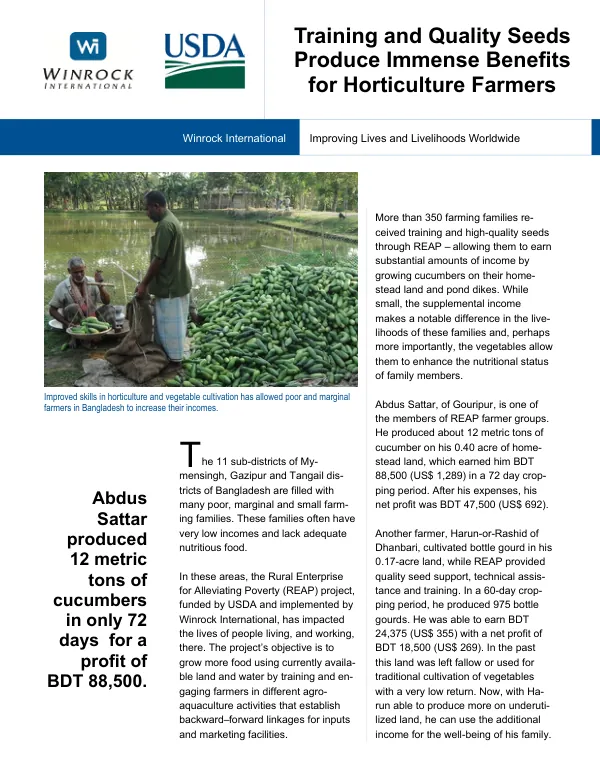
Funded by the United States Department of Agriculture (USDA) and implemented by Winrock International, the project's objective is to grow more food using currently available land and water by training and engaging farmers in different agro-aquaculture activities. More than 350 farming families received training and high-quality seeds through REAP, allowing them to earn substantial amounts of income by growing cucumbers on their homestead land and pond dikes. Abdus Sattar, a member of the REAP farmer group, produced about 12 metric tons of cucumber on his 0.40-acre of homestead land, earning BDT 88,500 (US$ 1,289) in a 72-day cropping period. After expenses, his net profit was BDT 47,500 (US$ 692). Another farmer, Harun-or-Rashid, cultivated bottle gourd in his 0.17-acre land, while REAP provided quality seed support, technical assistance, and training. In a 60-day cropping period, he produced 975 bottle gourds, earning BDT 24,375 (US$ 355) with a net profit of BDT 18,500 (US$ 269). The project's training and quality seeds have produced immense benefits for horticulture farmers, allowing them to increase their incomes. Improved skills in horticulture and vegetable cultivation have enabled poor and marginal farmers in Bangladesh to increase their incomes. Abdus Sattar's success in producing 12 metric tons of cucumbers in 72 days for a profit of BDT 88,500 is a notable example. Furthermore, he has used his skills to expand into other areas, bringing his family more food and income. Hanif Mia, another farmer, received training from REAP in horticulture and vegetable cultivation, allowing him to plant a plot of ridge gourd and harvest 928 kilograms of gourds, earning BDT 17,110 (US$ 249). The project has also benefited small-scale producers, especially women, who produce vegetables on their small pieces of homestead land. As a result of this intervention, about 9,000 people have indirectly benefited from more money and improved nutrition. The success of the project has inspired farmers to expand into other areas, bringing their families more food and income.