USAID
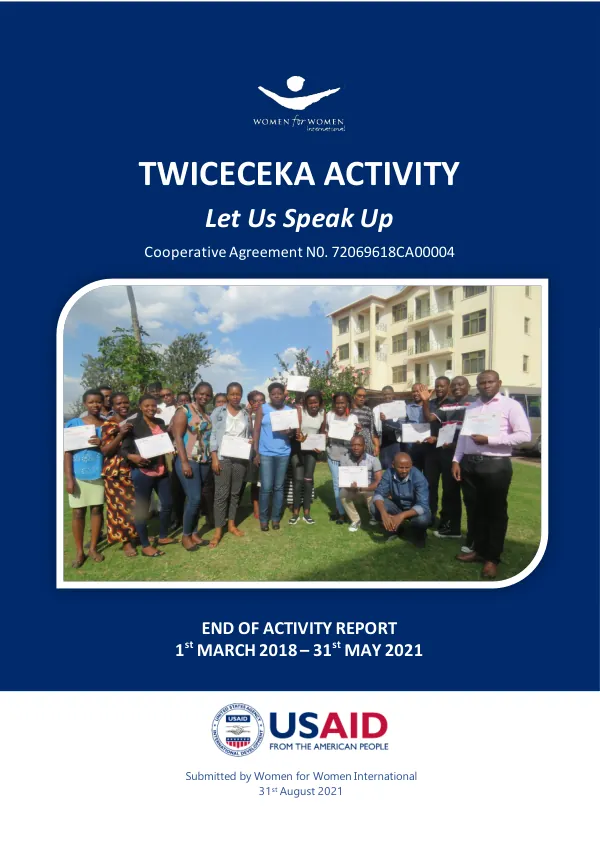
TWICECEKA (Let Us Speak Up) Activity March 2018 to May 2021 – Final report
The TWICECEKA (Let Us Speak Up) Activity was implemented from March 1, 2018 to May 31, 2021 in collaboration with civil society organizations (CSOs) in eight target districts in Rwanda.
2021 · 37 pages
Sign in to readA free account is required to download.
Abstract
The project aimed to strengthen Rwandan civil society's ability to engage with government in the fight against gender-based violence (GBV), increase awareness of GBV, and encourage government willingness to address GBV. The project was funded by the United States Agency for International Development (USAID) and implemented by Women for Women International (WfWI) and Women for Women Rwanda. To achieve this objective, WfWI invested in capacity-building of local institutions and CSOs, facilitating structured, action-oriented networking among CSOs and government officials. Local CSOs received targeted technical assistance to promote cooperative advocacy with government to foster change in the fight against GBV. These interventions improved understanding of GBV, prevention and response options among community leaders, local authorities, and service providers across the eight target districts. The project also created and strengthened GBV accountability mechanisms via civil society-led advocacy and interventions. WfWI awarded grants to CSOs in each of the eight target districts to execute advocacy and accountability projects, focusing on improving services, support for GBV survivors, and GBV intervention activities through engagement with local authorities and GBV service providers. CSOs also led community GBV awareness campaigns to educate citizens on women's rights. WfWI has been working in Rwanda since 1997 and has served over 75,000 women with transformative programs and support. The organization has developed considerable expertise in equipping women with the knowledge, skills, and pathways to become empowered agents of change within families and communities. Through its support, women increase their ability to plan their businesses, save and earn an income with new skills that are in demand. They learn about their legal rights and become knowledgeable about health and nutrition. The project's interventions included technical assistance to CSO partners, GBV mapping and advocacy conferences, and tailored technical assistance to CSO partners. These interventions were designed to improve understanding of GBV, prevention and response options among community leaders, local authorities, and service providers across the eight target districts. The project also focused on improving referral systems, providing psychosocial support to GBV survivors, and increasing access to improved livelihoods and economic opportunities for GBV survivors, especially teenage mothers. CSOs led community GBV awareness campaigns to educate citizens on women's rights and led activities to improve referral systems, provide psychosocial support to GBV survivors, and increase access to improved livelihoods and economic opportunities for GBV survivors. The project's results showed a significant increase in awareness of GBV among community leaders, local authorities, and service providers across the eight target districts. The project also improved understanding of GBV, prevention and response options among community leaders, local authorities, and service providers. The project's interventions also led to improved referral systems, increased access to psychosocial support for GBV survivors, and increased access to improved livelihoods and economic opportunities for GBV survivors. The project's lessons learned highlighted the importance of building the capacity of local institutions and CSOs to engage with government in the fight against GBV. The project also emphasized the need for sustained advocacy and awareness-raising efforts to address GBV. The project's recommendations included continued support for CSOs to engage with government in the fight against GBV and continued awareness-raising efforts to address GBV.