USAID FAMINE EARLY WARNING SYSTEMS NETWORK
Uganda Food Security Outlook Update September 2012
The agricultural sector in Uganda is experiencing a stable food security situation as the country prepares for the heavy second rainy season.
2012 · 3 pages
Sign in to readA free account is required to download.
Abstract
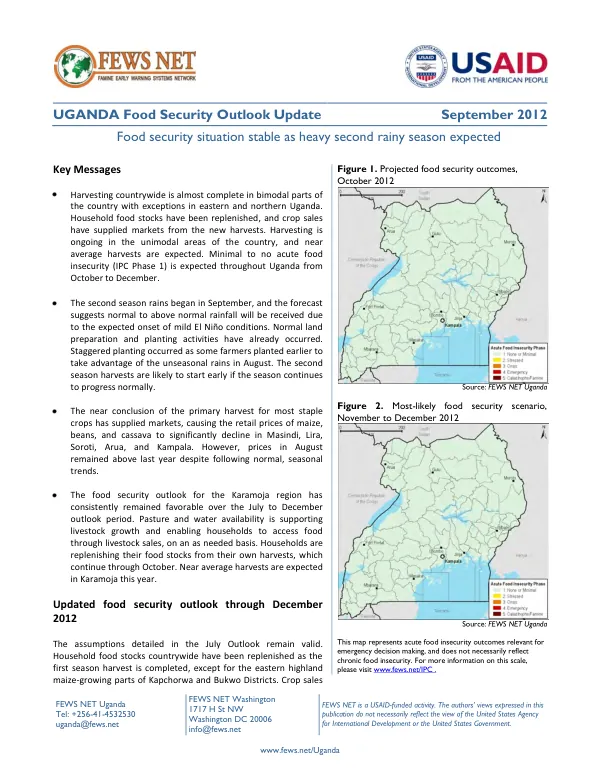
Harvesting is almost complete in the bimodal parts of the country, with household food stocks replenished and crop sales supplying markets from the new harvests. Minimal to no acute food insecurity (IPC Phase 1) is expected throughout Uganda from October to December. The second season rains began in September, with a forecast suggesting normal to above normal rainfall due to the expected onset of mild El Niño conditions. Normal land preparation and planting activities have already occurred, with some farmers planting earlier to take advantage of the unseasonal rains in August. The second season harvests are likely to start early if the season continues to progress normally. Retail prices of staple crops such as maize, beans, and cassava have significantly declined in markets such as Masindi, Lira, Soroti, Arua, and Kampala. However, prices in August remained above last year's levels despite following normal seasonal trends. The food security outlook for the Karamoja region has consistently remained favorable over the July to December outlook period, with pasture and water availability supporting livestock growth and enabling households to access food through livestock sales. Households in the Karamoja region are replenishing their food stocks from their own harvests, which continue through October. Near average harvests are expected in Karamoja this year. The prices of cereals in Karamoja are expected to decrease after the harvest is complete in October, with trading activities expected to behave normally except for the deterioration of roads into the region. Assuming no serious outbreaks of livestock diseases between now and December and the continued rains as forecast, poor households are expected to access adequate food supplies and incomes from crop sales and livestock sales. Overall, households in the country are expected to maintain no or minimal acute food insecurity (IPC Phase 1) from November to December. The seasonal calendar indicates that typical livelihood activities are being carried out throughout the period between now and December, including land preparation, drying, and other postharvest and storage activities for crops such as beans, maize, sweet potatoes, cassava, simsim (sesame), millet, and sorghum. The cumulative rainfall in the Karamoja region has been near normal to above normal, enhancing the availability of pasture and water resources and supporting livestock growth. Regional demand from South Sudan and Kenya for maize and beans, among other commodities, and local demand for animal feeds and food processing industries will keep prices on the high side. However, the overall food security situation in Uganda is expected to remain stable, with households able to meet their essential and non-food needs without engaging in atypical, unsustainable coping strategies to access food or income.