USAID DEC
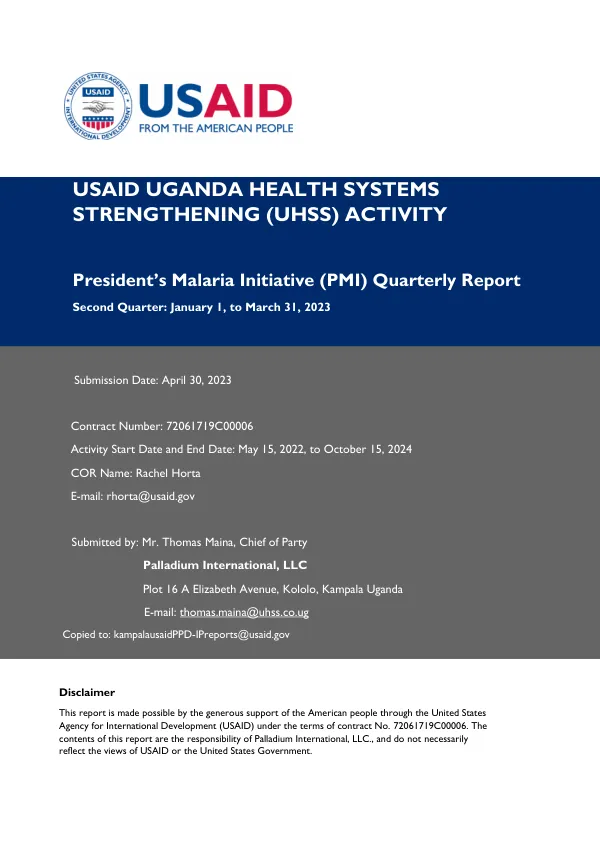
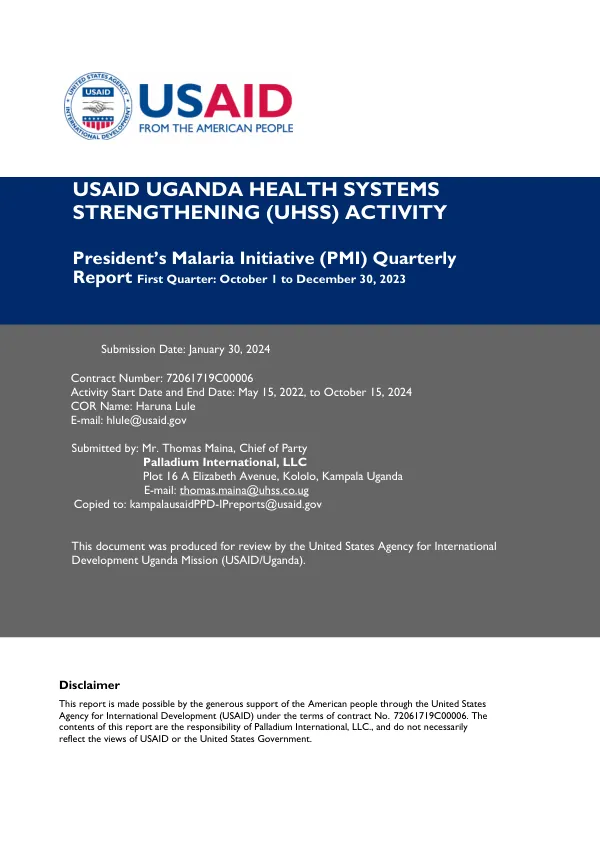
UHSS President's Malaria Initiative (PMI) Quarterly Report First Quarter: October 1 to December 31, 2023
Sign inMINISTRY OF HEALTH
UHSS President's Malaria Initiative (PMI) Quarterly Report First Quarter: October 1 to December 31, 2023
The USAID Uganda Health System Strengthening (UHSS) Activity aims to strengthen Uganda's health system through technical assistance that improves leadership and accountability for results in public and private health sectors at national, sub-national, and community levels.
2023 · 19 pages
Sign in to readA free account is required to download.
Abstract
The President's Malaria Initiative (PMI) increased funding to the UHSS Activity to implement interventions in 15 malaria high-burden districts to strengthen community systems for quality health services. During Program Year 5 quarter 1 (Q1), which covers the period October 2023 to December 2023, the UHSS Activity implemented several activities to reduce malaria and strengthen the quality of health services at the community level. One notable achievement was the overall reduction in malaria positivity in the 14 sub-counties where UHSS conducted community engagements (CEs). In the previous quarter, the positivity rate stood at 56 percent, but in program year (PY) 5 Q1, it decreased to 50 percent. Community leaders, including technical district representatives and political leaders, disseminated malaria prevention and reduction messages to over 7,095 persons during 112 community dialogue meetings. UHSS in collaboration with Uganda Health Activity (UHA) supported the Ministry of Health (MoH) in piloting the revised community HMIS tools. The MoH Health Information, Innovation, and Research Technical Working Group (TWG) reviewed and approved the national HMIS reporting tools, including the community HMIS tools, in December 2023. These revised tools integrate key indicators proposed by USAID and its partners from programs such as family planning, malaria, reproductive health, HIV/AIDS, maternal and child health, nutrition, tuberculosis, and water, sanitation, and hygiene. Additionally, during the quarter, UHSS finalized the upgrade of the community health workers registry (CHWR). The upgraded system includes a CHWR dashboard intended to facilitate data use for CHW data at all levels by the different stakeholders. The link to access the current CHWR demo is https://dev-hris.health.go.ug/ with a username of [email protected] and a password of ihris. In the second quarter, UHSS will finalize the integration of the standard health facility lists into the CHWR, which will enable community health worker (CHW) data migration into the new system before the national rollout. Once the MoH rolls out the CHWR nationally, it is anticipated that the system will map the CHW footprint, foster interoperability with other health information systems, link CHW duties to key performance outcomes, and inform MoH decisions regarding their deployment, retention, and remuneration. To further reduce the stock out of malaria and non-malaria commodities, UHSS successfully advocated for the inclusion of the 15 PMI target districts as part of the districts to receive non-malaria commodities of Amoxicillin and oral rehydration salt for the UHSS-trained Village Health Teams (VHT) on integrated community case management (iCCM). The commodities are expected to be delivered in the next distribution cycle by National Medical Stores. As part of the CHEW pilot documentation roadmap, UHSS documented the cost of implementing the CHEW pilot program. The costing documentation was aimed at determining the unit costs for the successful rollout of the CHEW program. The costing analysis revealed that the overall unit cost for delivering the CHEW program for one year per site/district was UGX 20 million. The findings also revealed that the unit cost of implementing the CHEW program varied depending on the district, with some districts having lower costs due to existing infrastructure and resources. The UHSS Activity has made significant progress in strengthening community systems for quality health services in the 15 malaria high-burden districts. The reduction in malaria positivity, the piloting of revised community HMIS tools, and the upgrade of the CHWR are notable achievements that demonstrate the effectiveness of the UHSS Activity in improving health outcomes in Uganda.
Related documents