USAID DEC
Water use behaviors and water access in intermittent and continuous water supply areas during the COVID-19 pandemic
Sign inNORTH CAROLINA A&T STATE UNIVERSITY
Water use behaviors and water access in intermittent and continuous water supply areas during the COVID-19 pandemic
Hubballi–Dharwad, a twin city in northern Karnataka, India, with a population of over one million, has a unique water supply system.
2021 · 10 pages
Sign in to readA free account is required to download.
Abstract
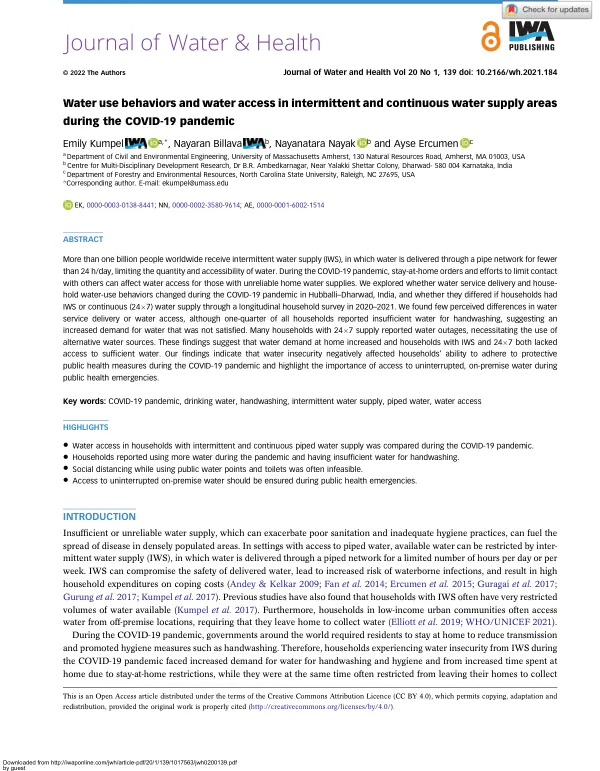
Approximately 10% of the population received continuous (24/7) water supply on a pilot scale in 2006 and 2007, while the rest of the city received intermittent water supply (IWS). The conversion from IWS to 24/7 supply had a significant impact on child health, household economics, and water quality, as documented in previous studies. During the COVID-19 pandemic, stay-at-home orders and efforts to limit contact with others affected water access for households with unreliable home water supplies. In Hubballi–Dharwad, households with IWS and those with continuous water supply were compared in terms of water access, water usage, and adherence to disease transmission mitigation behaviors during and after the stay-at-home orders. The study area consisted of 16 wards with at least 50% of households having 24/7 supply, and 16 IWS wards matched as controls. The study found that households with IWS and those with continuous water supply both experienced increased demand for water during the pandemic, but households with IWS often had insufficient water for handwashing. Many households with 24/7 supply reported water outages, necessitating the use of alternative water sources. The findings suggest that water insecurity negatively affected households' ability to adhere to protective public health measures during the COVID-19 pandemic. The study used a genetic matching algorithm to select IWS wards as matched controls for the 16 wards with at least 50% 24/7 service. Wards were matched on socioeconomic indicators, sanitation conditions, and pre-upgrade water service using a representative dataset collected before the conversion. The study enrolled households from the remaining 31 wards in Hubballi–Dharwad, India, with a target of approximately 20 households per ward. The results of the study indicate that households with IWS and those with continuous water supply both faced challenges in accessing sufficient water during the pandemic. The study highlights the importance of access to uninterrupted, on-premise water during public health emergencies. The findings suggest that additional measures are needed to ensure water access, particularly for households with IWS, and that efforts to upgrade IWS systems to provide continuous supply are essential. The study's findings have implications for future policies and interventions to improve water access during public health emergencies. The results suggest that households with IWS may have experienced differential changes in water access and water-use behaviors during the pandemic, and that IWS affected their ability to adhere to mitigation measures. The study's findings can inform efforts to prioritize upgrading IWS systems to provide continuous supply and to ensure access to uninterrupted, on-premise water during public health emergencies.
Related documents