USAID DEC
Universal coverage with insecticide-treated nets – applying the revised indicators for ownership and use to the Nigeria 2010 malaria indicator survey data
Sign inMALARIA CONSORTIUM
Universal coverage with insecticide-treated nets – applying the revised indicators for ownership and use to the Nigeria 2010 malaria indicator survey data
Malaria prevention with insecticide-treated nets (ITN) has been a key strategy in reducing malaria cases worldwide.
2013 · 12 pages
Sign in to readA free account is required to download.
Abstract
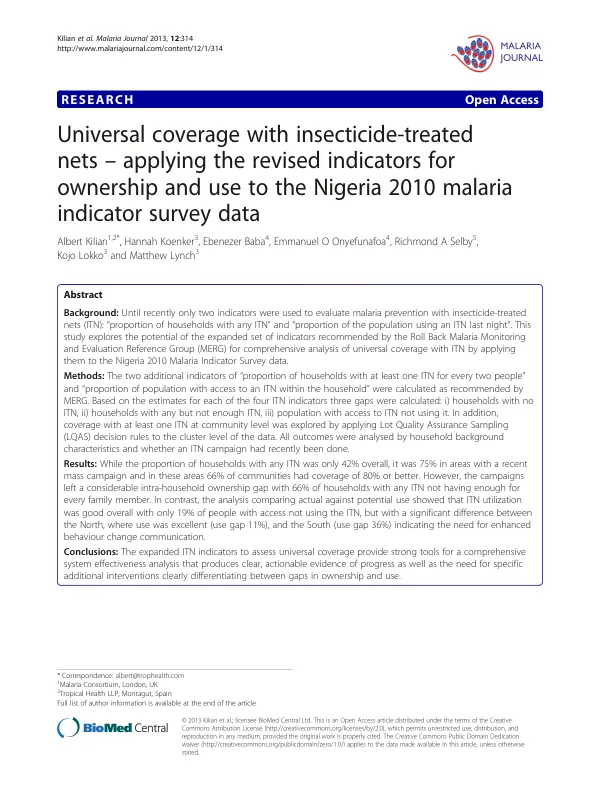
Until recently, only two indicators were used to evaluate ITN effectiveness: the proportion of households with any ITN and the proportion of the population using an ITN the previous night. However, these indicators have been criticized for not accurately measuring ITN coverage, as they do not account for intra-household ownership and use. The Roll Back Malaria Monitoring and Evaluation Reference Group (MERG) has recommended two additional indicators to assess universal coverage with ITN: the proportion of households with at least one ITN for every two people and the proportion of the population with access to an ITN within the household. These indicators aim to better define the ownership gap and the use gap, respectively. The ownership gap refers to households with no or insufficient ITN, while the use gap refers to the part of non-use that is not explained by the absence of a usable ITN. The Nigeria 2010 Malaria Indicator Survey data were used to apply the new indicators and explore their usefulness. The survey was conducted in six geopolitical zones, targeting 1,000 households per zone, and collected data on malaria interventions and parasitaemia in children. The data were analyzed using Stata 11.2 software. The results showed that while the proportion of households with any ITN was only 42% overall, it was 75% in areas with a recent mass campaign. However, the campaigns left a considerable intra-household ownership gap, with 66% of households with any ITN not having enough for every family member. In contrast, the analysis comparing actual against potential use showed that ITN utilization was good overall, with only 19% of people with access not using the ITN. The study found significant differences in ITN use between the North and South regions, with the North showing excellent use (use gap 11%) and the South showing poor use (use gap 36%). This highlights the need for enhanced behavior change communication in the South. The expanded ITN indicators provide strong tools for a comprehensive system effectiveness analysis, producing clear and actionable evidence of progress and the need for specific additional interventions. The study's findings suggest that the new indicators can help identify areas where ITN coverage is inadequate and where behavior change communication is needed. By applying these indicators to the Nigeria 2010 Malaria Indicator Survey data, the study demonstrates their usefulness in assessing universal coverage with ITN and provides a framework for malaria program managers and public health practitioners to evaluate ITN programs more effectively. The results of this study have implications for malaria control programs, highlighting the importance of addressing the intra-household ownership gap and the need for behavior change communication to improve ITN use. The study's findings also underscore the need for a more comprehensive approach to evaluating ITN programs, one that takes into account the complexities of intra-household ownership and use.
Related documents