USAID DEC
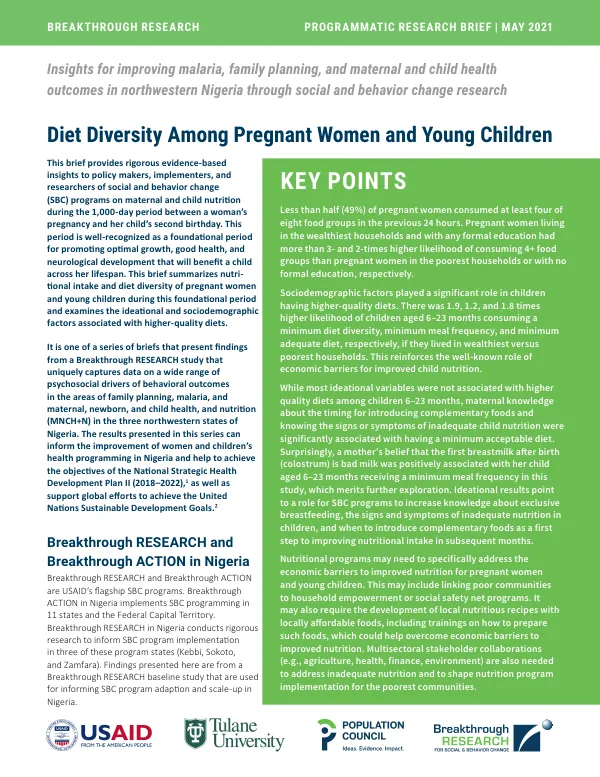
Diet diversity among pregnant women and young children—Insights for improving malaria, family planning, and maternal and child health outcomes in northwestern Nigeria through social and behavior change programming
Sign inBREAKTHROUGH ACTION
Diet diversity among pregnant women and young children—Insights for improving malaria, family planning, and maternal and child health outcomes in northwestern Nigeria through social and behavior change programming
The 1,000-day period between a woman's pregnancy and her child's second birthday is a foundational period for promoting optimal growth, good health, and neurological development that will benefit a child across her lifespan.
2021 · 8 pages
Sign in to readA free account is required to download.
Abstract
Good maternal and child nutrition during this period is a cornerstone of this development. However, in northwestern Nigeria, maternal and child malnutrition remains a significant concern. According to the 2018 National Nutrition and Health Survey, approximately 20% of children under 5 years old are underweight, and 37% are stunted. Previous research studies have shown that micronutrient deficiencies are common among pregnant women, particularly for iron, folate, vitamin A, and vitamin A. Anemia during pregnancy is also a recognized problem in this region. The purpose of this research brief is to summarize the nutritional intake and diet diversity of pregnant women and young children in Kebbi, Sokoto, and Zamfara States, and to examine the ideational and sociodemographic factors associated with higher-quality diets. The study used a cross-sectional design, with a sample size of 3,032 pregnant women and 3,043 women with a child under 2 years old. The results show that less than half (49%) of pregnant women consumed at least 4 or more food groups in the previous 24 hours. Pregnant women living in the wealthiest households and those with any formal education had a higher likelihood of consuming 4+ food groups than those in the poorest households or with no formal education. The study also found that nearly all pregnant women consumed grains, white roots, tubers, and plantains in the previous 24 hours, but less than one-quarter consumed eggs or vitamin-A rich foods. In terms of diet diversity among children aged 6-23 months, less than one-third had a minimum diet diversity, consuming 5+ food groups including breastmilk in the past 24 hours. Most children were given breastmilk and grains, white roots, tubers, and plantains, but less than half were given dairy or beans or nuts. The study suggests that sociodemographic factors, such as household wealth and education, play a significant role in determining diet diversity among pregnant women and young children. The results also highlight the importance of addressing economic barriers to improved nutrition, particularly in the poorest households. Additionally, the study emphasizes the need for SBC programs to increase knowledge about exclusive breastfeeding, the signs and symptoms of inadequate nutrition in children, and when to introduce complementary foods. The findings of this study have implications for improving maternal and child nutrition in northwestern Nigeria. The study recommends that SBC programs should focus on addressing economic barriers to improved nutrition, increasing knowledge about exclusive breastfeeding, and promoting the introduction of complementary foods. The study also suggests that multisectional stakeholder collaborations are needed to address the complex factors contributing to poor nutrition in the region.
Related documents
Documents in this collection
 2021
2021USAID DEC
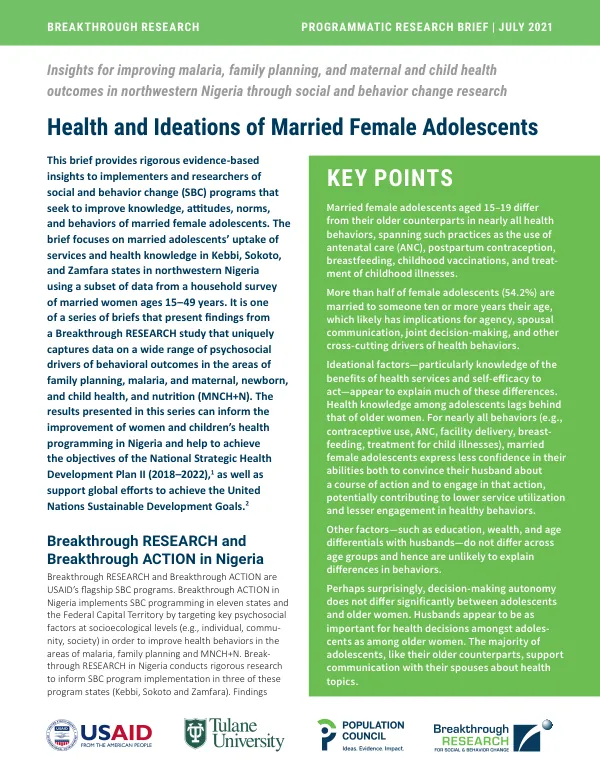
Health and Ideations of Married Female Adolescents—Insights for Improving Malaria, Family Planning, and Maternal and Child Health Outcomes in Northwestern Nigeria through Social and Behavior Change Programming
Open record 2021
2021USAID DEC