USAID DEC
Family planning—Insights for improving malaria, family planning, and maternal and child health outcomes in northwestern Nigeria through social and behavior change programming
Sign inBREAKTHROUGH ACTION
Family planning—Insights for improving malaria, family planning, and maternal and child health outcomes in northwestern Nigeria through social and behavior change programming
In northwestern Nigeria, there is a pressing need to promote voluntary contraceptive use and address unmet need among married women.
2021 · 8 pages
Sign in to readA free account is required to download.
Abstract
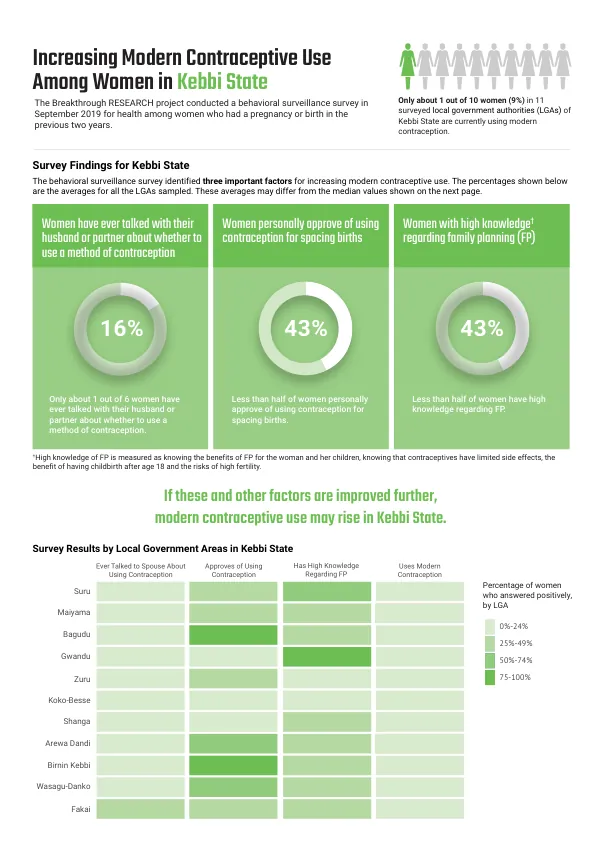
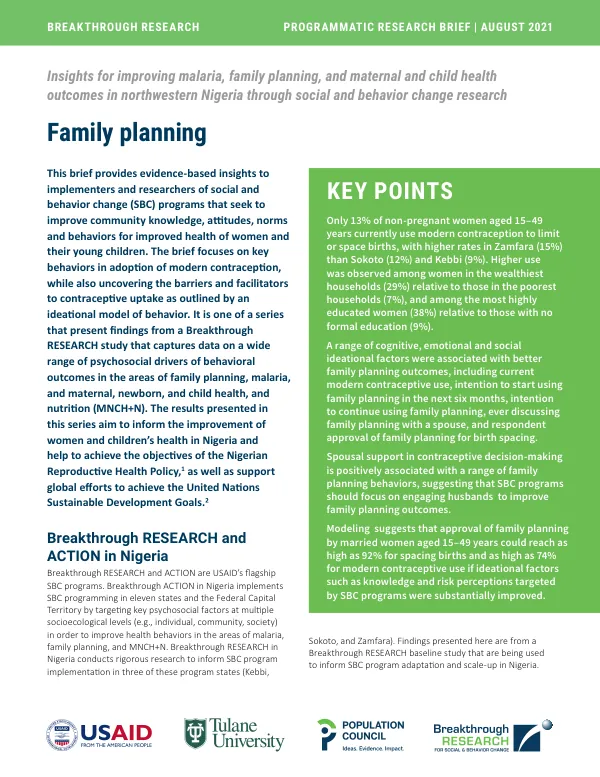
The 2018 Nigeria Demographic and Health Survey indicated that only 4% of married women in the states of Kebbi, Sokoto, and Zamfara were currently using any form of modern contraception, and unmet need for spacing or limiting stood at 12%. Much of the absence of demand for family planning has been attributed to lack of awareness of contraception and to social norms for high fertility. Decision-making processes are multifaceted and influenced by the complex interaction of knowledge, beliefs, social norms, and other psychosocial factors. A range of cognitive, emotional, and social ideational factors are associated with better family planning outcomes, including current modern contraceptive use, intention to start using family planning in the next six months, intention to continue using family planning, ever discussing family planning with a spouse, and respondent approval of family planning. Spousal support in contraceptive decision-making is positively associated with a range of family planning behaviors, suggesting that social and behavior change programs should focus on engaging husbands to improve family planning outcomes. Modeling suggests that approval of family planning by married women aged 15-49 years could reach as high as 92% for spacing births and as high as 74% for modern contraceptive use if ideational factors such as knowledge and risk perceptions targeted by social and behavior change programs were substantially improved. The Breakthrough RESEARCH study conducted in Kebbi, Sokoto, and Zamfara states found that only 13% of non-pregnant women aged 15-49 years currently use modern contraception to prevent pregnancy, with higher rates in Zamfara (15%) than in Sokoto (12%) or Kebbi (9%). Use of modern contraception was higher among respondents in the wealthiest households (29%) relative to the poorest (7%), and among the most highly educated women (38%) relative to those with no formal education (9%).
Related documents
Documents in this collection
 2021
2021USAID DEC
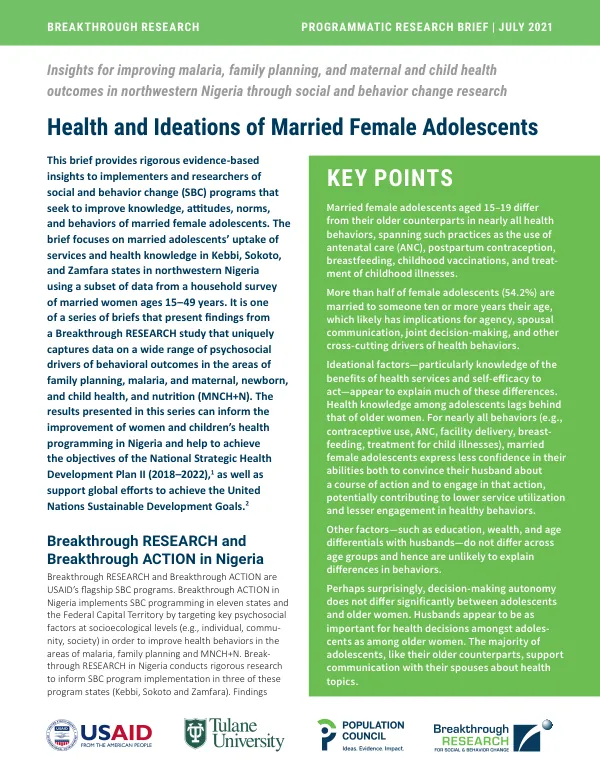
Health and Ideations of Married Female Adolescents—Insights for Improving Malaria, Family Planning, and Maternal and Child Health Outcomes in Northwestern Nigeria through Social and Behavior Change Programming
Open record 2021
2021USAID DEC