USAID DEC
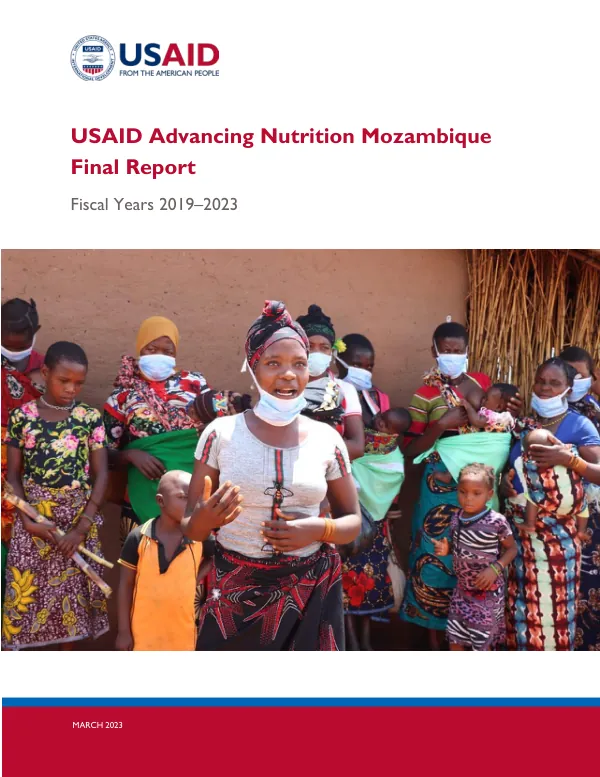
USAID Advancing Nutrition Mozambique Final Report: Fiscal Years 2019–2023 (March 2023)
Sign inJSI RESEARCH & TRAINING INSTITUTE, INC
USAID Advancing Nutrition Mozambique Final Report: Fiscal Years 2019–2023 (March 2023)
The Government of the Republic of Mozambique has prioritized reducing malnutrition as a key economic and health objective.
2023 · 32 pages
Sign in to readA free account is required to download.
Abstract
Despite recent economic growth and investments in food security and nutrition, the prevalence of malnutrition remains high, with 38% stunting and 6% wasting among children under five years of age. Nampula, one of the country's 11 provinces, has the highest population and is economically significant due to its agricultural productivity and transportation corridor. However, Nampula also has the highest prevalence of chronic malnutrition among children under five, at 47%, and the third-highest prevalence of wasting, at 5%. The Plano de Acção Multissectorial para Redução da Desnutrição Crónica (Multi-Sectoral Action Plan for the Reduction of Chronic Malnutrition) (PAMRDC) has been the technical lead on multi-sectoral nutrition programming since 2010. The plan is led by the Secretariado Técnico de Segurança Alimentar e Nutricional (Technical Secretariat for Food Security and Nutrition) (SETSAN) under the Ministry of Agriculture, in collaboration with the Ministério da Saúde (Ministry of Health) (MISAU). In 2017/2018, the Government of Mozambique established the National, Provincial, and District Councils on Food Security and Nutrition (CONSANs, COPSANs, and CODSANs) to promote and implement legislation, policies, strategies, and programs supporting food security and nutrition. The USAID Advancing Nutrition project, led by JSI Research & Training Institute, Inc. (JSI), aims to support the Government of Mozambique's efforts to reduce malnutrition. The project's multi-sectoral approach draws together global nutrition experience to design, implement, and evaluate programs addressing the root causes of malnutrition. The project's core-funded activities focused on improving maternal and child health, increasing access to nutritious food, and promoting social and behavior change. Implementation of the project's core-funded activities took place in Nampula Province, where the highest prevalence of chronic malnutrition among children under five was recorded. The project's interventions included training community health workers, establishing community health committees, and promoting the use of integrated nutrition packages. The project also supported the development of a performance monitoring plan to track progress and identify areas for improvement. The project's success was attributed to the strong collaboration between the project team, the Government of Mozambique, and other stakeholders, including the United Nations Children's Fund and other United Nations agencies.