USAID DEC
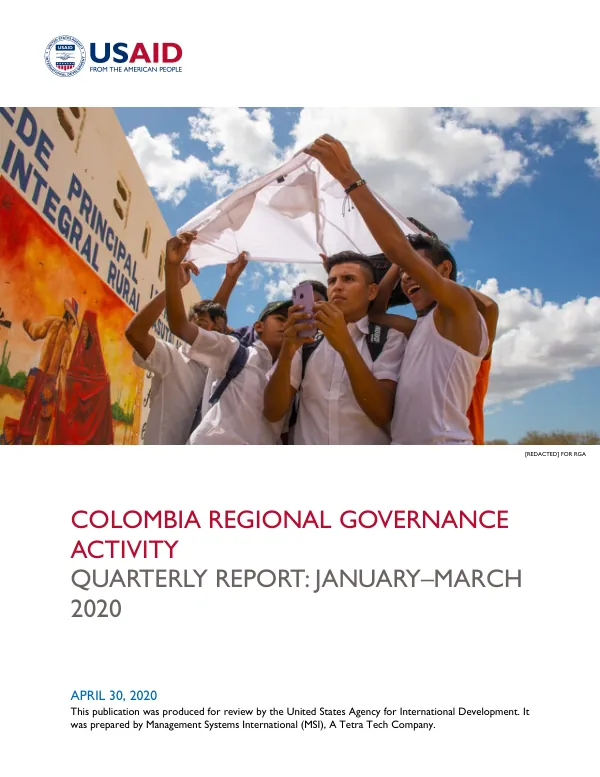
USAID Colombia - Regional Governance Activity- Quarterly Technical Report - JAN-MAR 2020
Sign inMANAGEMENT SYSTEMS INTERNATIONAL
USAID Colombia - Regional Governance Activity- Quarterly Technical Report - JAN-MAR 2020
The Regional Governance Activity (RGA) in Colombia began on June 22, 2015, with an initial period of performance of four and a half years.
2020 · 53 pages
Sign in to readA free account is required to download.
Abstract
The original objective was to improve governance in 40 Colombian municipalities affected by the nation's armed conflict through five program components: decentralization, public financial management, tertiary roads, citizen participation, and electoral reform. On April 23, 2019, RGA was awarded a six-month cost extension to June 21, 2020. The amendment added a sixth component and adjusted RGA's territorial focus to concentrate on 10 subnational governments (SNGs) in three border departments—Arauca, La Guajira, and Norte de Santander—to help them cope with the challenges created by the influx of Venezuelan migrants and Colombian returnees in host communities. RGA provided technical assistance to the ministry of Health (MOH) to draft and implement Decree 064, issued on January 20, 2020, which establishes that all migrants holding a valid Special Residence Permit (PEP) can be affiliated with Colombia's subsidized health care regime. RGA also assisted MOH in rolling out the decree, hosting workshops with public officials from departmental and municipal health secretariats in Arauca, Riohacha, and Cúcuta. These workshops focused on explaining the impact that Decree 064 has on migrant health care affiliation, as well as the financial resources and guidelines established in the decree. RGA promoted safe learning environments by assisting its 16 prioritized public schools to implement risk management strategies based on its previous work to identify risks and draft school risk management plans (PEGRs). With RGA support, school communities have implemented risk management strategies to reduce xenophobia and bullying, address human trafficking as a risk affecting migrant and returnee students, and promote inclusive education. The influx of Venezuelan migrants and Colombian returnees has created significant challenges for host communities in the three border departments. RGA is working to support SNGs in addressing these challenges, including improving health service provision, education service provision, and economic opportunities. RGA is also promoting citizen participation and community engagement to ensure that the needs and concerns of host communities are addressed. RGA's progress and accomplishments are reflected in the program indicators, which show significant improvements in health service provision, education service provision, and citizen participation. The program has also made significant progress in promoting economic opportunities and addressing the needs of host communities. The quarterly report also includes a success story, Youth: The Changemakers of Today, which highlights the impact of RGA's work on young people in the three border departments. The report also includes eight annexes that provide detailed information on selected program elements, including the national context, RGA's progress and accomplishments, and the program's coordination with USAID implementing partners and international donors. RGA's work in the three border departments has made significant progress in improving governance, promoting economic opportunities, and addressing the needs of host communities. The program's focus on supporting SNGs has helped to build their capacity to address the challenges created by the influx of Venezuelan migrants and Colombian returnees.