JSI RESEARCH & TRAINING INSTITUTE, INC
USAID Community Capacity for Health Program – Mahefa Miaraka FY2020 Annual Report
The USAID Community Capacity for Health Program – Mahefa Miaraka began in 2018 with a focus on strengthening community health systems in Madagascar.
2021 · 175 pages
Sign in to readA free account is required to download.
Abstract
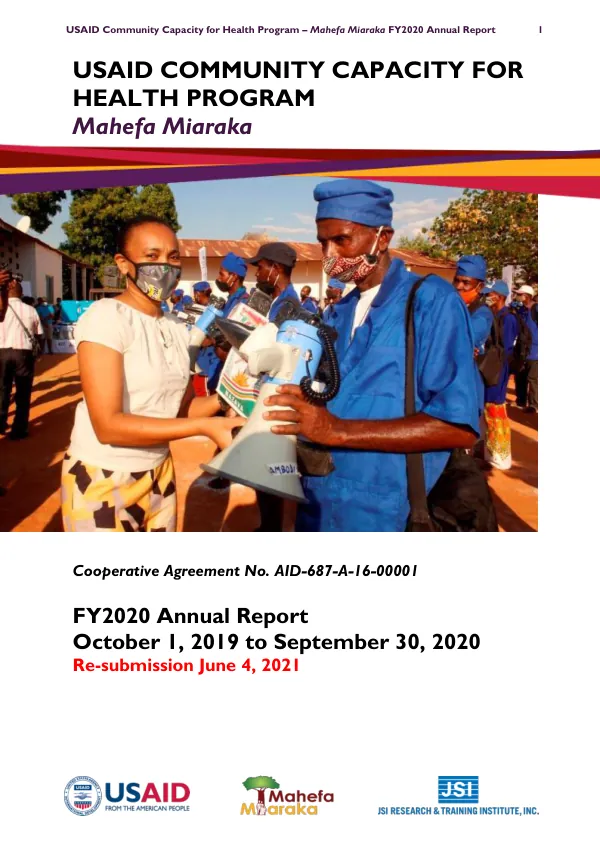
The program operates under Cooperative Agreement No. AID-687-A-16-00001 and is implemented by JSI Research & Training Institute, Inc. The program's geographic focus is on the Sofia, Menabe, and DIANA regions of Madagascar. Community Engagement and Ownership of Health Services was a key intervention area, with a focus on increasing the skills and competencies of community health volunteers (CHVs). Training programs were conducted for over 2,500 CHVs, with a focus on clinical and non-clinical topics. The program also aimed to strengthen community structures to improve health and sanitation planning, promote universal health care access and coverage, and sustain the CHV model. Behavior Change and Health Promotion was another key intervention area, with a focus on social and behavior change communication (SBCC) capacity building for community stakeholders. The program also innovated to promote adolescent and youth health, with a focus on reaching rural, underserved, and married young people. Health Service Planning, Management, and Governance was a critical intervention area, with a focus on reinforcing the Government of Madagascar's capacity to provide technical training and supportive supervision to CHVs and community leaders. The program also worked on pharmaceutical and commodity forecasting, health data quality management, and referral system strengthening between CHVs and community health services boards (CSBs). Monitoring and Evaluation, Learning Management, and Cross-Cutting Issues were also key components of the program, with a focus on program monitoring, evaluation, and performance system, as well as cross-cutting issues such as child, early, and forced marriage (CEFM) among high-risk and married girls. The program also responded to the COVID-19 epidemic, with a focus on distribution of masks, soap, information on COVID-19 prevention, and megaphones to support health education in communities. The program also worked on reducing CEFM among high-risk and married girls in the Sofia, Menabe, and DIANA regions of Madagascar. The program's administrative and financial management was also a key focus, with a focus on administration and financial management. The program's performance was monitored and evaluated through various indicators, including the number of local PNSC members trained on community health, participation and reporting of FKT heads in monthly CSB meetings, and CHV adherence to MOH and USAID FP compliance policies. The program's geographic focus was on the Sofia, Menabe, and DIANA regions of Madagascar, with a focus on strengthening community health systems and improving health outcomes. The program's timeframes were from October 1, 2019 to September 30, 2020, with a re-submission date of June 4, 2021.