USAID DEC
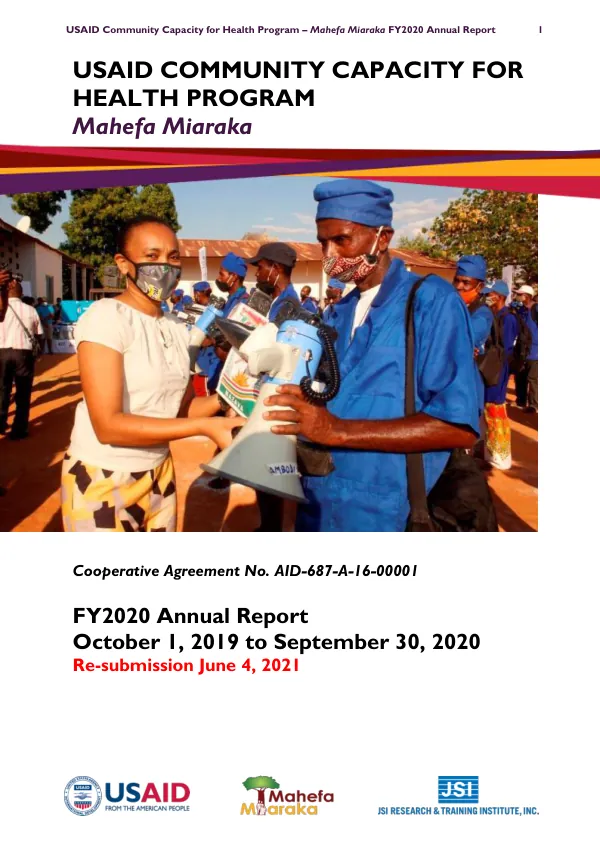
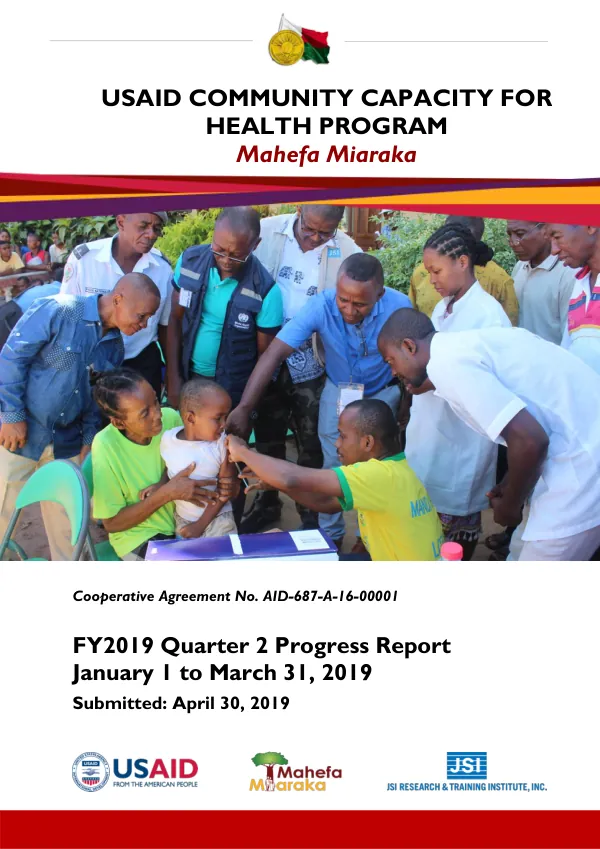
USAID Community Capacity for Health Program – Mahefa Miaraka FY2019 Quarter 2 Report
Sign inJSI RESEARCH & TRAINING INSTITUTE, INC
USAID Community Capacity for Health Program – Mahefa Miaraka FY2019 Quarter 2 Report
The Community Capacity for Health Program in Madagascar, implemented by JSI Research & Training Institute, Inc., aims to strengthen community health systems and improve health outcomes.
2019 · 51 pages
Sign in to readA free account is required to download.
Abstract
The program operates in the Sofia Region, with a focus on increasing access to health services, particularly for vulnerable populations. Community Health Volunteers (CHVs) play a crucial role in the program, providing essential health services, including vaccinations, growth monitoring, and family planning. In Q2 FY2019, CHVs trained in case management and service delivery topics, with a total of 1,200 CHVs trained in Q1-Q2 FY2019. CHVs also provided growth monitoring services to 12,000 children under 5, with a 90% coverage rate. The program has made significant progress in increasing access to family planning services. In Q2 FY2019, 3,500 women and girls used family planning services from program CHVs, with a 25% increase in new family planning users compared to Q1 FY2019. The program has also seen an increase in the use of long-acting and reversible contraceptives, with 1,200 women using these methods in Q2 FY2019. In terms of malaria services, CHVs provided malaria testing and treatment to 10,000 individuals in Q2 FY2019, with a 95% coverage rate. The program has also seen a reduction in malaria stockouts, with only 5% of CHVs reporting stockouts in Q2 FY2019. The program has also made progress in promoting health and sanitation practices. In Q2 FY2019, CHVs reached 20,000 individuals with key health and wash messages, with a 90% coverage rate. The program has also seen an increase in the number of health huts built and improved, with 500 health huts constructed in Q2 FY2019. The program has also strengthened the capacity of community stakeholders, including the Politique Nationale de Santé Communautaire (PNSC) coordination structure. In Q2 FY2019, 200 community stakeholders received training on community engagement, commodities, and reporting. The program has also made progress in improving health data quality, management, and use. In Q2 FY2019, the program implemented a program monitoring, evaluation, and performance system, which has improved data quality and management. The program has also faced challenges, including stockouts of essential commodities and limited access to health services in remote areas. However, the program has proposed solutions to address these challenges, including improving supply chain management and increasing access to health services in remote areas. Overall, the Community Capacity for Health Program in Madagascar has made significant progress in improving health outcomes and increasing access to health services. The program has strengthened community health systems, improved health data quality, and promoted health and sanitation practices.