FAO
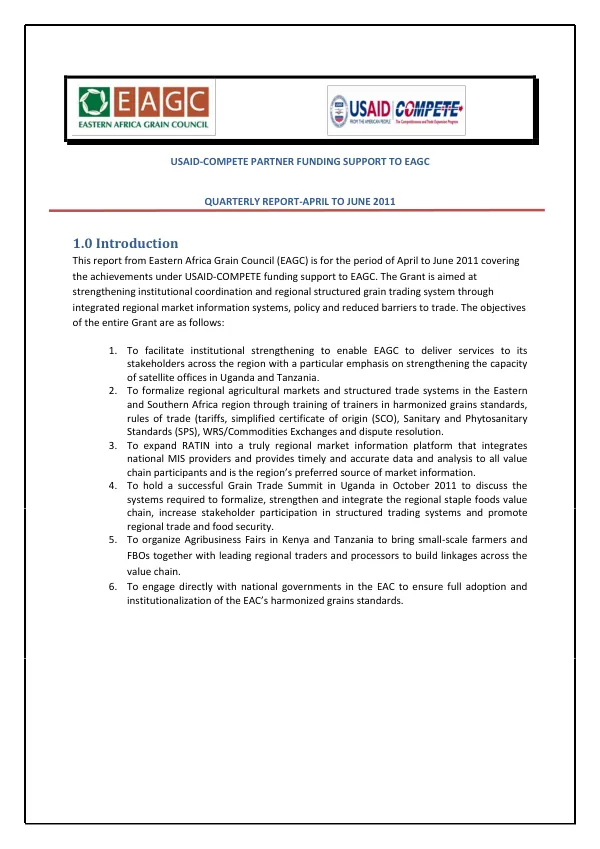
USAID-COMPETE Partner Funding Support to EAGC Quarterly Report - April to June 2011
The Eastern Africa Grain Council (EAGC) implemented a regional structured grain trading system through integrated regional market information systems, policy, and reduced barriers to trade.
2011 · 11 pages
Sign in to readA free account is required to download.
Abstract
The initiative, supported by USAID-COMPETE funding, aimed to strengthen institutional coordination and regional market systems. Key objectives included facilitating institutional strengthening, formalizing regional agricultural markets, and expanding the Regional Agricultural Trade Information Network (RATIN) into a regional market information platform. EAGC's institutional strengthening efforts involved the Annual General Meeting and Luncheon, which brought together EAGC members from Kenya, Uganda, and Tanzania. The meeting featured a keynote address on food security in Malawi from the National Smallholder Farmers' Association of Malawi. The EAGC Board transitioned, with a new board of directors elected during the AGM. The secretariat continued to deliver services to members and stakeholders across the region through the three country offices in Kenya, Uganda, and Tanzania. Market institutions were established and strengthened through the Warehouse Receipt System (WRS). In Kenya, the WRS task force reviewed the WRS bill, and the maize deposited under the WRS scheme in Nakuru was sold in April 2011, resulting in significant financial gains for smallholder farmers. In Uganda, EAGC promoted the WRS, working with MASSGA warehouse in Masindi to build the capacity of farmers on post-harvest handling and storage. In Tanzania, EAGC partnered with the Tanzania Warehousing Licensing Board to support harmonization of rules and protocols for Warehouse operation. Agricultural information generation, dissemination, and networking systems were strengthened through the update of RATIN and EGT Africa websites. The sites provided daily price information for maize, sorghum, millet, beans, and rice commodities, as well as cross-border flow data for 5 border points. Harmonization of data collection methodology was underway, with a draft report expected in July 2011. Formal relationships were being established with national data service providers, including the Ministry of Agriculture-Rwanda and the MAS (FAO, WFP, and FewsNet) group. The Grain Value Chain Stakeholder Capacity was built through the development of the STS Handbook, which contained six main modules on post-harvest management, grades and standards, warehouse receipt system, commodity exchange, trade contracts, and market information. The handbook was used during the Training of Trainers (TOT) workshop in Dar es Salaam. EAGC also organized a one-day TOT workshop in Rwanda, which aimed to build the capacity of stakeholders in the grain value chain. Regional and country operations continued to deliver services to members and stakeholders across the region. The EAGC Board remained the decision-making organ of the council, with the secretariat responsible for implementing the program. The regional and country offices in Kenya, Uganda, and Tanzania were fully operational, providing services to members and stakeholders. The Grain Trade Summit was scheduled to take place in Uganda in October 2011, aiming to discuss the systems required to formalize, strengthen, and integrate the regional staple foods value chain. Agribusiness Fairs were planned in Kenya and Tanzania to bring small-scale farmers and FBOs together with leading regional traders and processors to build linkages across the value chain. Engagement with national governments in the EAC was ongoing to ensure full adoption and institutionalization of the EAC's harmonized grains standards.