GOVERNMENT OF HAITI
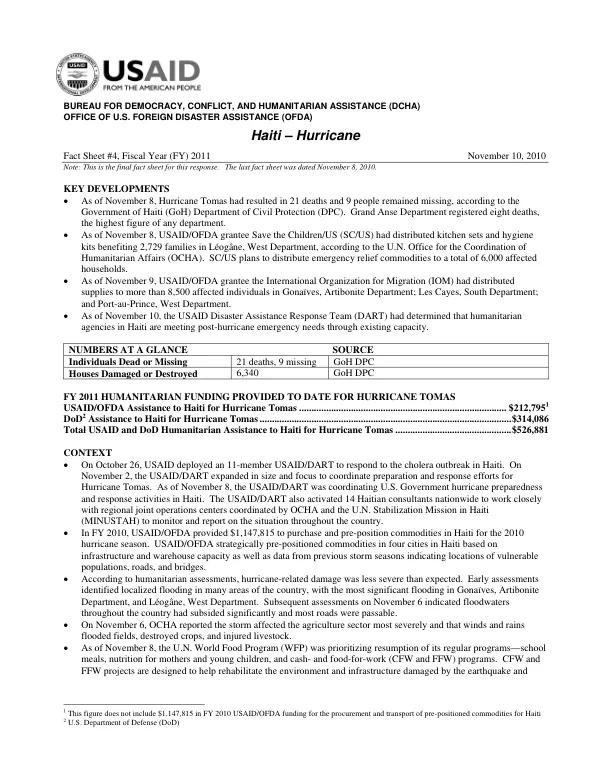
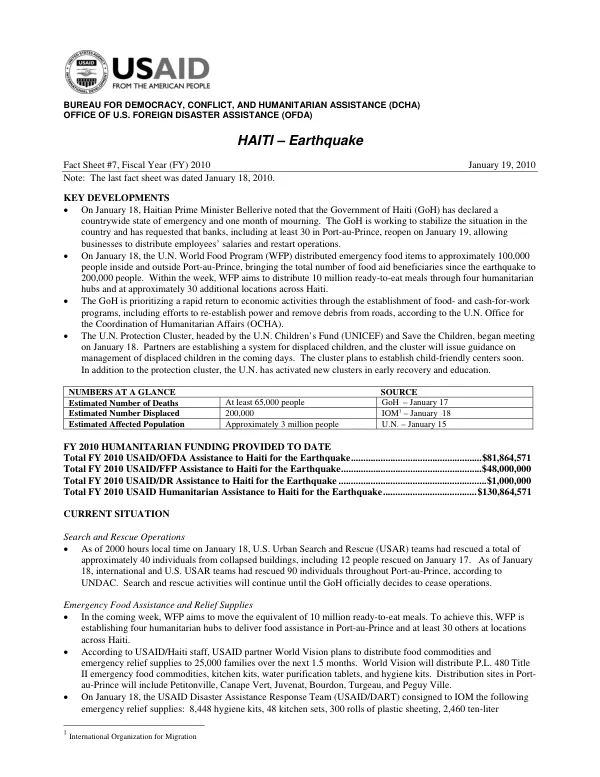
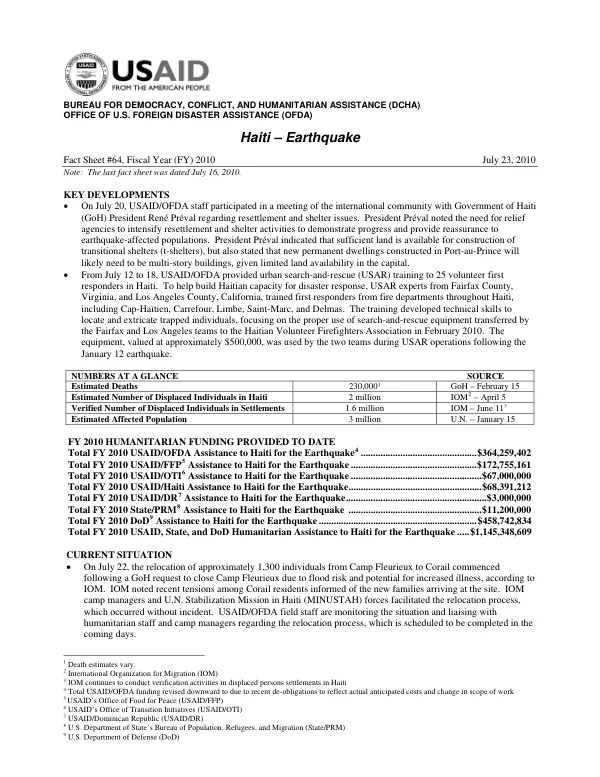
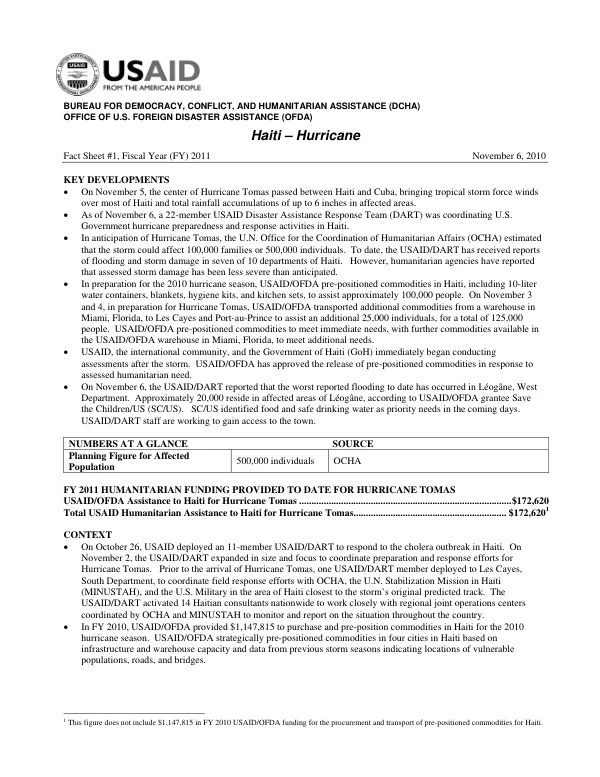
USAID-DCHA Haiti Earthquake Fact Sheet #48 4/2/2010
The U.N.
2010 · 6 pages
Sign in to readA free account is required to download.
Abstract
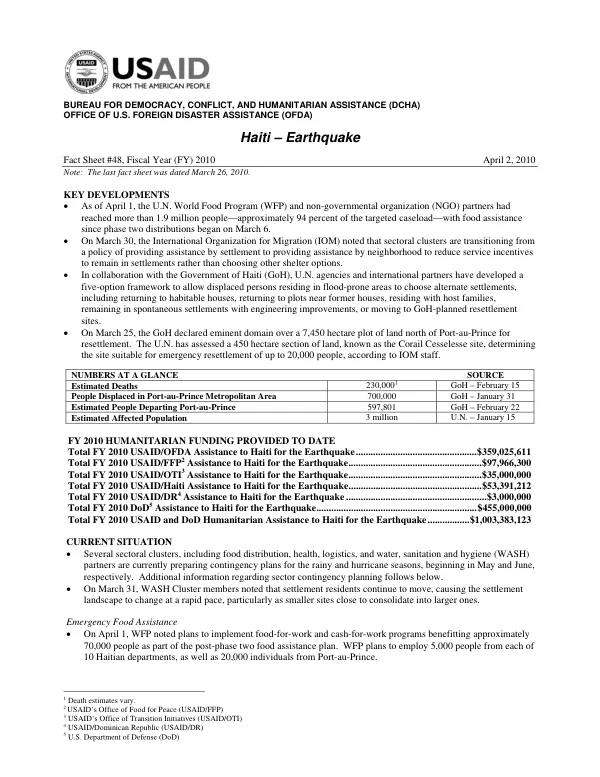
World Food Program (WFP) and non-governmental organization (NGO) partners have reached more than 1.9 million people, approximately 94 percent of the targeted caseload, with food assistance since phase two distributions began on March 6. The International Organization for Migration (IOM) has noted that sectoral clusters are transitioning from providing assistance by settlement to providing assistance by neighborhood to reduce service incentives to remain in settlements rather than choosing other shelter options. In collaboration with the Government of Haiti (GoH), U.N. agencies and international partners have developed a five-option framework to allow displaced persons residing in flood-prone areas to choose alternate settlements. The framework includes returning to habitable houses, returning to plots near former houses, residing with host families, remaining in spontaneous settlements with engineering improvements, or moving to GoH-planned resettlement sites. The GoH has declared eminent domain over a 7,450 hectare plot of land north of Port-au-Prince for resettlement, and the U.N. has assessed a 450 hectare section of land, known as the Corail Cesselesse site, determining the site suitable for emergency resettlement of up to 20,000 people. The estimated death toll from the earthquake is 230,000, according to the GoH. The estimated number of people displaced in the Port-au-Prince metropolitan area is 700,000, and the estimated number of people departing Port-au-Prince is 597,801. The estimated affected population is 3 million, according to the U.N. As of April 1, the WFP has plans to implement food-for-work and cash-for-work programs benefiting approximately 70,000 people as part of the post-phase two food assistance plan. The WFP has also reported plans to assess food needs of people relocating to GoH-identified sites from crowded or flood-prone spontaneous settlements. The WFP anticipates that displaced persons may require up to three months of emergency food assistance. The WFP has indicated plans to establish a network of five sub-offices and 13 field offices throughout Haiti to serve as operational bases to respond to localized emergencies nationwide. The U.N. Office for Project Services (UNOPS) has reported that UNOPS-trained GoH Ministry of Public Works (MoPW) engineers have assessed nearly 15,000 buildings in Port-au-Prince, finding that approximately 54 percent of assessed buildings were safe for habitation, 30 percent could be rendered safe with repairs, and 16 percent were unsafe and require demolition. The MoPW has employed social workers to educate spontaneous settlement residents on the habitability assessment process and inform residents when return to safe houses becomes possible. The Hygiene Promotion Working Group has reported developing a rainy season contingency plan focusing on preventing outbreaks of water-borne diseases. The WASH Cluster has commenced rainy season preparations by pre-positioning WASH-related emergency relief supplies in Haiti. The GoH National Direction for Potable Water and Sanitation (DINEPA) has recommended repairing the piped water network and developing new water sources to improve water availability in Tabarre, Croix des Bouquets, and Cité Soleil areas of metropolitan Port-au-Prince. The Pan American Health Organization, International Rescue Committee (IRC), and Management Sciences for Health have reported commencing a survey of 200 spontaneous settlements to identify and address gaps in primary health care coverage. Disease surveillance teams in 52 sentinel sites have been reporting surveillance data to the GoH Ministry of Health Epidemiology Unit, indicating that no diseases have reached epidemic levels to date. The WFP has reported that phase two nutrition activities remain ongoing, targeting children between six and 59 months of age and pregnant and lactating women in Port-au-Prince and other affected areas with corn-soy blend, oil, and sugar. The GoH has asked the WFP to provide school feeding for all schools in West Department to reach an estimated 500,000 children. The USAID/FFP field officer notes that the WFP also plans to reach up to 500,000 school children in other departments, for a total of up to one million children.