USAID DEC
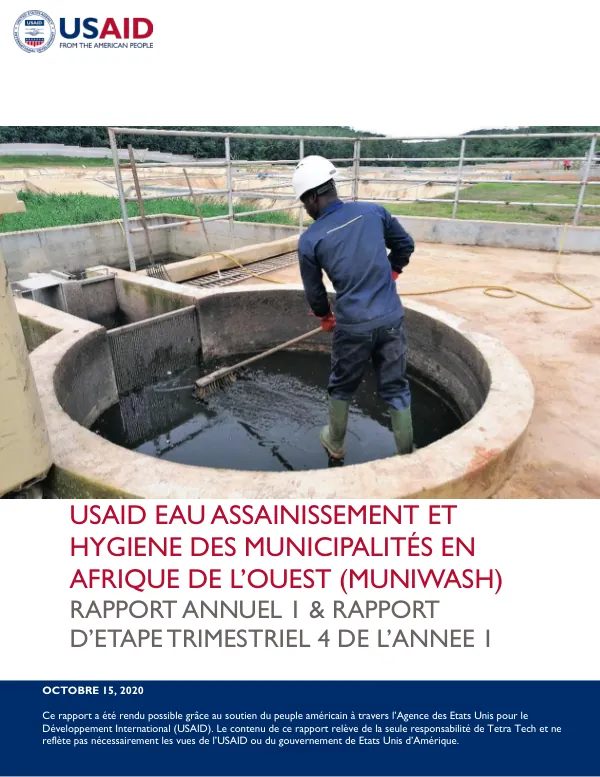
USAID EAU ASSAINISSEMENT ET HYGIENE DES MUNICIPALITÉS EN AFRIQUE DE L’OUEST (MUNIWASH) RAPPORT ANNUEL 1 & RAPPORT D’ETAPE TRIMESTRIEL 4 DE L’ANNEE 1
Sign inTETRA TECH
USAID EAU ASSAINISSEMENT ET HYGIENE DES MUNICIPALITÉS EN AFRIQUE DE L’OUEST (MUNIWASH) RAPPORT ANNUEL 1 & RAPPORT D’ETAPE TRIMESTRIEL 4 DE L’ANNEE 1
The USAID West Africa Municipal Water, Sanitation, and Hygiene project began in FY 2020 with the goal of improving access to safe water, sanitation, and hygiene services in West African municipalities.
2020 · 59 pages
Sign in to readA free account is required to download.
Abstract
The project is implemented by Tetra Tech under the USAID contract No. 72062419F00001. The project's main objective is to improve the financial viability and private sector investment in the water and sanitation sector. To achieve this, the project focuses on four main domains of service: financial viability and private sector investment, operational reliability, governance and municipal management, and regional learning and knowledge sharing. In the first year of the project, the team conducted a selection process for municipal partners, prepared feasibility studies, and negotiated memoranda of understanding (MOUs) with 15 municipalities in West Africa. The team also conducted a subvention under contract and analyzed and developed a gender strategy. The project's financial viability and private sector investment domain focused on evaluating the financial performance and commercial models of water and sanitation services, reinforcing the capacity of water services, and improving public financial planning and control. The team also worked to expand access to financial products for service providers and clients. The operational reliability domain aimed to improve the operational reliability of water and sanitation services and service providers. The team conducted a market mapping and customer satisfaction study, improved operational processes of service providers, extended and diversified services for the poor, and improved the operational environment of enterprises. The governance and municipal management domain focused on improving the governance and management capacity of the water and sanitation sector at the municipal level. The team implemented the Institutional Strengthening Index (ISI), reinforced the capacity of municipalities in planning and budgeting, supported collaboration between central and municipal levels, and improved the capacity of municipalities to supervise and treat service providers. The regional learning and knowledge sharing domain aimed to promote regional learning and knowledge sharing for the reproduction of successful approaches. The team established an agenda for learning and communities of practice, collected and documented lessons learned, documented and disseminated investment opportunities, developed and implemented an external communication strategy, and offered formal learning opportunities. Throughout the first year of the project, the team conducted regular follow-up, evaluation, and learning activities. The team also developed and validated tools for collecting data on indicators, and provided training to personnel on data collection tools. The project's personnel, management, and administration were also established, and regular reports and summaries of contract deliverables were submitted. The project collaborated with the national government, other donor projects, and other US government projects to achieve its objectives. The team established links with relevant ministries, other donor organizations, and other USAID projects to leverage resources and expertise.