TRAINING RESOURCES GROUP – TRG
USAID Ecosystem-based Adaptation and Water Security Evidence Summary
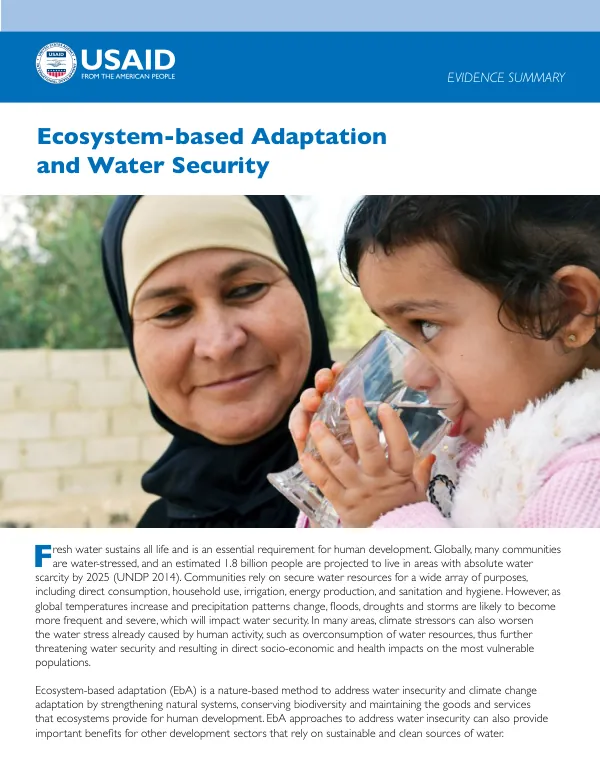
Fresh water sustains all life and is an essential requirement for human development.
2019 · 8 pages
Sign in to readA free account is required to download.
Abstract
Globally, many communities are water-stressed, and an estimated 1.8 billion people are projected to live in areas with absolute water scarcity by 2025. Communities rely on secure water resources for a wide array of purposes, including direct consumption, household use, irrigation, energy production, and sanitation and hygiene. However, as global temperatures increase and precipitation patterns change, floods, droughts, and storms are likely to become more frequent and severe, which will impact water security. In many areas, climate stressors can also worsen the water stress already caused by human activity, such as overconsumption of water resources, thus further threatening water security and resulting in direct socio-economic and health impacts on the most vulnerable populations. Water security refers to the protection of the physical water resource, equitable access to that resource, and mitigation of water-related disasters. Water security has quantity, quality, and spatial-temporal dimensions. The United Nations defines water security as the capacity of a population to safeguard sustainable access to adequate quantities of acceptable quality water for sustaining livelihoods, human well-being, and socio-economic development, for ensuring protection against water-borne pollution and water-related disasters, and for preserving ecosystems in a climate of peace and political stability. Globally, water insecurity is a constraint on sustainable development and poverty reduction, as nearly four billion people experience severe water scarcity at least one month per year. Climate stressors exacerbate other pressures on freshwater resources. Increasing temperatures and evaporation, more variable rainfall, and changes in water flow all impact freshwater resources. More frequent and intense weather events, such as floods, droughts, and storms, can also increase water insecurity. As weather patterns change, more rivers, lakes, wetlands, and aquifers are expected to dry up, and water systems will become increasingly stressed in regions susceptible to drought. There are many other stresses on freshwater resources, with water security impacted by growing demand, population growth, unsustainable consumption, wasteful practices, and pollution. Lack of sanitation services and environmental pollution contaminate water and make it unsafe for household use. Ecosystem-based adaptation (EbA) is a nature-based method to address water insecurity and climate change adaptation by strengthening natural systems, conserving biodiversity, and maintaining the goods and services that ecosystems provide for human development. EbA approaches to address water insecurity can also provide important benefits for other development sectors that rely on sustainable and clean sources of water. EbA involves the use of biodiversity and ecosystem services to help people and communities adapt to the adverse impacts of climate change. EbA approaches can help communities adapt to water insecurity in several ways, including increasing water quantity and enhancing water quality, minimizing impacts to water security from extreme weather events, and providing additional development benefits. EbA can increase water quantity and enhance water quality by restoring and conserving healthy ecosystems, such as forests, mangroves, and wetlands. These ecosystems have a direct impact on water quantity by maintaining water flow, absorbing rainfall, and replenishing watersheds. EbA approaches can also improve access to clean water by providing water filtration benefits similar to drainage and wastewater treatments. For example, forested areas regulate water quality and decrease pollution by filtering runoff, preventing erosion, and slowing sedimentation. Similarly, wetlands and riparian buffers filter runoff from industrial areas or farmland and remove sediment before it contaminates groundwater. EbA can also minimize impacts to water security from extreme weather events by providing protection from storm surges, floods, and hurricanes/typhoons. The conservation and restoration of mangroves, coastal marshes, and coral reefs can serve as physical buffers that retain excess water, dissipate wave energy, and stabilize shorelines. Additionally, the management and restoration of natural floodplains can reduce flood and drought risk and control erosion by regulating and controlling water flows during peak events and by recharging aquifers. EbA approaches can also provide additional development benefits, including carbon sequestration, biodiversity conservation, and important goods such as wild fish, fuel, and non-timber forest products.
Related documents