ENVIRONMENTAL INCENTIVES, LLC
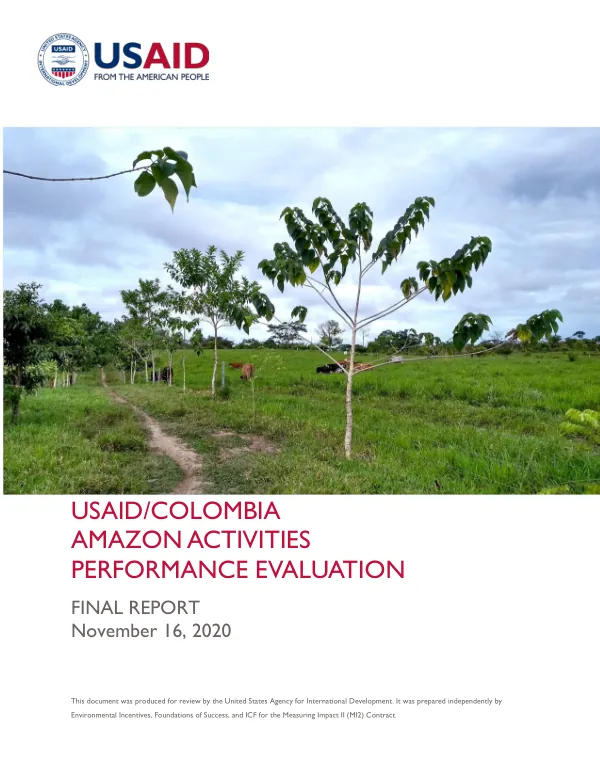
USAID/COLOMBIA AMAZON ACTIVITIES PERFORMANCE EVALUATION FINAL REPORT
The Amazon Activities in Colombia were two initiatives, Conservation and Governance and Connected Landscapes, implemented by USAID in 2013 to reduce deforestation and protect biodiversity in the Colombian Amazon.
2020 · 113 pages
Sign in to readA free account is required to download.
Abstract
The activities aimed to improve livelihoods, foster sustainable development, and enable the country to advance on its journey to self-reliance. The initiatives shared an implicit theory of change, which posited that building the capacity and will for better land use practices would result in more sustainable land use decisions and reduced deforestation. The activities employed two strategies: improving governance by strengthening and empowering local civil society and local/regional governments, and promoting alternative, sustainable production systems. The main interventions included silvopastoral systems, improving value chains, agroforestry, payments for ecosystem services, and governance capacity building. The evaluation was based on a range of qualitative and quantitative data about the activities' main interventions and their effects on improving livelihoods and reducing deforestation. The data showed that the activities were effective at providing benefits for local communities, such as increased productivity, income, and food security. The activities were also successful in raising awareness of the importance of forests and sustainable land use, as well as building capacity to implement more sustainable practices. However, total forest cover declined in the geographies covered by the activities, and only in one municipality was there a reduction in the rate of forest cover loss coincident with the start of the activity. The evaluation highlighted the need to develop a monitoring and evaluation framework that would allow for testing two core assumptions in the theory of change. The first assumption was that increased productivity and income would result in reduced land clearing and deforestation. Interviews revealed that beneficiaries did not view these benefits as meaningful incentives for conservation. The second assumption was that farm-level interventions were an adequate match for combating the region's main drivers of forest and biodiversity loss. The evaluation recommended that future activities should consider leveraging USAID's emerging best practices in Thinking and Working Politically to support national and local authorities' efforts to break the dynamics of land grabbing. It also suggested that community-focused initiatives should be linked with government oversight and carefully designed support for law enforcement and the judiciary. Another key finding was that beneficiary perceptions of the results of the activities on deforestation differed from what the spatial data showed, with all focus group participants believing that the activities had contributed to a reduction in deforestation. The evaluation concluded that the activities had made progress in building a constituency and capacity for conservation that would serve as a valuable foundation for expanding the scope and scale of conservation efforts going forward. However, it also emphasized the need to address the key drivers of deforestation, including extensive low-density cattle ranching and land grabbing, through a combination of productivity and income interventions, outreach, awareness, and strengthening governance, as well as law enforcement interventions.
Related documents