USAID
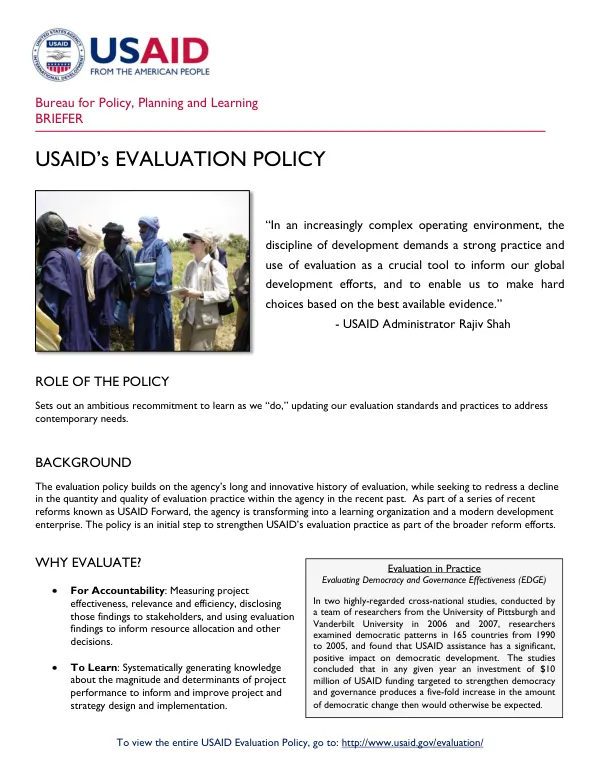
USAID Evaluation Policy - one pager
The USAID Evaluation Policy sets out an ambitious recommitment to learn as the agency "does," updating its evaluation standards and practices to address contemporary needs.
2011 · 2 pages
Sign in to readA free account is required to download.
Abstract
This policy builds on the agency's long and innovative history of evaluation, while seeking to redress a decline in the quantity and quality of evaluation practice within the agency in the recent past. The policy emphasizes the importance of evaluation for accountability, learning, and decision-making. For accountability, evaluation measures project effectiveness, relevance, and efficiency, disclosing findings to stakeholders and using them to inform resource allocation and other decisions. To learn, evaluation systematically generates knowledge about the magnitude and determinants of project performance to inform and improve project and strategy design and implementation. Two types of evaluation are conducted at USAID: performance evaluation and impact evaluation. Performance evaluation focuses on questions linked to program design or management decisions, such as how a project is being implemented, how it is perceived, and whether expected results are occurring. Mixed qualitative and quantitative methods are used in performance evaluations, which constitute the majority of evaluations at USAID. Impact evaluation, on the other hand, measures the change in a development outcome that is attributable to a defined intervention, requiring a credible counterfactual or comparison group to control for factors other than the intervention that might account for the observed change. The policy requires evaluation for large projects, which are defined as a set of interventions intended to achieve a defined development result and that equals or exceeds in dollar value the average project size for an Operating Unit. Evaluation is also required for pilot or innovative development interventions, which demonstrate new approaches anticipated to be expanded in scale or scope. However, the policy does not require evaluations for each USAID project, rather it requires strategic choices to be made for what should and should not be evaluated based on management and learning priorities. The USAID Evaluation Policy is an initial step to strengthen the agency's evaluation practice as part of broader reform efforts. The policy aims to transform USAID into a learning organization and a modern development enterprise, using evaluation as a crucial tool to inform global development efforts and make hard choices based on the best available evidence.