USAID DEC
USAID Fair, Accountable, Independent, and Responsible (FAIR) Judiciary Program in Ukraine
Sign inUSAID DEC
USAID Fair, Accountable, Independent, and Responsible (FAIR) Judiciary Program in Ukraine
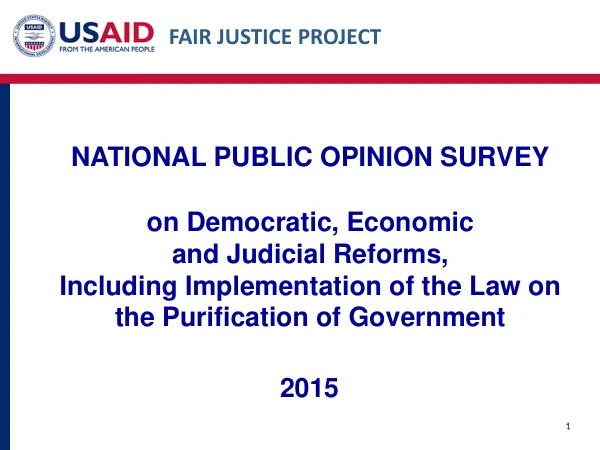
The Fair Justice Project conducted a national public opinion survey in Ukraine in 2015 to gauge public opinion on democratic, economic, and judicial reforms, including the implementation of the Law on the Purification of Government.
2015 · 67 pages
Sign in to readA free account is required to download.
Abstract
The survey aimed to identify the extent to which Ukrainians believe the government is implementing vetting and lustration processes, and whether these processes will lead to a better future for Ukraine and its people. The survey was implemented by GfK Ukraine, a leading marketing and social research company in Ukraine, in collaboration with the Fair Justice Project. The questionnaire was developed in cooperation with international and Ukrainian experts, including the Department for Lustration of the Ministry of Justice of Ukraine and the Interim Special Commission for Vetting Judges of the High Council of Justice. The survey consisted of 192 variables, including socio-demographic data, and was tested and verified by GfK. A total of 2,359 respondents were interviewed in all oblasts of Ukraine, except for occupied territories and ATO zones. The sample was representative of all Ukraine, with a statistical error not exceeding 2%. The respondents were also weighted by gender, age, settlement size, and region of residence according to statistical data from the State Committee of Statistics of Ukraine in 2014. The survey data underwent three-tier quality control. The survey results showed that the majority of respondents, 55%, primarily communicate with their family members in Ukrainian, while 43% use Russian. The economic situation for respondents worsened over the past 12 months, with 43% of respondents reporting a significant worsening and 37% reporting a somewhat worsening. In terms of social status, 42% of respondents were employed full-time, while 29% were pensioners. The survey also revealed regional differences in public opinion. In the Kyiv City region, 92% of respondents primarily communicate in Ukrainian, while in the East region, 78% use Russian. The economic situation also varied by region, with the West region experiencing the most significant worsening, at 54%. The social status of respondents also differed by region, with the North region having the highest percentage of employed full-time respondents, at 50%. The survey results provide valuable insights into public opinion on democratic, economic, and judicial reforms in Ukraine. The findings highlight the need for the government to address the economic concerns of the population and to improve the implementation of vetting and lustration processes. The regional differences in public opinion also underscore the importance of tailoring reforms to the specific needs and concerns of different regions in Ukraine.