USAID
USAID Food Assistance Funding Fact Sheet
The U.S.
2017 · 3 pages
Sign in to readA free account is required to download.
Abstract
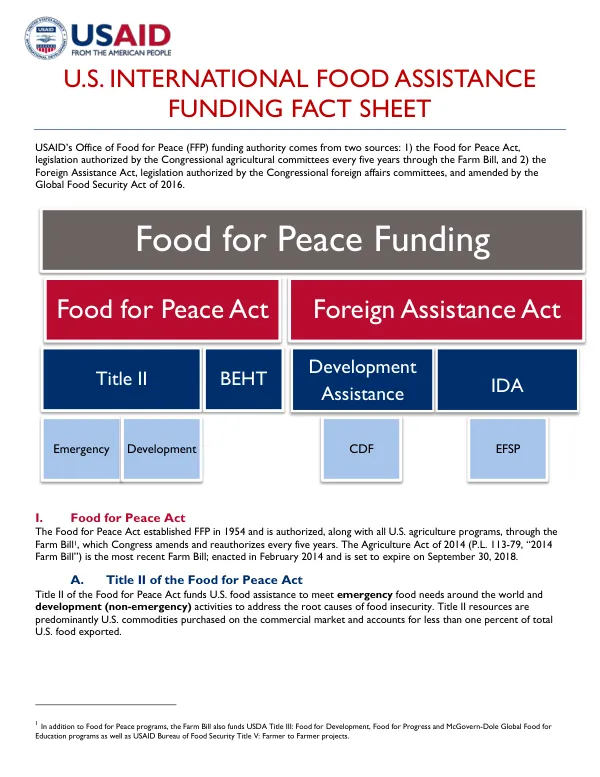
International Food Assistance funding authority comes from two primary sources: the Food for Peace Act and the Foreign Assistance Act. The Food for Peace Act, established in 1954, is authorized through the Farm Bill, which is amended and reauthorized by Congress every five years. The most recent Farm Bill, the Agriculture Act of 2014, was enacted in February 2014 and is set to expire on September 30, 2018. Title II of the Food for Peace Act funds U.S. food assistance to meet emergency food needs around the world and development activities to address the root causes of food insecurity. Title II resources are predominantly U.S. commodities purchased on the commercial market and account for less than one percent of total U.S. food exported. The Bill Emerson Humanitarian Trust (BEHT) is a special authority in the Farm Bill that allows the United States to respond to unanticipated food emergencies abroad. The Foreign Assistance Act, amended over the years, promotes the foreign policy, security, and general welfare of the United States by assisting peoples of the world in their efforts towards economic development and internal and external security. The 2016 Global Food Security Act reinforced the federal government's successful inter-agency approach to increasing food security and nutrition through the Feed the Future initiative. It amended the Foreign Assistance Act to codify funding for both USAID's agricultural development assistance and International Disaster Assistance funds. Development Assistance funds, provided through USAID's Bureau for Food Security, are used to complement Title II resources and support community-level development activities aimed at increasing the resilience of the rural poor and accelerating their participation in agricultural development and food security programs. International Disaster Assistance funds are used to support emergency humanitarian assistance operations in response to international crises as well as disaster preparedness activities. Emergency Food Security Program funds address the highest priority, immediate, emergency food security needs using market-based food assistance and complementary activities. FFP funding by account in FY 2017 included $1.1 billion for Title II Emergency, $1.1 billion for Title II Development, $200 million for BEHT, and $100 million for EFSP. In FY 2017, Congress appropriated more than $1 billion dollars in supplemental humanitarian assistance, above the normal IDA levels, to meet humanitarian needs in ISIS-affected areas and for the prevention, relief, and mitigation of famine, particularly in Nigeria, Somalia, South Sudan, and Yemen.