USAID DEC
USAID fortalece la capacidad de FONTIERRAS para efectuar diagnósticos y planes con comunidades agrarias y mejorar la nutrición y reducir la pobreza
Sign inUSAID
USAID fortalece la capacidad de FONTIERRAS para efectuar diagnósticos y planes con comunidades agrarias y mejorar la nutrición y reducir la pobreza
FONTIERRAS, a decentralized institution of the Guatemalan State, was established in 1999 as part of the Peace Accords.
2015 · 1 pages
Sign in to readA free account is required to download.
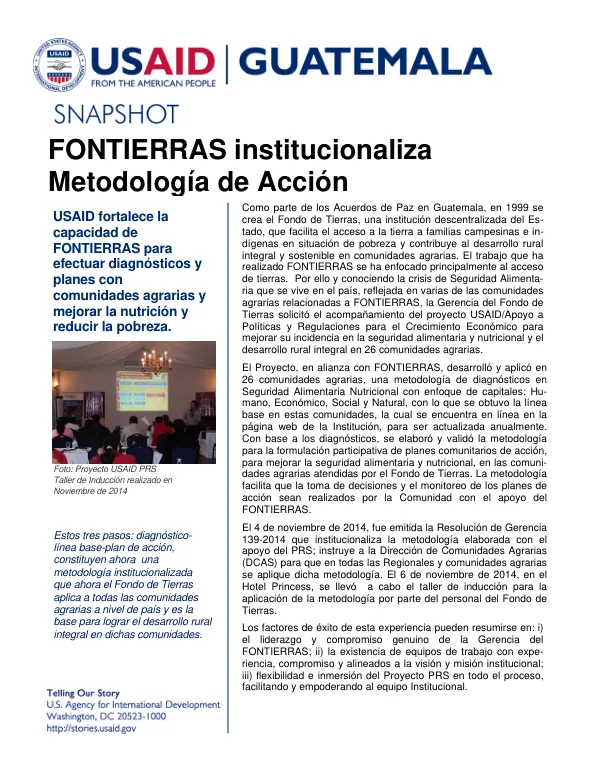
Abstract
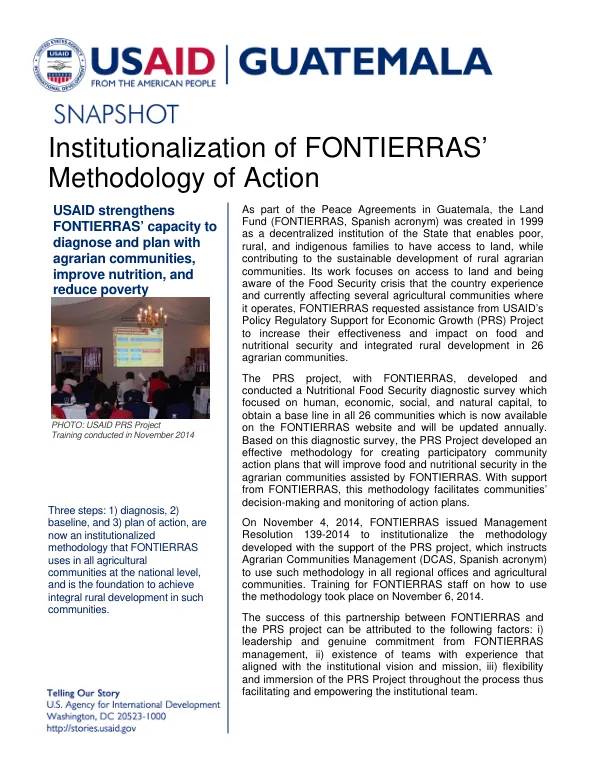
The organization facilitates access to land for impoverished rural families and indigenous communities, contributing to sustainable rural development and integral community development. FONTIERRAS' primary focus has been on land access, but in response to the country's food security crisis, the institution's management requested the assistance of the USAID-funded Project for Support to Policies and Regulations for Economic Growth to improve its impact on food security, nutrition, and rural development in 26 agricultural communities. The project, in partnership with FONTIERRAS, developed and applied a methodology for nutritional security diagnostics with a focus on human, economic, social, and natural capital in 26 agricultural communities. This resulted in a baseline for these communities, which is available on the institution's website for annual updates. Based on the diagnostics, a participatory methodology for formulating community action plans to improve food security and nutrition was developed and validated for the communities served by FONTIERRAS. The methodology enables community decision-making and action plan monitoring with the support of FONTIERRAS. The institutionalization of this methodology was formalized through Resolution of Management 139-2014, which instructs the Directorate of Agricultural Communities to apply the methodology in all regional and agricultural communities. A training session for FONTIERRAS personnel was held on November 6, 2014, at the Hotel Princess, marking the beginning of the methodology's implementation. The success factors of this experience can be summarized as follows: i) genuine leadership and commitment from FONTIERRAS' management; ii) the presence of experienced, committed, and aligned teams; and iii) the flexibility and immersion of the PRS project throughout the process, facilitating and empowering the institutional team. The methodology has become a cornerstone for achieving rural development and integral community development in agricultural communities across the country.
Related documents