USAID DEC
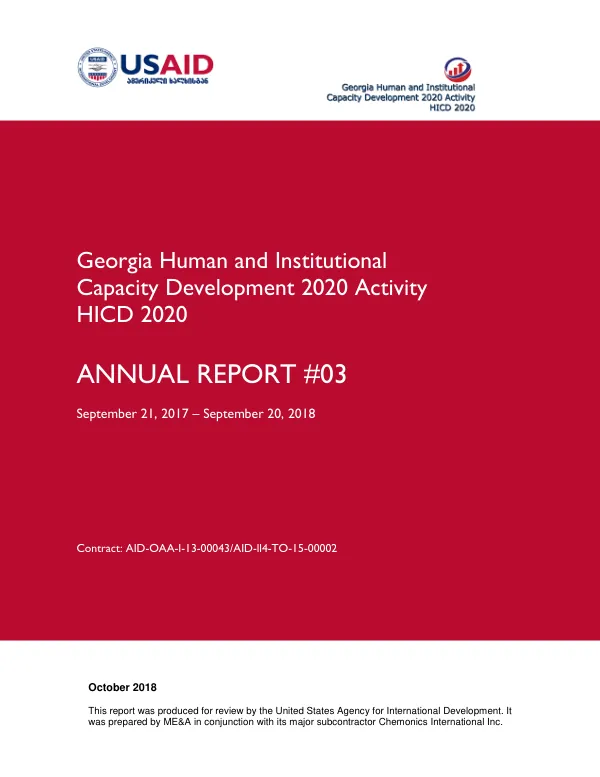
USAID/Georgia Human and Institutional Capacity Development 2020 Activity Annual Report #03
Sign inCHEMONICS
USAID/Georgia Human and Institutional Capacity Development 2020 Activity Annual Report #03
The USAID/Georgia Human and Institutional Capacity Development (HICD) 2020 activity is a three-year project implemented by ME&A in conjunction with its consortium members, Chemonics International and Performance Design Partners.
2018 · 42 pages
Sign in to readA free account is required to download.
Abstract
The project aims to strengthen the capacity of Georgian institutions and civil society organizations to implement effective policies and programs. During the third year of implementation, HICD 2020 successfully completed two HICD programs with the National Intellectual Property Center, Sakpatenti, and the Electric System Commercial Operator (ESCO). The project also continued to implement Performance Solutions Packages (PSPs) for the State Fund for Protection and Assistance of Victims of Human Trafficking (ATIPFund) and launched a new HICD program for the International Society for Fair Elections and Democracy (ISFED). In addition to the HICD initiatives, the project completed five Targets of Opportunity (TO) programs. The HICD 2020 team supported the Civil Service Bureau (CSB) to strengthen its institutional set-up and practice generalization department. The project also developed the fundraising capacity at the Civic Education Teachers' Forum (CETF), resulting in the forum receiving two grants. Furthermore, the project assisted the Caucasus Environmental NGO Network (CENN) to strengthen its human capacity and the Georgian National Communications Commission (GNCC) to map and analyze its organizational structure. The project's activities were implemented in four components: HICD Initiatives, Targets of Opportunity, Participant Training Support, and Building Local HICD Capacity. The HICD Initiatives component focused on strengthening the capacity of Georgian institutions and civil society organizations to implement effective policies and programs. The Targets of Opportunity component supported the development of specific skills and knowledge among Georgian institutions and civil society organizations. The Participant Training Support component provided training and capacity-building activities for participants. The Building Local HICD Capacity component aimed to build the capacity of local service providers to implement HICD activities. The project's performance was monitored and evaluated through the Performance Monitoring and Evaluation System (PMES). The PMES tracked the project's progress and provided data for decision-making. The project's results were reported in the Results Reporting Table, which provided an overview of the project's achievements. The project's success was demonstrated through the completion of HICD programs and Targets of Opportunity programs. The project's activities resulted in the strengthening of Georgian institutions and civil society organizations, which will have a positive impact on the country's development. The project's achievements were recognized through the receipt of grants and awards, which demonstrated the project's effectiveness and impact. The project's implementation was supported by a team of experts from ME&A, Chemonics International, and Performance Design Partners. The team worked closely with Georgian institutions and civil society organizations to implement the project's activities. The project's success was also supported by the Government of Georgia, which provided resources and support for the project's implementation. The project's achievements and lessons learned will be used to inform future development projects in Georgia. The project's success demonstrated the importance of strengthening the capacity of Georgian institutions and civil society organizations to implement effective policies and programs. The project's achievements will have a lasting impact on the country's development and will contribute to the achievement of the country's development goals.