USAID
USAID/GH WTL Factsheet
The Waste Treatment Locator (WTL) is a database of potentially available waste treatment technology units operating around the world.
2024 · 2 pages
Sign in to readA free account is required to download.
Abstract
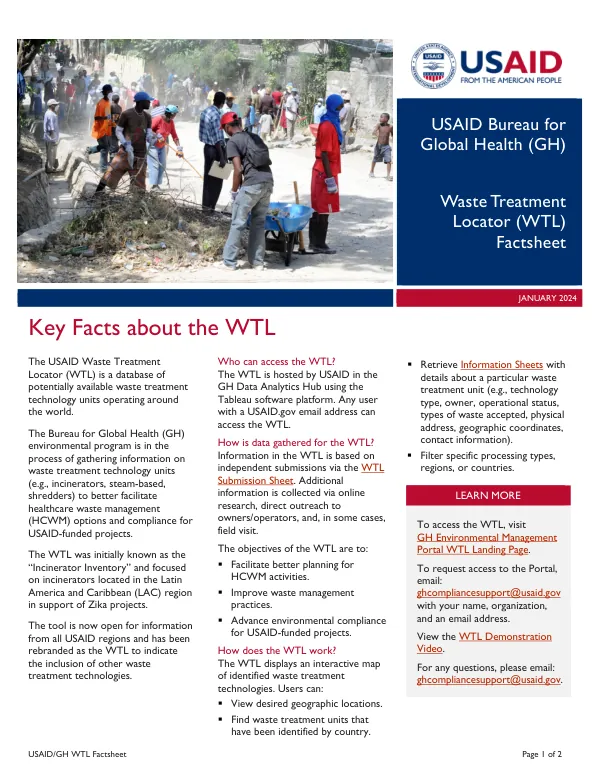
The Bureau for Global Health (GH) environmental program is gathering information on waste treatment technology units to facilitate healthcare waste management (HCWM) options and compliance for USAID-funded projects. The WTL was initially known as the "Incinerator Inventory" and focused on incinerators located in the Latin America and Caribbean (LAC) region in support of Zika projects. The tool is now open for information from all USAID regions and has been rebranded as the WTL to indicate the inclusion of other waste treatment technologies. The WTL is hosted by USAID in the GH Data Analytics Hub using the Tableau software platform. Any user with a USAID.gov email address can access the WTL. Information in the WTL is based on independent submissions via the WTL Submission Sheet, as well as online research, direct outreach to owners/operators, and field visits. The objectives of the WTL are to facilitate better planning for HCWM activities, improve waste management practices, and advance environmental compliance for USAID-funded projects. The WTL displays an interactive map of identified waste treatment technologies. Users can view desired geographic locations, find waste treatment units that have been identified by country, retrieve Information Sheets with details about a particular waste treatment unit, and filter specific processing types, regions, or countries. The WTL includes data on 18 countries supported by LAC and the Bureau for Africa (AFR), with the intent to collect additional information on waste treatment locations around the world and expand the database. The WTL includes the following waste treatment processing types: mechanical, steam-based, chemical, dry heat, microwave, encapsulation, and incineration. The accuracy of the data in the WTL reflects the best available information at the time of data collection, and USAID does not guarantee the accuracy of the information presented. Users are recommended to contact in-country USAID or Implementing Partner (IP) staff to obtain the latest data about a particular option. USAID is seeking support to advance sound waste management practices through expansion of the WTL tool. Funding is available to support research and data collection/population, and users can submit data for waste treatment options directly via the WTL Submission Sheet. The desired data includes technology type, physical address, geographic coordinates, municipality, country, type of facility, owner/operator, processing capacity, types of waste accepted, operational status, certification, maintenance, and contact information.