USAID DEC
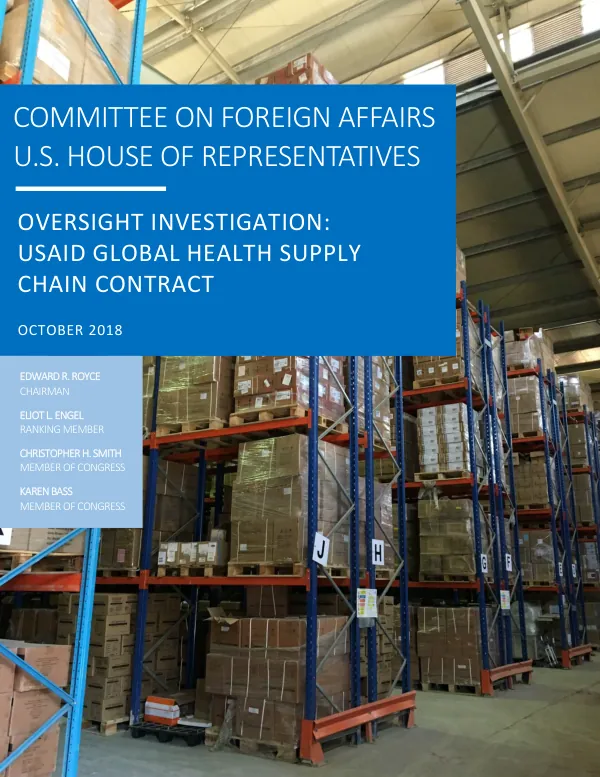
USAID Global Health Supply Chain Oversight Investigation: USAID Global Health Supply Chain Contract
Sign inCHEMONICS
USAID Global Health Supply Chain Oversight Investigation: USAID Global Health Supply Chain Contract
The United States Agency for International Development (USAID) Global Health Supply Chain - Procurement and Supply Management (GHSC-PSM) contract is the primary vehicle for delivering life-saving global health commodities for most of the United States Government's global health initiatives.
2018 · 33 pages
Sign in to readA free account is required to download.
Abstract
Under this contract, USAID supplies, procures, and delivers commodities to 60 countries, provides technical assistance in 40 countries, operates field offices in 33 countries, and employs more than 1,000 field-based staff. On any given day, there are approximately 5,700 commodities orders in progress. The GHSC-PSM contract has a ceiling of $9.5 billion over five years and is the largest contract USAID has ever awarded and managed. This single-award "indefinite delivery/indefinite quantity" (IDIQ) contract was signed on April 15, 2015, between Chemonics International, Inc. and USAID to serve as the primary vehicle through which USAID will procure and provide health commodities for all USAID health programs. The contract replaced two separate global health supply chain contracts that began in 2005 and 2006, respectively. The delivery of commodities is inextricably linked to the success of U.S. global health programs, including the President's Emergency Plan for AIDS Relief (PEPFAR). PEPFAR, first authorized by Congress in 2003, is widely regarded as one of the most effective U.S. foreign assistance programs since the Marshall Plan, and has earned bipartisan support from Congress and multiple administrations. As of March 30, 2018, PEPFAR supports more than 14 million people with lifesaving antiretroviral treatment. With PEPFAR support, more than 2.2 million babies have been born HIV-free to pregnant women living with HIV, and their mothers have been kept healthy and alive to raise them. Reports of declining on-time delivery rates under the GHSC-PSM contract surfaced publicly in late August 2017, eighteen months into the life of the contract. The Committee launched an oversight investigation in October 2017, after receiving additional reports of depleted inventories and "stock-outs" of life-saving commodities in recipient countries. Over the course of its bipartisan investigation, the Committee held dozens of meetings, conducted staff field visits to Ethiopia and Uganda, and held an oversight hearing with the USG officials responsible for overseeing the contract. The Committee's bipartisan investigation revealed that significant mistakes were made by all parties involved in USAID's health commodities supply chain, at virtually every level and stage of the GHSC-PSM contract. Initial reports of massive stock-outs of commodities were exaggerated, and the Committee did not find evidence that life-saving commodities or services were denied to patients currently receiving treatment. Nevertheless, these mistakes did result in delays and unacceptable performance under USAID's largest-ever contract, jeopardizing U.S. global health priorities and undermining the program's value to American taxpayers. The investigation identified several key findings and recommendations to improve future performance under this and similar USAID contracts. USAID must improve its solicitation and evaluation process for the GHSC-PSM contract prior to re-competing. USAID's solicitation and evaluations of the contractors' proposals for the GHSC-PSM contract was flawed, and the agency did not receive sufficient input from the State Department's Office of the Global AIDS Coordinator (S/GAC) and key USAID officers. As a result, both USAID and Chemonics underestimated important operational challenges. Going forward, USAID should revise its solicitation and evaluation process to ensure these issues are addressed. When transitioning work between different contractors, USAID must establish a realistic transition strategy, and must ensure critical data is retained and passed on to the new contractor. Disputes between Chemonics and the prior contractor led to substantial delays in the implementation of the GHSC-PSM contract. The Committee recommends that USAID establish a clear transition plan and ensure that critical data is transferred to the new contractor to avoid similar delays in the future. The Committee also recommends that USAID improve its monitoring and evaluation of the GHSC-PSM contract, including regular reporting on key performance indicators and the implementation of corrective actions to address any issues that arise. Additionally, the Committee recommends that USAID establish a more robust system for tracking and reporting on the delivery of commodities, including the use of real-time data to monitor inventory levels and identify potential stock-outs. Overall, the Committee's bipartisan investigation highlights the need for USAID to improve its management of the GHSC-PSM contract and to take steps to ensure that the delivery of life-saving commodities is not compromised. By implementing the recommendations outlined in this report, USAID can improve the performance of the GHSC-PSM contract and ensure that U.S. global health priorities are met.