USAID DEC
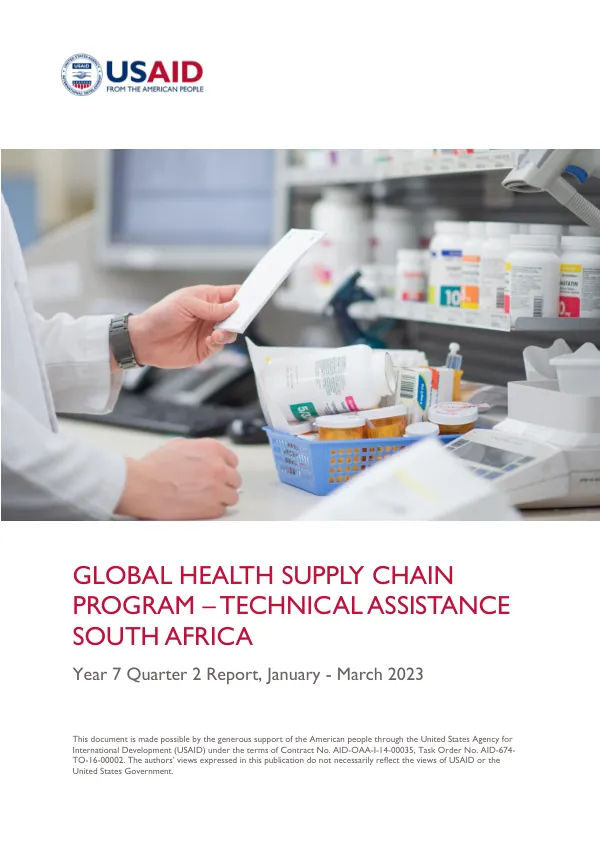
USAID GLOBAL HEALTH SUPPLY CHAIN PROGRAM – TECHNICAL ASSISTANCE SOUTH AFRICA Year 7 Quarter 2 Report, January - March 2023
Sign inCLINTON HEALTHCARE ACCESS INITIATIVE
USAID GLOBAL HEALTH SUPPLY CHAIN PROGRAM – TECHNICAL ASSISTANCE SOUTH AFRICA Year 7 Quarter 2 Report, January - March 2023
The Global Health Supply Chain Program – Technical Assistance in South Africa is a USAID-funded initiative aimed at improving the country's health supply chain.
2023 · 69 pages
Sign in to readA free account is required to download.
Abstract
The program's primary objective is to increase medicine availability and improve the overall efficiency of the supply chain. The program's activities are focused on six key objectives: improving the selection and use of medicines, supporting the optimization of the supply chain, strengthening governance, improving workforce management, strengthening information systems and information management, and improving financial management. The program's technical assistance is provided through a range of activities, including training, capacity building, and infrastructure development. One of the key achievements of the program is the improvement in medicine availability. The overall percentage of medicine availability increased to 85% in Year 7 Quarter 2, with significant improvements in provinces such as KwaZulu-Natal and the Western Cape. The program's efforts to strengthen the supply chain have also led to improvements in demand planning, TLD transition, and multi-month dispensing. The program has also made significant progress in strengthening governance, including the institutionalization of the National Surveillance Center (NSC) and the implementation of a new budgeting process. The program's efforts to improve workforce management have resulted in the development of a comprehensive workforce management plan, which includes training and capacity building for health workers. In addition, the program has made significant progress in strengthening information systems and information management, including the development of a Medicine Master Data System (MMDS) and the implementation of a core supply chain information system. The program's efforts to improve financial management have resulted in the development of a comprehensive financial management plan, which includes budgeting, forecasting, and reporting. The program's achievements are reflected in the key performance indicators (KPIs) reported in the document. The KPIs include the overall percentage of medicine availability, the number of medicine selection decisions made utilizing health technology assessment processes, the percentage of assisted pharmaceutical and therapeutics committees with improved operational capacity, and the percentage of antiretroviral units delivered by suppliers within contractual lead-time. The program's success is also reflected in the lessons learned and best practices documented in the report. The report highlights the importance of collaboration and coordination among stakeholders, the need for a comprehensive and integrated approach to supply chain management, and the importance of continuous monitoring and evaluation. Overall, the Global Health Supply Chain Program – Technical Assistance in South Africa has made significant progress in improving the country's health supply chain and increasing medicine availability. The program's achievements are a testament to the importance of technical assistance and capacity building in improving health outcomes and reducing the burden of disease. The program's efforts to strengthen governance, improve workforce management, and strengthen information systems and information management have resulted in significant improvements in the overall efficiency and effectiveness of the supply chain. The program's achievements are also reflected in the key performance indicators reported in the document, which demonstrate significant improvements in medicine availability, demand planning, and supplier performance reliability. The program's achievements are a testament to the importance of technical assistance and capacity building in improving health outcomes and reducing the burden of disease. The program's success is also a reflection of the commitment and dedication of the program's staff and partners, who have worked tirelessly to improve the health supply chain in South Africa. The program's efforts to improve financial management have resulted in the development of a comprehensive financial management plan, which includes budgeting, forecasting, and reporting. The program's achievements in this area are reflected in the key performance indicators reported in the document, which demonstrate significant improvements in financial management and reporting.