INTERNATIONAL ORGANIZATION FOR MIGRATION
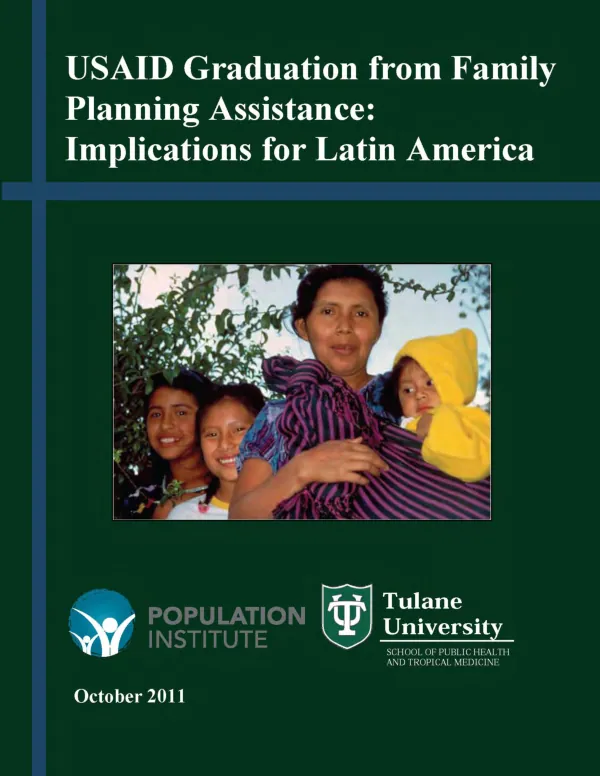
USAID Graduation from Family Planning Assistance: Implications for Latin America
The United States Agency for International Development (USAID) has played a pivotal role in family planning in developing countries worldwide for nearly half a century.
2012 · 106 pages
Sign in to readA free account is required to download.
Abstract
From the 1960s, USAID has provided financial and technical support to public and private sector programs in these countries. Over this 50-year period, the average number of children per woman in the developing world has dropped from around 6 to 2.7. Family planning has evolved from a politically controversial and socially sensitive topic to a routine part of public health service delivery in many countries. In 2004, USAID recognized the need to be more strategic in the allocation of its funding and more systematic in its process of "graduating" countries from family planning assistance. The criteria for considering countries for graduation have evolved since then. Currently, the criteria for "imminent graduation" include a total fertility rate (TFR) of 3.0 or less and a modern contraceptive prevalence rate (MCPR) of at least 55 percent. Additional criteria relate to urban-rural inequities, method mix, and size of the population. Four countries in the Latin America and Caribbean (LAC) region are scheduled to graduate from USAID's family planning assistance: El Salvador, Honduras, Nicaragua, and Paraguay. One additional country, Peru, was scheduled for graduation in FY 2010, but that decision is under review. Five LAC countries have ended their programs under the graduation criteria: Jamaica in 2009 and the Dominican Republic in 2009. Three LAC countries do not yet meet the graduation criteria: Bolivia, Guatemala, and Haiti. The Ministries of Health (MOHs) in the nine countries mentioned above have changed their role in family planning over the past decade. The MOHs are generally supportive of family planning and the public sector is the major source of contraceptive provision in most of these countries. The International Planned Parenthood Federation (IPPF) member associations, which were pioneers for family planning in most Latin American countries, now play a supportive but reduced role in family planning service delivery. Two key elements are necessary for successful graduation: Government commitment to using its own funds to procure contraceptives on the international market, and the technical and managerial savvy to manage the complex contraceptive logistics process. USAID has worked with the MOHs in Honduras, Nicaragua, and Paraguay to strengthen both the commitment and capacity in these areas. While they have been successful in strengthening the procurement and logistics capacity, it is uncertain whether there will be a sufficiently strong and lasting commitment to allocating resources to purchase contraceptals in some of the graduating countries. In June 2010, the eight countries that have graduated from USAID's family planning assistance had a total fertility rate of 2.5 or less and a modern contraceptive prevalence rate of 60 percent or more. The countries that have graduated from USAID's family planning assistance have also made significant progress in reducing urban-rural inequities in access to family planning services. The countries that have graduated from USAID's family planning assistance have also made significant progress in increasing the use of modern contraceptive methods. The countries that are scheduled to graduate from USAID's family planning assistance, Honduras, Nicaragua, and Paraguay, have made significant progress in reducing their total fertility rate and increasing their modern contraceptive prevalence rate. However, they still face challenges in reducing urban-rural inequities in access to family planning services and increasing the use of modern contraceptive methods. The countries that do not yet meet the graduation criteria, Bolivia, Guatemala, and Haiti, face significant challenges in reducing their total fertility rate and increasing their modern contraceptive prevalence rate. They also face challenges in reducing urban-rural inequities in access to family planning services and increasing the use of modern contraceptive methods. USAID has worked with the MOHs in the nine countries mentioned above to strengthen their commitment and capacity to manage the complex contraceptive logistics process. USAID has also worked with the MOHs to strengthen their forecasting and logistics capacity to deliver contraceptive services. The MOHs have developed the technical and managerial savvy to manage the complex contraceptive logistics process and to deliver contraceptive services. The MOHs in the nine countries mentioned above have also made significant progress in increasing the use of modern contraceptive methods and reducing urban-rural inequities in access to family planning services. The MOHs have also made significant progress in strengthening their commitment to using their own funds to procure contraceptives on the international market.
Related documents