USAID DEC
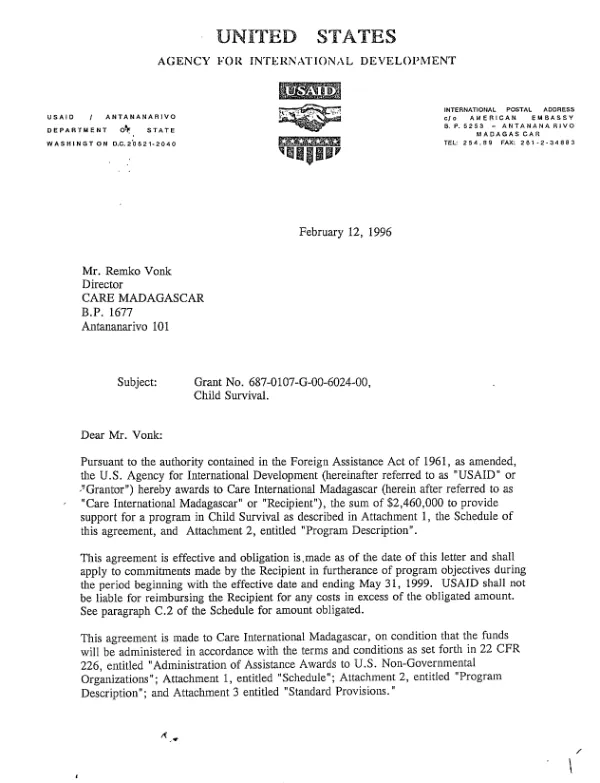
USAID grant no. 687-0107-G-00-6030-00 to Catholic Relief Services to support child survival in Madagascar
Sign inUSAID. MISSION TO MADAGASCAR
USAID grant no. 687-0107-G-00-6030-00 to Catholic Relief Services to support child survival in Madagascar
Grant is provided to Catholic Relief Services (CRS) for a Food-Assisted Child Survival/Focused Nutrition Program in Madagascar.
1996
Sign in to readA free account is required to download.
Abstract
Under the program, CRS will phase over its existing center-based maternal/child care (MCH) programs, which are linked to a Catholic clinics (or a Ministry of Health facility, where no Catholic clinic is available) to a community-based model. To prepare for the phase-over, CRS will develop a new child survival and health promotion curriculum (covering breastfeeding promotion and child feeding practices, proper management of diarrhea, promotion of immunization, growth surveillance, and prenatal care for mothers) and use it to train the staff of the 13 Catholic dioceses and their feeding centers; dioceses and centers unable or unwilling to make the transition will be eliminated from the program. During the training, center staff will solicit assistance from one or two community members in order to introduce the concept of Village Health Promoters (VHPs). The VHPs will play a vital role in the new community-based approach; under the aegis of the Village Health Committee (VHC), VHPs will be trained to: animate health education sessions, counsel mothers during growth monitoring sessions, identify children with faltering growth and organize home visits for them, mobilize mothers to conduct growth monitoring, review immunization status of children and mothers, inform the VHC of the community"s health status, and refer children in need of nutritional supplementation to the center. VHPs will also serve on the VHC, which will be composed of officials elected democratically by the community and trained in community mobilization. The health centers will continue to distribute food and collect beneficiary contributions, but will assume a more active role in targeting of communities and community development. The dioceses will monitor food distribution and community development activities. The Health Information System (HIS) will be used to monitor the impact of the project through knowledge, practice, and coverage (KPC) surveys, village census reports, and village development surveys. The dioceses and diocesan center managers will be provided with copies of these surveys and trained in how to complete them. The health center managers will compile and send reports to the dioceses which will analyze them and send results, along with recommendations, to CRS/Madagascar. To ensure institutional sustainability, the project will collaborate with local health care services and church clinics that can serve as community referral centers after the project"s termination; engage the community itself in decisions on the types of health activities to be implemented in their communities; and use the VHC to improve community access to services (e.g., through facilitating vaccination campaigns or access to oral rehydration saltsa). A total of 300 VHPs (75 per year) will be trained, after which they will train the VHC in selected health interventions, data collection, and community development. Once VHPs have trained the VHC, the latter will train the community in groups of 15-20 people each month. In terms of financial sustainability, contributions for health education will be requested at the community levels to cover VHPs" salary. To cover the cost of the food transport, contributions will also be requested for the supplemental feeding at the centers.
Related documents
Documents in this collection
 1989
1989USAID DEC
AID cooperative agreement no. OTR-0500-A-00-9157-00 with World Relief Corporation for a mother/child health program in Honduras
Open record 1990
1990USAID DEC