ECODIT, INC.
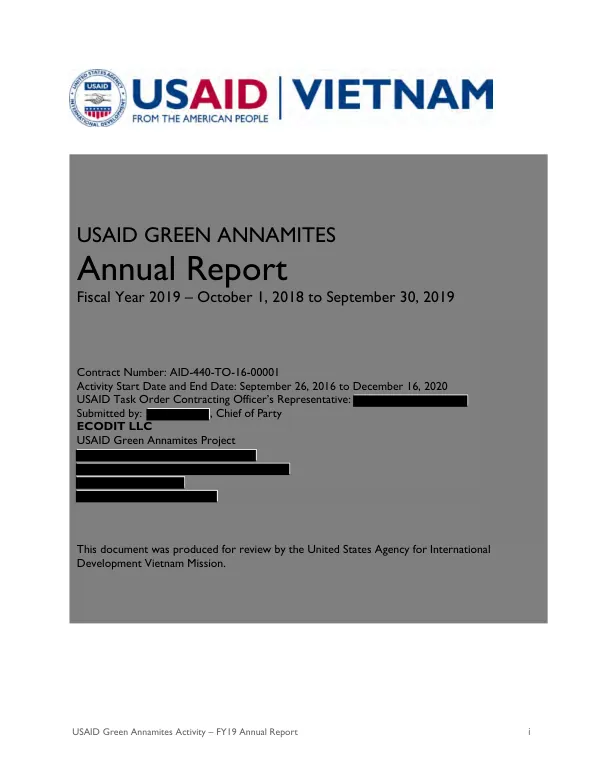
USAID Green Annamites Activity – FY19 Annual Report
The USAID Green Annamites Activity is a project implemented in Vietnam to promote sustainable land use practices, biodiversity conservation, and community resilience in the Annamites Mountains region.
2019 · 54 pages
Sign in to readA free account is required to download.
Abstract
The project began on September 26, 2016, and is scheduled to end on December 16, 2020. In Fiscal Year 2019, the project achieved significant milestones in its three main tasks: increasing the application of low-emissions land use practices, strengthening biodiversity conservation, and increasing the resilience of vulnerable communities. Task 1 focused on promoting sustainable agriculture practices, such as assisted natural regeneration and climate-smart agriculture, among farmers in the region. The project trained over 1,000 farmers in sustainable agriculture techniques and established demonstration plots to showcase the benefits of these practices. Task 2 aimed to strengthen biodiversity conservation in the Annamites Mountains region. The project worked with local communities to establish community conservation groups and village patrolling groups to monitor and protect protected areas. The project also supported the development of biodiversity inventories and action plans for protected areas. Task 3 focused on increasing the resilience of vulnerable communities in the region. The project implemented activities to support climate change adaptation and disaster risk reduction, including the establishment of early warning systems and the provision of climate-resilient livelihoods to communities. The project also supported the development of ecotourism initiatives in the region, which provided income-generating opportunities for local communities. The project also made significant progress in integrating cross-cutting issues and USAID Forward priorities. The project implemented activities to promote gender equity and social inclusion, including the establishment of women's groups and the provision of training on gender-sensitive conservation practices. The project also supported the development of public-private-community partnerships and the mobilization of funds for conservation activities. In terms of stakeholder participation, the project engaged with a range of stakeholders, including local communities, government agencies, and non-governmental organizations. The project also established a project steering committee to provide guidance and oversight on project activities. The project's management and administration were also a key focus area in Fiscal Year 2019. The project mobilized a team of staff and consultants to implement project activities, and established a system for tracking and reporting on project progress. The project also collaborated with provincial governments and other stakeholders to ensure that project activities were aligned with national and provincial priorities. Overall, the USAID Green Annamites Activity made significant progress in Fiscal Year 2019 towards its goal of promoting sustainable land use practices, biodiversity conservation, and community resilience in the Annamites Mountains region. The project's achievements in this year demonstrate its commitment to supporting the Government of Vietnam in achieving its conservation and development goals. The project's achievements in Fiscal Year 2019 are reflected in the following key results: * 1,000 farmers trained in sustainable agriculture techniques * 15 community conservation groups established * 10 village patrolling groups established * 5 protected areas with biodiversity inventories and action plans * 2 ecotourism pilot projects established * 1,000 households supported with climate-resilient livelihoods * 500 community members trained in ecotourism skills The project's achievements in Fiscal Year 2019 demonstrate its commitment to supporting the Government of Vietnam in achieving its conservation and development goals. The project's success in promoting sustainable land use practices, biodiversity conservation, and community resilience in the Annamites Mountains region has the potential to benefit not only the local communities but also the broader region and the country as a whole.
Related documents