CHEMONICS
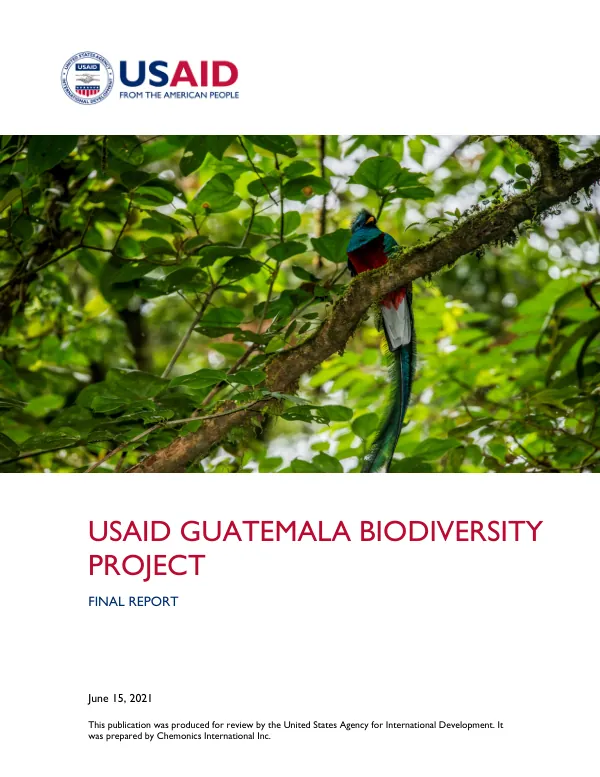
USAID GUATEMALA BIODIVERSITY PROJECT FINAL REPORT
The Guatemala Biodiversity Project, implemented by Chemonics International Inc.
2021 · 75 pages
Sign in to readA free account is required to download.
Abstract
and funded by the United States Agency for International Development, aimed to strengthen conservation efforts in the Pacific Coast region of Guatemala. The project focused on the mangrove ecosystems of the Machón-Guamuchal Ramsar Site and La Chorrera Private Natural Reserve, as well as the cloud forests of the Sierra de las Minas Biosphere Reserve. The project's theory of change and approach were centered on improving conservation approaches through better information on key species and ecosystems. This involved monitoring quetzal populations, among other endemic species, in the cloud forests of the Sierra de las Minas Biosphere Reserve to evaluate the health of ecosystems that host diverse animal species. Additionally, the project supported the monitoring of macaw nests to assess reproductive success, increase captive reproduction, and analyze and document potential threats to natural nesting areas. Key outcomes of the project included improved capacity to monitor and implement conservation actions, strengthened national and sub-national information systems, and mitigation of climate risks. The project also supported national and sub-national policy and legislative reforms, improving regulatory frameworks and instruments, and creating collaborative spaces for local governance dialogue on policy and regulation. Furthermore, the project connected Guatemalan actors with international opportunities to advance policy objectives and legal protections. The project also focused on building capacity for effective enforcement and prosecution of crimes committed within protected areas. This involved improving the enforcement and management of cases related to environmental crimes, using innovative technology to identify and address environmental crimes, and engaging local stakeholders in conservation efforts. Additionally, the project strengthened micro, small, and medium enterprises and community-based organizations dedicated to sustainable, environmentally friendly practices, improving sustainable practices of producers in industries with a high environmental impact, and enhancing public-private partnerships. The project's monitoring, evaluation, and learning activities were centered on collaborating, learning, and adapting. Performance against indicator targets was also a key aspect of the project's evaluation. The project's financial report is included in Annex A.
Related documents