USAID DEC
USAID’s INTEGRATED COMMUNITY AGRICULTURE AND NUTRITION (ICAN) ACTIVITY Annual Work Plan
Sign inABT ASSOCIATES
USAID’s INTEGRATED COMMUNITY AGRICULTURE AND NUTRITION (ICAN) ACTIVITY Annual Work Plan
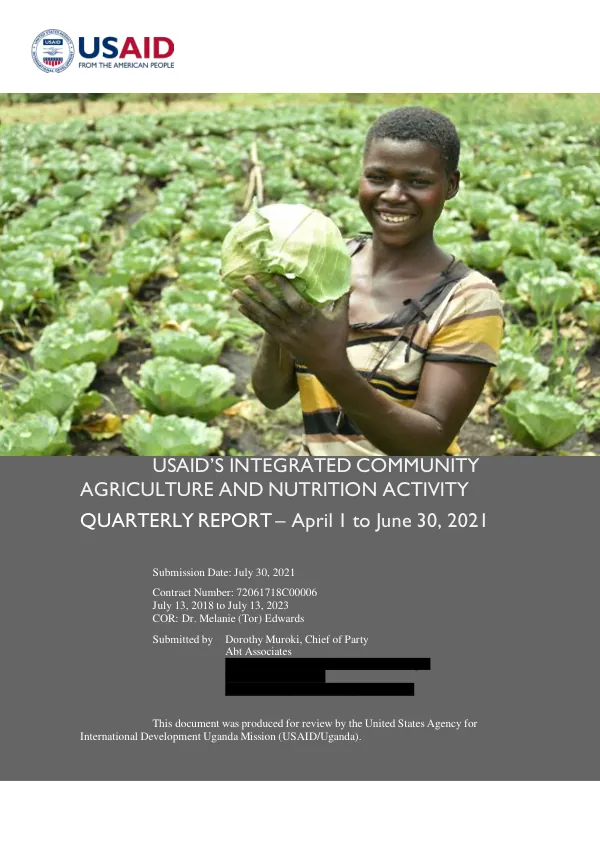
The Integrated Community Agriculture and Nutrition Activity (ICAN) is a resilience project awarded to Abt Associates by USAID/Uganda in July 2018.
2018 · 40 pages
Sign in to readA free account is required to download.
Abstract
The Activity goal is to enhance the resilience of vulnerable households in eight districts of Uganda, including Kanungu, Kisoro, Rukungiri, Gulu, Lamwo, Nwoya, Kaabong, and Kotido. ICAN will work with community groups to maximize economic opportunities, stabilize access to and consumption of diverse and nutritious diets, and increase social capital by reinforcing relationships among formal governance systems and communities. ICAN will focus on three key strategic themes: Resilience, Partnerships, and Collaboration, Learning and Adapting (CLA). The Activity will define the terms resilient household and resilient community with target communities in the three sub-regions. ICAN will strengthen community groups, primarily village savings and loan associations (VSLAs), to support vulnerable households and move them along a Pathway to Self-Reliance. The Activity will also work with local structures and partners to increase resilience, including by adding value to other projects and encouraging District Local Governments (DLGs) to be more sustainable or achieve better results. ICAN's Theory of Change (TOC) is "If vulnerable Ugandans increase their economic opportunities and diversify their livelihoods; adopt practices to improve their nutritional status; and participate in inclusive effective governance processes, then they will achieve sustainable gains in their ability to respond to and recover from shocks and stresses." The Activity has three interlinked objectives or sub-purposes. ICAN's first objective is to increase economic opportunities and diversify livelihoods for poor households. This will be achieved by partnering with sustainable private and public structures to organize farmers in groups, including VSLAs, and enabling them to save with a purpose (SWAP) and pay for viable business services. ICAN's second objective is to improve the nutrition of children, adolescents, and women of reproductive age. This will be achieved by partnering with the Regional Health Integration to Enhance Services (RHITES) and other stakeholders to promote practices that improve nutritional status. ICAN will also work with local health structures to increase access to and consumption of diverse and nutritious diets. The Activity's third objective is to increase household participation in local planning and service delivery. This will be achieved by partnering with local governance structures to increase the capacity of community groups to participate in inclusive effective governance processes. ICAN will operate in four districts during Phase I, including Kisoro, Kanungu, Lamwo, and Kotido. Phase II will start in Q4 of FY19 and will enter the remaining four districts of Rukungiri, Gulu, Nwoya, and Kaabong. The Activity will use facilitative approaches to layer interventions with other Activities and will incorporate CLA principles by identifying, testing, and replicating the most effective methodologies for building the capacity of community groups, public- and private-sector service providers, and local government stakeholders.