USAID DEC
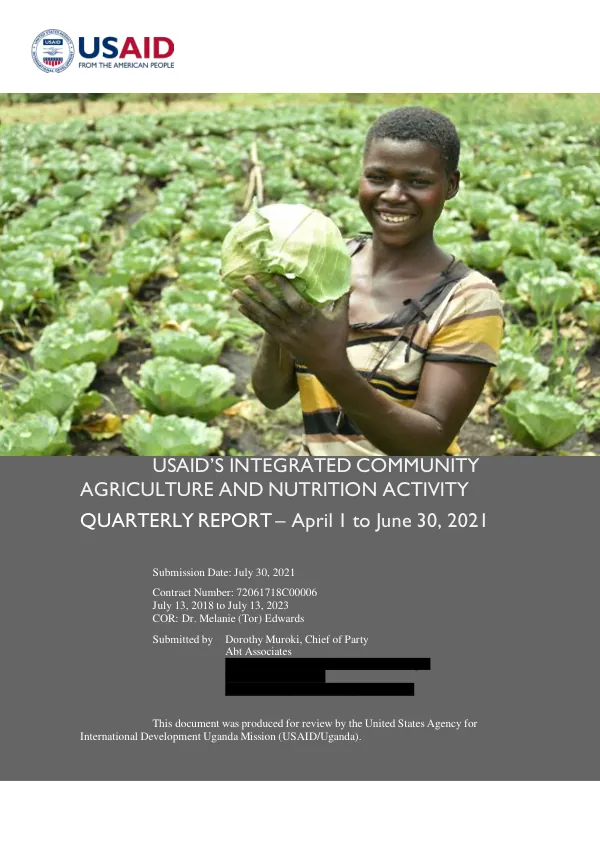
USAID's Integrated Community Agriculture and Nutrition Activity in Uganda Quarterly Report – April 1 to June 30, 2021
Sign inABT ASSOCIATES
USAID's Integrated Community Agriculture and Nutrition Activity in Uganda Quarterly Report – April 1 to June 30, 2021
The Integrated Community Agriculture and Nutrition Activity (ICAN) in Uganda continued to build hope and resilience during the second wave of the Coronavirus (COVID-19) pandemic.
2021 · 46 pages
Sign in to readA free account is required to download.
Abstract
ICAN prepared communities to protect themselves from illness and work toward a better life and livelihood. The activity increased coverage of its interventions, reaching over 165,045 beneficiaries with U.S. Government support. Over 76 percent of the beneficiaries were female, and close to 54,759 received access to economic livelihood interventions, cumulatively reaching 80,604 (94 percent) of the annual target. ICAN promoted the 1,000-days window of opportunity nutrition interventions, directly reaching over 28,203 women (of whom 5,566 were pregnant) with nutrition interventions in Q3. The activity also conducted nutrition assessments for children aged 6-59 months, with 71,522 children assessed in Q3 versus 65,271 in Q2. Of these children, 1,643 had moderate acute malnutrition, and 279 had severe acute malnutrition. ICAN shifted focus to accommodate pandemic-related restrictions and continued to support remedial home-based learning for children in the lower primary age group (P.1 – P.3). The activity reached 1,554 learners (938 boys and 616 girls) in P.1 – P.3 through remedial classes to enable them to continue their learning in 16 learning centers (eight in Kaabong and another eight in Kotido). ICAN also supported school structures to print materials for learners and conduct training for teachers on the Journey curriculum, which supports the Uganda Ministry of Education and Sports' implementation of the National Strategy and Action Plan on Violence against Children in Schools. The Journey Activity Handbook for Pupils encourages students to form clubs and carry out activities that build five essential social and emotional learning competencies related to the life skills in the thematic curriculum: self-awareness, social awareness, relationship skills, self-management, and responsible decision-making. ICAN's efforts to promote social and emotional learning competencies aim to support the development of well-rounded individuals who can navigate the challenges of life effectively. ICAN's quarterly report highlights the activity's progress in implementing its interventions, including the promotion of economic livelihoods, nutrition, and social and emotional learning competencies. The report also provides an overview of the activity's achievements and challenges, as well as its plans for the next quarter.