DAI
USAID Indonesia Urban Water Sanitation and Hygiene Quarterly Progress Report 15
The USAID Indonesia Urban Water Sanitation and Hygiene program is a comprehensive initiative aimed at improving access to safe drinking water, sanitation, and hygiene in urban areas of Indonesia.
2015 · 199 pages
Sign in to readA free account is required to download.
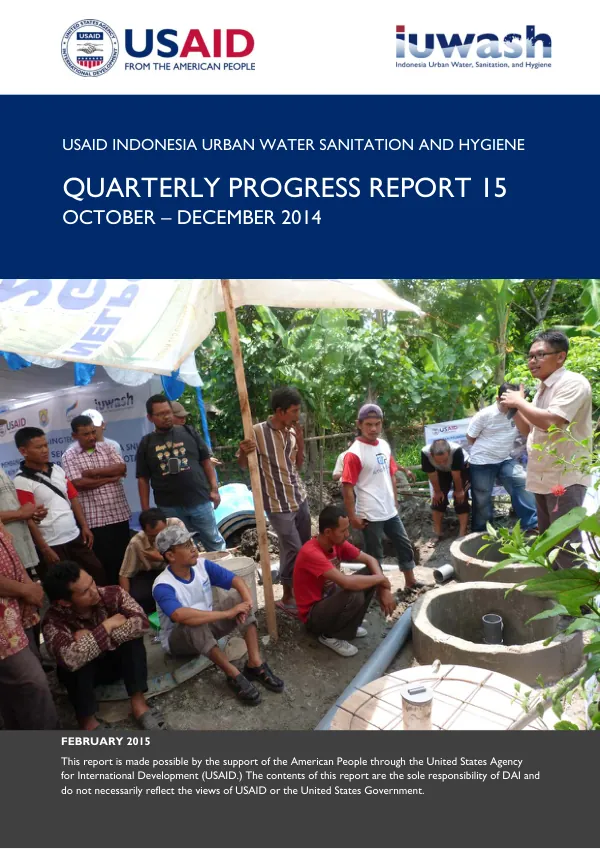
Abstract
The program is implemented by DAI and is supported by the American People through the United States Agency for International Development (USAID). In the Central Java Province, IUWASH conducted a series of training on toilet with septic tank construction in collaboration with PNPM Mandiri Perkotaan. This successful partnership resulted in the construction of 6,612 new toilets in 10 districts/cities, including Batang, Kendal, Semarang, Salatiga, Surakarta, Klaten, Sukoharjo, Kudus, and Rembang. The program's water supply sector focuses on improving the technical, financial, and customer aspects of PDAM (Perusahaan Daerah Air Minum), the local water utility company. Program WS 1 aims to improve PDAM's technical aspects, including water treatment and distribution systems. Program WS 2 focuses on improving PDAM's financial aspects, such as revenue collection and cost management. Program WS 3 targets PDAM's customer aspects, including customer service and billing systems. In the sanitation sector, Program SAN 1 aims to increase access to improved individual sanitation systems, while Program SAN 2 targets increased sanitation access through communal systems. Program SAN 3 focuses on increasing access to off-site sanitation, including sewerage systems. Program SAN 4 aims to improve urban sludge management, and Program SAN 5 supports wastewater institutions. The program also has cross-cutting sector components, including increased local government policies, budget, and citizen engagement. Program CC-1 aims to increase the number of local government policies, while Program CC-2 targets increased local government budget. Program CC-3 focuses on improving citizen engagement, and Program CC-4 aims to mainstream gender. Program CC-5 mobilizes corporate social responsibility (CSR) funding. In addition to the program's sectoral components, the grants program provides funding for specific projects and activities. National activities and key upcoming events are also highlighted in the report, including project management, communication and reporting, monitoring and evaluation, and environmental compliance. Regional highlights are also provided, including summaries, success stories, and regional highlights by sector for North Sumatra, West Java/DKI Jakarta/Banten, and Central Java. The report highlights the program's achievements and progress in improving access to safe drinking water, sanitation, and hygiene in urban areas of Indonesia.