USAID DEC
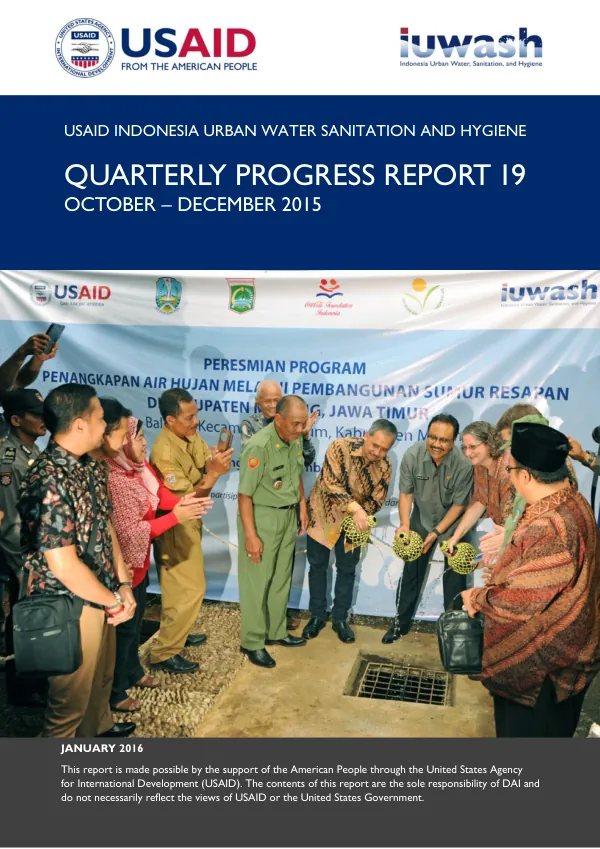
USAID Indonesia Urban Water Sanitation and Hygiene Quarterly Progress Report 19 October – December 2015
Sign inDAI
USAID Indonesia Urban Water Sanitation and Hygiene Quarterly Progress Report 19 October – December 2015
The USAID Indonesia Urban Water Sanitation and Hygiene project began in 2011 with a five-year contract to improve access to safe drinking water, sanitation, and hygiene in urban areas of Indonesia.
2016 · 145 pages
Sign in to readA free account is required to download.
Abstract
The project is implemented by DAI and is funded by the USAID/Indonesia Office of Environment. The project's main goal is to increase access to safe drinking water and sanitation services for urban residents, particularly in low-income communities. The project focuses on improving water supply systems, sanitation infrastructure, and hygiene practices in urban areas. Key interventions include improving the technical and financial aspects of public water utilities, increasing access to improved sanitation through individual and communal systems, and promoting hygiene practices through community engagement and education. The project also aims to increase the number of local government policies and budgets allocated for water and sanitation, as well as to improve citizen engagement and gender mainstreaming. During the period of October 1 to December 31, 2015, the project achieved several key results. In the water supply sector, the project improved the technical aspects of public water utilities, including the installation of master meters and the development of raw water sources. The project also increased access to microfinance for water supply, enabling low-income households to access safe drinking water. In the sanitation sector, the project increased access to improved sanitation through individual and communal systems, and improved urban septage management. The project also made progress in cross-cutting areas, including increasing the number of local government policies and budgets allocated for water and sanitation, and improving citizen engagement and gender mainstreaming. The project's grants program also supported local initiatives to improve water and sanitation services. The project's performance is monitored and evaluated through a range of indicators, including the number of households with access to safe drinking water and sanitation services, the number of public water utilities improved, and the number of local government policies and budgets allocated for water and sanitation. The project's progress is reported quarterly to USAID and other stakeholders. In terms of specific achievements, the project reported that 800 infiltration ponds were constructed in Malang district to help replenish raw water sources. The project also reported that more than 2,500 households had access to improved sanitation through individual and communal systems. In addition, the project reported that 15 public water utilities had been improved, and that 10 local government policies and budgets had been allocated for water and sanitation. Overall, the USAID Indonesia Urban Water Sanitation and Hygiene project has made significant progress in improving access to safe drinking water and sanitation services in urban areas of Indonesia. The project's focus on improving water supply systems, sanitation infrastructure, and hygiene practices has helped to increase access to safe drinking water and sanitation services for low-income households.