USAID DEC
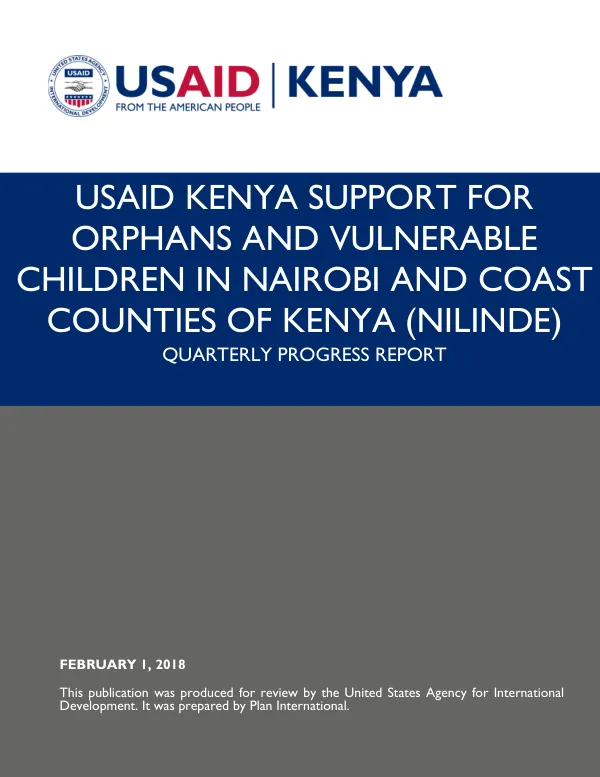
USAID KENYA Support for Orphans and Vulnerable Children in Nairobi and Coast Counties of Kenya (Nilinde) Quarterly Progress Report
Sign inDEUTSCHE GESELLSCHAFT FÜR INTERNATIONALE ZUSAMMENARBEIT GMBH
USAID KENYA Support for Orphans and Vulnerable Children in Nairobi and Coast Counties of Kenya (Nilinde) Quarterly Progress Report
The Nilinde project, led by Plan International, aims to improve the welfare and protection of vulnerable children affected by HIV in Nairobi and Coast Counties of Kenya.
2018 · 71 pages
Sign in to readA free account is required to download.
Abstract
The project works to strengthen the capacity of caregivers and communities to provide for children's basic needs, while also strengthening social systems and structures to support orphans and vulnerable children. Nilinde collaborates with the Department of Children Services and various government line ministries to ensure local ownership and optimal support to government-led priorities. Strategic partnerships with other USAID-funded projects and public-private partnerships continue to play a critical role in facilitating access to critical services. Nilinde works with 32 Service Delivery Partners who support a community workforce comprised of Community Health Volunteers, Community Based Trainers, Community Volunteers, and school-based focal point persons. This quarter, Nilinde supported 4,198 community workforce members, exceeding the Year 3 target of 4,165. The community workforce conducted home visits with 152,907 orphans and vulnerable children, with 75,129 males and 77,778 females. To promote critical conversations around key themes, Nilinde supported 48 community conversations and celebrated the Day of the African Child. The project also worked to reduce stigma and promote disclosure of HIV status, with a focus on girls' education. Nilinde's efforts aim to improve the lives of vulnerable children and their caregivers, while also strengthening social systems and structures to support their needs. The project's community workforce conducted household vulnerability assessments, which identified 58,317 households caring for target orphans and vulnerable children. Nilinde worked to strengthen the capacity of these households to provide for their children's basic needs, while also promoting social and economic empowerment. The project's efforts focused on improving access to critical services, including healthcare, education, and economic opportunities. Nilinde's partnerships with other organizations, including World Bicycle Relief, Kenya Commercial Bank Foundation, and Research Triangle Institute/Kenya Youth Employability and Skills, continue to play a critical role in facilitating access to critical services. The project's work aims to improve the lives of vulnerable children and their caregivers, while also strengthening social systems and structures to support their needs. The Nilinde project's quarterly progress report highlights the project's achievements and challenges during the period from October 1, 2017, to December 31, 2017. The report provides an overview of the project's activities, outcomes, and lessons learned, which will inform future programming and decision-making. The report also highlights the project's commitment to transparency and accountability, with a focus on ensuring that project resources are used effectively and efficiently to achieve project goals. In terms of implementation, Nilinde worked to strengthen the capacity of caregivers and communities to provide for children's basic needs, while also promoting social and economic empowerment. The project's community workforce conducted household visits, provided training and support to caregivers, and promoted critical conversations around key themes. Nilinde also worked to reduce stigma and promote disclosure of HIV status, with a focus on girls' education. The project's partnerships with other organizations continued to play a critical role in facilitating access to critical services. Nilinde worked with 32 Service Delivery Partners who supported a community workforce comprised of Community Health Volunteers, Community Based Trainers, Community Volunteers, and school-based focal point persons. The project's efforts aimed to improve the lives of vulnerable children and their caregivers, while also strengthening social systems and structures to support their needs. In terms of outcomes, Nilinde's community workforce conducted home visits with 152,907 orphans and vulnerable children, with 75,129 males and 77,778 females. The project also supported 48 community conversations and celebrated the Day of the African Child. Nilinde's efforts aimed to promote critical conversations around key themes, reduce stigma, and promote disclosure of HIV status, with a focus on girls' education. The project's quarterly progress report highlights the importance of partnerships and collaboration in achieving project goals. Nilinde's partnerships with other organizations, including World Bicycle Relief, Kenya Commercial Bank Foundation, and Research Triangle Institute/Kenya Youth Employability and Skills, continue to play a critical role in facilitating access to critical services. The project's work aims to improve the lives of vulnerable children and their caregivers, while also strengthening social systems and structures to support their needs.