TETRA TECH
USAID AMPR Year II MEL Plan FINAL
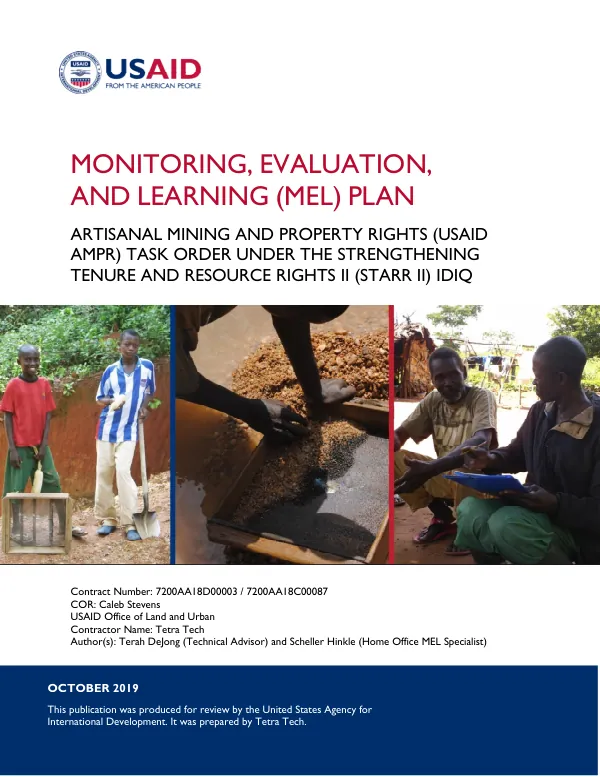
The USAID Artisanal Mining and Property Rights (USAID AMPR) Project aims to address land and resource governance challenges around the Artisanal and Small-Scale Mining (ASM) sector in the Central African Republic (CAR).
2019 · 60 pages
Sign in to readA free account is required to download.
Abstract
The project's main purpose is to strengthen the legal chain of custody for diamonds and gold through training and capacity-building, regulatory reform, empowerment of communities, and improving stakeholder coordination. This approach is expected to promote compliance with Kimberley Process (KP) requirements, which will in turn promote licit economic opportunities and enable community resilience and social cohesion to increase. The project is designed around a theory of change that outlines the expected outcomes of USAID AMPR's activities. The theory of change posits that if USAID AMPR strengthens the legal chain of custody for diamonds and gold, compliance with KP requirements will increase, promoting licit economic opportunities and enabling community resilience and social cohesion to increase. Additionally, if successful approaches adopted for the diamond sector are extended to the gold sector, and key linkages between ASM and complex development issues are addressed, all stakeholders in the ASM sector worldwide will benefit from improved livelihoods, peace, and stability. To progress through the theory of change, USAID AMPR activities will be structured around four objectives. The first objective is to assist the Government of CAR (GoCAR) to improve compliance with KP requirements to promote licit economic opportunities. The second objective is to strengthen community resilience, social cohesion, and response to violent conflict in CAR. The third objective is to increase awareness and understanding of the ASM sector among stakeholders, including government officials, community leaders, and miners. The fourth objective is to provide on-demand short-term technical assistance on development challenges associated with ASM to various USAID Operating Units (OUs) around the globe. The project's monitoring and evaluation plan is designed to track progress towards these objectives and outcomes. The plan includes a set of performance indicators that will be used to measure progress, as well as a data collection and analysis plan. The plan also outlines the roles and responsibilities of various stakeholders, including the project team, government officials, and community leaders. The project's results framework is based on a set of intermediate results (IRs) that are expected to be achieved over the course of the project. The IRs are organized around the four objectives and include metrics such as the number of government officials trained on KP requirements, the number of communities empowered through land and resource planning, and the number of stakeholders aware of the ASM sector. The project's learning and adaptive management plan is designed to ensure that the project is responsive to changing circumstances and that lessons learned are incorporated into the project's activities. The plan includes a set of adaptive management and learning questions that will be used to guide the project's decision-making and ensure that the project is on track to achieve its objectives. Overall, the USAID AMPR Project aims to address the complex development challenges associated with the ASM sector in CAR and to promote licit economic opportunities, community resilience, and social cohesion. The project's monitoring and evaluation plan is designed to track progress towards these objectives and outcomes, and the project's learning and adaptive management plan is designed to ensure that the project is responsive to changing circumstances and that lessons learned are incorporated into the project's activities. The project's geographic focus is on the Central African Republic, with a primary focus on diamonds and a secondary focus on gold. The project's timeframes are from October 1, 2019, to September 30, 2020, with a monitoring period from October 1 to September 30 each year. The project's recommendations are based on the project's theory of change and the expected outcomes of the project's activities.