USAID DEC
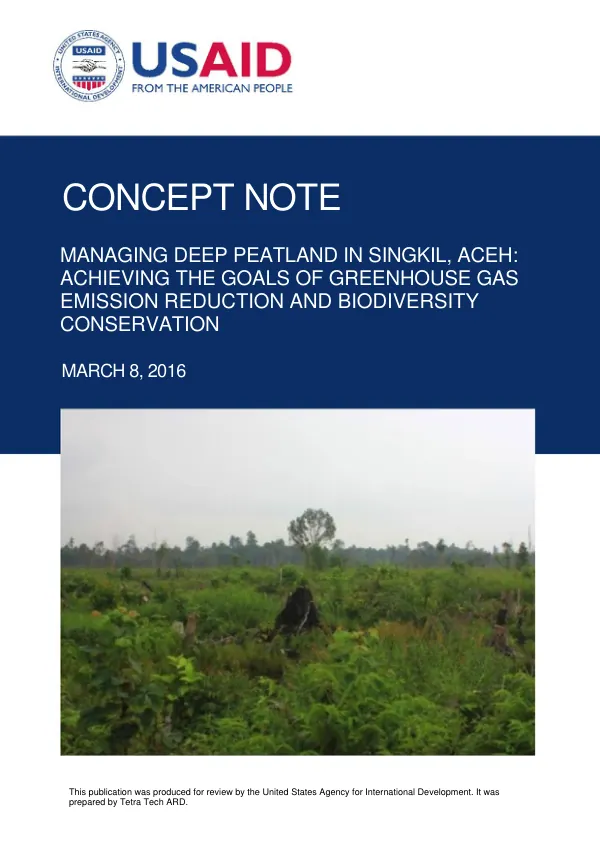
USAID LESTARI Concept Note: Managing Deep Peatland In Singkil, Aceh: Achieving The Goals Of Greenhouse Gas Emission Reduction And Biodiversity Conservation
Sign inMICHIGAN STATE UNIVERSITY FOUNDATION
USAID LESTARI Concept Note: Managing Deep Peatland In Singkil, Aceh: Achieving The Goals Of Greenhouse Gas Emission Reduction And Biodiversity Conservation
Aceh Province in Indonesia contains three main peat swamp forests: Tripa, Singkil, and Kluet.
2016 · 28 pages
Sign in to readA free account is required to download.
Abstract
Peat forests in Aceh hold significant carbon stocks per hectare, making their protection crucial for the Government of Indonesia's greenhouse gas emissions reduction strategy. However, the 2015 Indonesian fire and haze event resulted from irresponsible peatland management, highlighting the threat to the region's health, economy, climate, and biodiversity. The peat swamp forests in Aceh are under threat from illegal oil palm and logging interests. The ongoing degradation and conversion of Singkil and Kluet peat forests heighten the risk of widespread fires across the western Leuser Ecosystem. A proactive and pre-emptive approach is critical for avoiding fires, as demonstrated by the experience from Tripa, where a deep peatland was degraded by illegal oil palm encroachment and systematic use of fire. The Situation Analysis presented in this report reveals several key gaps that undermine efforts to safeguard Singkil Wildlife Reserve and Aceh's other peat swamp forests. These gaps include low management capacity of BKSDA, lack of actionable information on illegal oil palm and timber supply chains, lack of transparency on the status of existing concessions, and poor knowledge of district government on land use planning policies and laws. To address these gaps, a multi-layered approach is proposed, consisting of four objectives: 1. Increase management effectiveness of Singkil Wildlife Reserve to protected peat forest and wildlife. 2. Assess and monitor the ecosystem service benefits provided by Singkil Wildlife Reserve. 3. Investigate illegal supply chains for palm oil and timber in forest and peatland areas in Aceh Selatan, Subulussulam, and Singkil, which present a high future fire risk to Aceh's forests and biodiversity. 4. Assess the financial incentives that currently drive forest clearance on peatlands in Aceh, at district, provincial, and national levels, to build a business case for sustainable land use. To preserve Singkil and its ecosystem services, a range of actions involving government partners at all levels is required. LESTARI can play a key leadership role in coordinating and supporting the work of district, provincial, and national level government agencies. This includes supporting the production of a detailed national peatland map, improved technical guidance for peatland governance and ecosystem restoration, and strengthened community-based fire monitoring systems. USAID LESTARI supports the Government of Indonesia to reduce greenhouse gas emissions and conserve biodiversity in carbon-rich and biologically significant forest and mangrove ecosystems. The project applies a landscape approach to reduce greenhouse gas emissions, integrating forest and peatland conservation with low emissions development on other, already degraded land. This is achieved through improved land use governance, enhanced protected areas management, protection of key species, sustainable private sector and industry practices, and expanded constituencies for conservation among various stakeholders. The LESTARI project is implemented under the leadership of Tetra Tech and a consortium of partners, including WWF-Indonesia, Winrock International, Wildlife Conservation Society (WCS), Blue Forests, Yayasan Sahabat Cipta, PT Hydro South Pole Carbon, Sustainable Travel International (STI), Michigan State University, and the FIELD Foundation. The project runs from August 2015 through July 2020.