TETRA TECH ARD, INC.
USAID LESTARI – Village-Based Forest Management
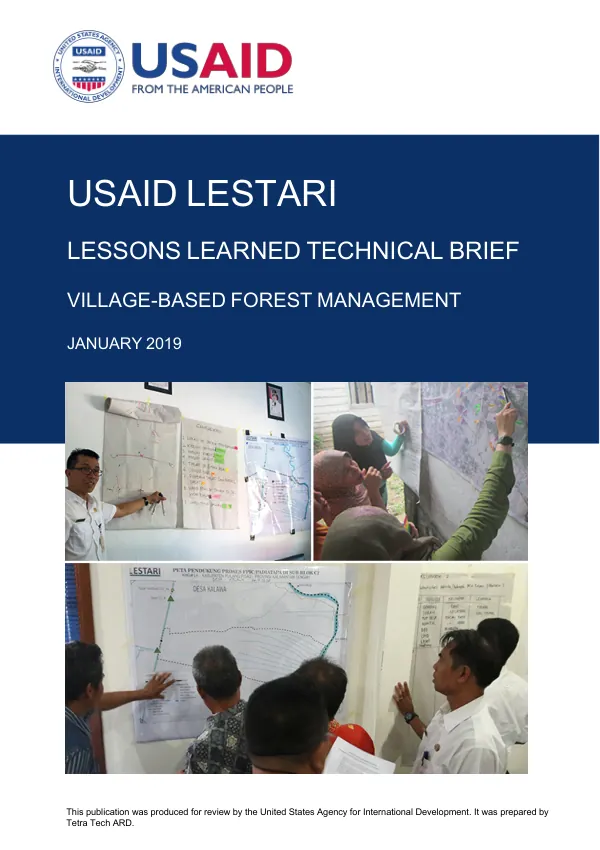
The village-based forest management approach implemented by USAID LESTARI aims to improve forest management within four priority landscapes in Indonesia.
2019 · 29 pages
Sign in to readA free account is required to download.
Abstract
This approach involves engagement with local stakeholders to support the development of sustainable forest management planning. Technical assistance is provided to conduct environmental assessments, regional development plans, spatial plans, conservation area management plans, Forest Management Unit plans, and village development plans. A major part of the LESTARI landscape approach is the engagement with local stakeholders, including villages, to support the development of sustainable forest management planning. This includes providing technical assistance to conduct environmental assessments, regional development plans, spatial plans, conservation area management plans, Forest Management Unit plans, and village development plans. The village-level engagement is a crucial part of LESTARI's overall approach because it contributes to bottom-up development for inclusion and sustainability, villages have overlapping jurisdictions with national parks and Forest Management Unit areas, villages now control significant annual budgets, and the feasibility of affecting village budgets is generally higher than other options. In implementing the above approach, LESTARI has identified and engaged with 50 villages across the provinces of Aceh, Central Kalimantan, and Papua. Villages were selected based on their reliance and impact on forest ecosystems: watershed boundaries in Aceh, peatlands in Central Kalimantan, and buffer zones of conservation areas in Papua. Some key lessons learned include engagement with villages is a vital component of improving forest management and conservation, villages have sizeable development budgets, but there remains a lack of capacity in planning and budgeting for sustainable forest management, LESTARI's village-level work has led to more inclusive village development processes, increased village budget allocations for sustainable forest management, and leveraged funding from district and provincial budgets. The village approach has enabled the incorporation of sustainable forest management within village development plans. Support for conservation and forest management planning at village level is most effective when working through existing regulatory mechanisms such as social forestry. LESTARI should continue with village-level engagement in project Years 4-5, but with a shift towards amplification and sustainability. During Years 4-5, the objective is to leverage LESTARI's models of village planning so that the approach is understood and replicated by local governments as well as non-government actors. To achieve this, LESTARI will advocate to and provide capacity building for Village Empowerment Agencies, develop or revise knowledge management products as needed, facilitate field visits by decision makers to LESTARI-supported villages, and engage non-government stakeholders to understand and utilize the village approach. This will ensure that LESTARI's village-level work on improved forest management will continue to have an impact beyond the end of the project in 2020.