GOVERNMENT OF INDONESIA
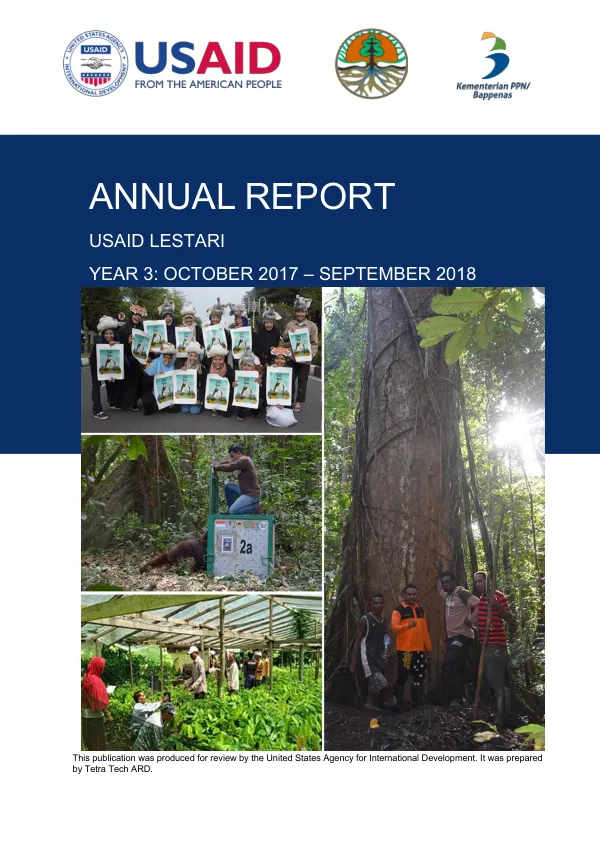
USAID LESTARI Year 3 Annual Report (October 2017 - September 2018)
The USAID LESTARI project, implemented by Tetra Tech ARD, aimed to improve forest and biodiversity conservation practices, build the capacity and self-reliance of local government and civil society partners, and promote the U.S.-Indonesia strategic partnership.
2018 · 147 pages
Sign in to readA free account is required to download.
Abstract
The project was conducted in six landscapes across the provinces of Aceh, Central Kalimantan, and Papua. Key stakeholders included the Government of Indonesia, private sector, and local communities. Throughout Year 3, LESTARI implemented landscape initiatives and supporting technical activities in accordance with the Year 3 Work Plan. Achievements were made possible through close cooperation with key stakeholders. The project's core strategy was to lay a foundation for sustainable impact by operationalizing various tools and approaches. Technical Theme 1: Forest & Land Use Governance & Advocacy focused on awareness and advocacy, operationalizing Strategic Environmental Assessments (SEA) and Landscape Conservation Plans (LCP) to improve land use governance, and sustainable landscape governance. Technical Theme 2: Improved Conservation & Forest Management included co-management and Forest Management Unit (FMU) strengthening, protected area management, and key species conservation. Technical Theme 3: Private Sector Engagement focused on green enterprises, private sector best management practices, and innovative financing for sustainable land and forest management. Landscape Initiatives were implemented across the six project landscapes, including the Leuser Landscape, Katingan-Kahayan Landscape, Papua Provincial Initiatives, Lorentz Lowlands Landscape, Mappi-Bouven Digoel Landscape, Sarmi Landscape, and Cyclops Landscape. Gender Integration and Grants Fund were also key components of the project. Project Management, Coordination, and Communications ensured effective implementation and coordination among stakeholders. The project's progress was monitored and evaluated through various tools and approaches, including the Management Effectiveness Tracking Tool (METT) and the Spatial Monitoring and Reporting Tool (SMART).