USAID DEC
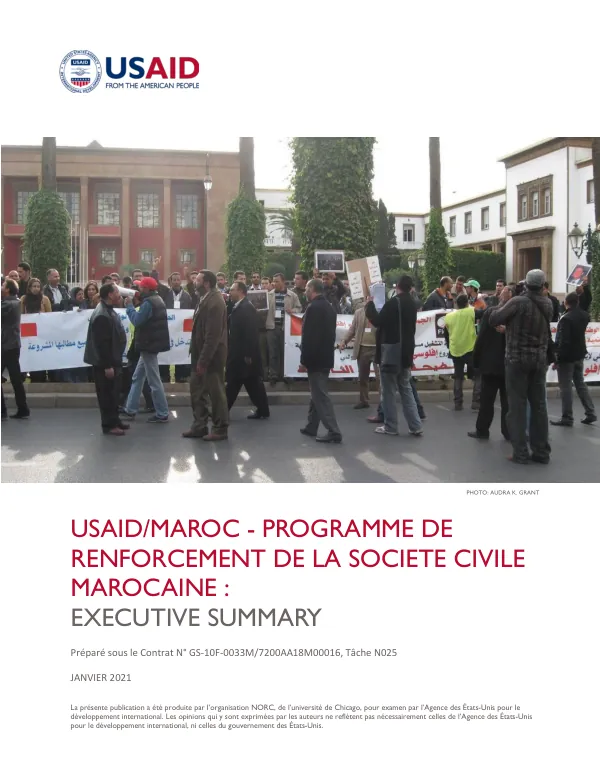
USAID/MAROC : PROGRAMME DE RENFORCEMENT DE LA SOCIETE CIVILE MAROCAINE : RAPPORT D’EVALUATION FINALE
Sign inCOUNTER PART INTERNATIONAL
USAID/MAROC : PROGRAMME DE RENFORCEMENT DE LA SOCIETE CIVILE MAROCAINE : RAPPORT D’EVALUATION FINALE
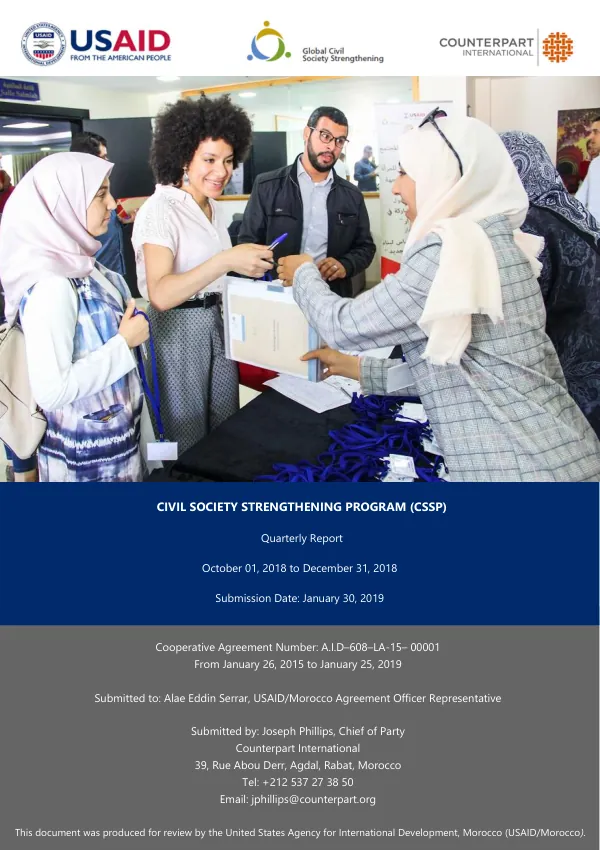
The Civil Society Strengthening Program (CSSP) was developed by USAID in Morocco to encourage a better interaction between civil society organizations (CSOs) and government institutions, and to improve the skills, knowledge, and resources of CSOs through training and direct subsidies.
2021 · 11 pages
Sign in to readA free account is required to download.
Abstract
The program was implemented from January 2015 to July 2019 by Counterpart International (CI), with the partnership of the International Center for Not-for-Profit Law (ICNL). In parallel, USAID awarded direct projects to five intermediary support organizations (ISOs) to strengthen the capacities of other small CSOs across the country. The five ISOs are: the Association Colombe Blanche (ACB), the Mouvement Alternatives Citoyenne (ALCI), the Association marocaine de solidarité et de développement (AMSED), the Forum Azzahrae, and the Association Ennakhil. USAID/Maroc requested NORC to conduct a final evaluation of the CSSP's performance to understand to what extent the program contributed directly to the intermediate result 1 of the USAID/Maroc mission for democracy and governance, "Increased contribution of civil society to the public policy process." NORC evaluated the CSSP's capacity to achieve two main objectives: Objective 1: Strengthening CSOs and enabling them to contribute more effectively to law-making and public policy; and Objective 2: Supporting the Moroccan Government in promoting significant opportunities for civil society to participate in the development and implementation of public policies in Morocco. The evaluation covered the entire period of four and a half years and will be used for the implementation of future programs in Morocco or similar contexts. The evaluation used different strategies, qualitative and quantitative, to assess the CSSP's progress. Before data collection, the NORC team conducted a comprehensive review of the program's documents. To facilitate qualitative data collection, the team organized 10 discussion groups from a random sample of beneficiary CSOs, including grant recipients. Due to COVID-19 pandemic restrictions, the evaluation team conducted the discussion groups via the Zoom platform. The team also conducted a total of 37 in-depth interviews (EAs) remotely with various stakeholders of the CSSP, including government officials, personnel from collaborating ISOs, personnel from participating CSOs, association representatives, and USAID/Maroc personnel. Quantitative strategies included an online and phone survey of beneficiary CSOs and non-affiliated stakeholders, following the discussion groups and EAs, to capture the range of perspectives and experiences of stakeholders regarding the program. Fieldwork took place from July to September 2020. Results were triangulated to ensure consistency of results between different data collection methods. The CSSP faced implementation challenges in its initial phase (2016-2017), which eroded CSSP-ISO relations. However, these relations significantly improved after the program's leadership change in 2018, allowing the CSSP to achieve numerous results for objectives 1 and 2. The program relied on two support models: the cascade model, in which USAID allocated resources to ISOs, which in turn supported CSOs; and a more direct support model through a combination of grants, training, and technical assistance. In total, the CSSP provided capacity-building and assistance to eight national coalitions, over 500 CSOs, including the five USAID ISOs, and 32 sub-grantees who received direct subsidies from the CSSP. The evaluation found that the cascade model was vital for working with local CSOs, but their ISO intermediaries indicated that the CSSP's capacity-building activities intended for them could be improved. Personal interactions played a major role in obtaining positive results. The sharing and application of technical knowledge depended on the project manager, as well as the relationships between the partner and the beneficiary organizations.
Related documents
Documents in this collection
 2013
2013USAID DEC
EVALUATION ET DEMARCHE DE DISSEMINATION DU PROJET : GRILLE DE QUALIFICATION DES AUTORISATIONS DE CONSTRUIRE
Open record 2012
2012USAID DEC
COMPÉTITIVITÉ ÉCONOMIQUE DU MAROC DEVELOPPEMENT DE LA FILIERE CAPRIERE A SAFI ET ACCOMPAGNEMENT A LA CERTIFICATION D’ENTREPRISES AGROALIMENTAIRES
Open record