USAID DEC
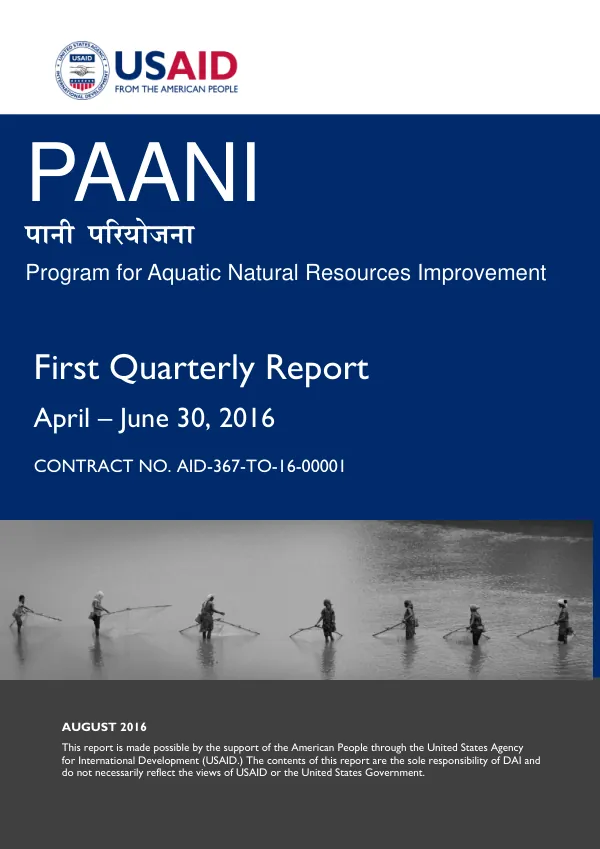
USAID/Nepal’s Program for Aquatic Natural Resources Improvement: First Quarterly Report April – June 30, 2016
Sign inDAI
USAID/Nepal’s Program for Aquatic Natural Resources Improvement: First Quarterly Report April – June 30, 2016
The USAID-funded Program for Aquatic Natural Resources Improvement (PANI) aims to enhance Nepal's ability to manage water resources for multiple uses and users through climate change adaptation and the conservation of freshwater biodiversity.
2016 · 28 pages
Sign in to readA free account is required to download.
Abstract
PANI employs an integrated, whole-of-basin approach with activities at the watershed, river basin, and national levels to reduce threats to freshwater biodiversity and increase the ability of targeted human and water users in the Karnali, Mahakali, and Rapti river basins to adapt to the adverse impacts of climate change. At the community and watershed levels, PANI will increase the knowledge, engagement, and benefits of local water users in target river basins to improve local freshwater management capacity. At the river basin level, PANI's activities focus on sustainable hydropower, flood prevention, and participatory basin governance. At the national level, PANI will improve policy and enabling environment and enhance coordination among stakeholders at all levels. Under its support across all levels, PANI will also expand the knowledge base and build Nepal's capacity for ongoing learning on freshwater biodiversity, climate change, and water resources management. The PANI project will be implemented over a 56-month period, from April 2016 to December 2020. The project's overall funding will come from two US congressional "earmarks": for Biodiversity Conservation and for Climate Change adaptation. Each of these funding sources has requirements that apply to all USAID programs worldwide and have helped shape PANI's technical approach. PANI's development hypothesis is based on the integration of the climate change and biodiversity elements, which can be adapted to design at multiple scales of geography and governance. The project's overall goal is to catalyze change in Nepal's capacity to manage its freshwater resources and enhance resilience to a changing climate. By demonstrating the value of freshwater biodiversity, strengthening governance and stakeholder engagement at all levels, and increasing the evidence base, PANI aims to improve the management of water resources in Nepal. The project's implementation will be implemented through a Task Order, which was signed on April 11, 2016. The Task Order enabled DAI Global to begin setting up the project during the period covered by the First Quarterly Report. In mid-July 2016, the Government of Nepal (GoN) Ministry of Finance and USAID signed an Implementation Letter that enables DAI formally to begin coordination and work with GoN and other stakeholders to carry out the PANI project. PANI's Results Framework is presented in Annex 2, which outlines the project's intermediate results, indicators, and indicators' targets. The framework is designed to track the project's progress and assess its impact on the target communities and river basins. The framework includes four intermediate results, which are: 1. Increased knowledge, engagement, and benefits for local water users in target river basins. 2. Improved basin-level management of water resources. 3. Strengthened coordination and enabling environment among stakeholders at all levels. 4. Expanded knowledge base and capacity for ongoing learning on freshwater biodiversity, climate change, and water resources management. The project's implementation will be implemented through a range of activities, including: * Community and watershed-level activities to increase the knowledge, engagement, and benefits of local water users in target river basins. * River basin-level activities to improve sustainable hydropower, flood prevention, and participatory basin governance. * National-level activities to improve policy and enabling environment and enhance coordination among stakeholders at all levels. * Capacity building and knowledge management activities to expand the knowledge base and build Nepal's capacity for ongoing learning on freshwater biodiversity, climate change, and water resources management. The project's implementation will be implemented through a range of partners, including the Government of Nepal, local communities, civil society organizations, and private sector companies. The project's overall budget will be approximately US$ 10 million, which will be allocated over the 56-month period.