INTERNATIONAL CHILDREN'S FUND, INC.
USAID/OFDA DRC Complex Emergency Situation Report #1
The Democratic Republic of the Congo (DRC) has been experiencing a complex emergency since 1998, resulting in an estimated 5.4 million deaths due to indirect consequences of fighting, such as disease, malnutrition, and neonatal- and pregnancy-related complications.
2009 · 4 pages
Sign in to readA free account is required to download.
Abstract
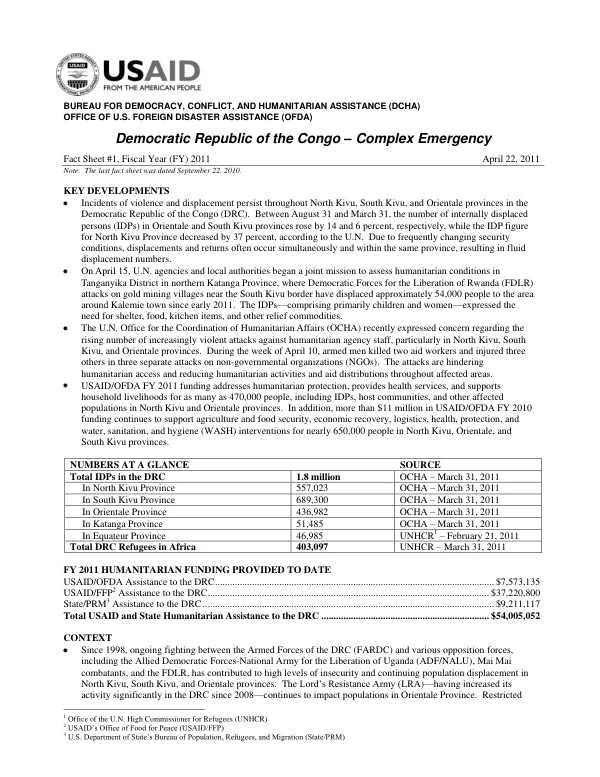
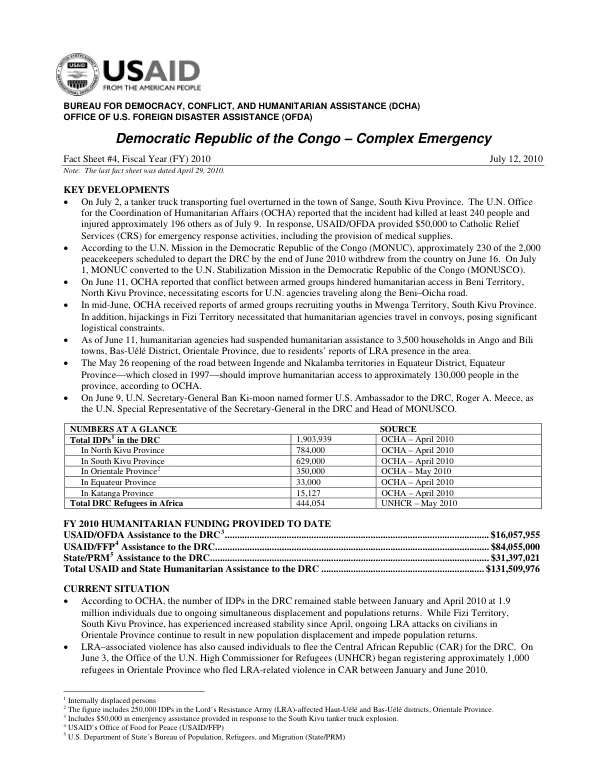
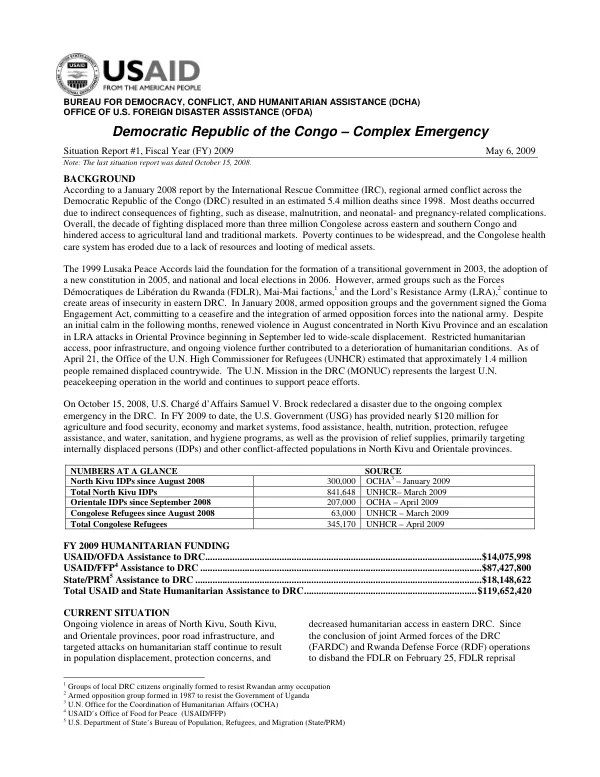
The decade-long conflict has displaced more than three million Congolese across eastern and southern Congo, hindering access to agricultural land and traditional markets. Poverty remains widespread, and the Congolese healthcare system has eroded due to a lack of resources and looting of medical assets. The 1999 Lusaka Peace Accords laid the foundation for the formation of a transitional government in 2003, the adoption of a new constitution in 2005, and national and local elections in 2006. However, armed groups such as the Forces Démocratiques de Libération du Rwanda (FDLR), Mai-Mai factions, and the Lord's Resistance Army (LRA) continue to create areas of insecurity in eastern DRC. In January 2008, armed opposition groups and the government signed the Goma Engagement Act, committing to a ceasefire and the integration of armed opposition forces into the national army. Despite an initial calm, renewed violence in August concentrated in North Kivu Province and an escalation in LRA attacks in Oriental Province beginning in September led to wide-scale displacement. As of April 21, the Office of the U.N. High Commissioner for Refugees (UNHCR) estimated that approximately 1.4 million people remained displaced countrywide. The U.N. Mission in the DRC (MONUC) represents the largest U.N. peacekeeping operation in the world and continues to support peace efforts. On October 15, 2008, U.S. Chargé d'Affairs Samuel V. Brock redeclared a disaster due to the ongoing complex emergency in the DRC. In FY 2009 to date, the U.S. Government (USG) has provided nearly $120 million for agriculture and food security, economy and market systems, food assistance, health, nutrition, protection, refugee assistance, and water, sanitation, and hygiene programs, as well as the provision of relief supplies, primarily targeting internally displaced persons (IDPs) and other conflict-affected populations in North Kivu and Orientale provinces. Ongoing violence in areas of North Kivu, South Kivu, and Orientale provinces, poor road infrastructure, and targeted attacks on humanitarian staff continue to result in population displacement, protection concerns, and decreased humanitarian access in eastern DRC. Since the conclusion of joint Armed forces of the DRC (FARDC) and Rwanda Defense Force (RDF) operations to disband the FDLR on February 25, FDLR reprisal attacks against civilian populations have increased in areas of North Kivu Province, particularly in southern Lubero and Walikale territories, as well as South Kivu Province. In addition, sporadic LRA attacks in Orientale province continue to exacerbate the security situation and impede humanitarian access. As of April 8, an estimated 207,000 people remained displaced in Orientale Province, while 9,300 individuals and 30,000 people had returned to Haut-Uélé and Bas-Uélé districts, respectively, according to OCHA. In addition, UNHCR reported that unrelated armed group violence between Popular Front for Justice in the Congo (FPJC) and the Revolutionary Front for Peace in the Ituri (FPRI) displaced approximately 30,000 individuals in Ituri District, Orientale Province, between March 31 and April 2. In FY 2009, USAID/OFDA has provided more than $14 million to support agriculture and food security, economy and market systems, logistics and relief commodity, health, nutrition, protection, and water, sanitation, and hygiene programs targeting displaced and conflict-affected populations in eastern DRC.