CONCERN INTERNATIONAL
USAID/OFDA Ethiopia Complex Emergency situation Report #2 FY2009
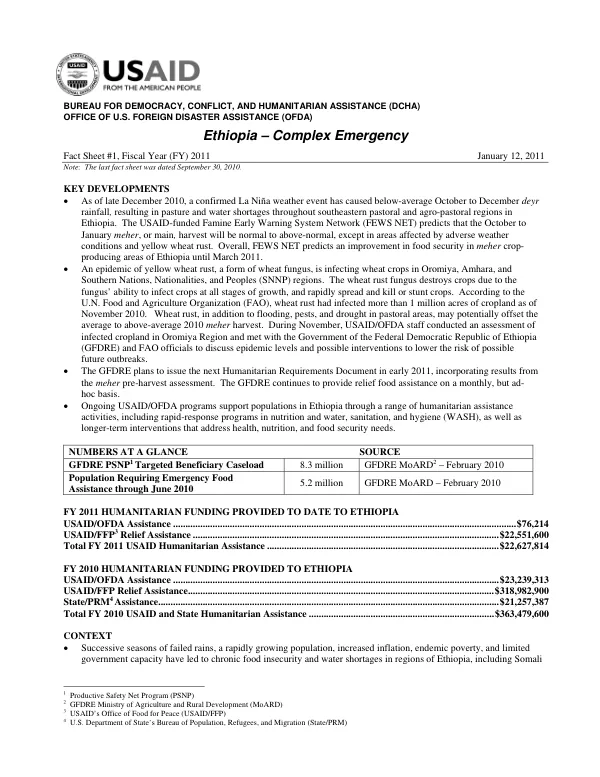
The complex emergency in Ethiopia is characterized by chronic food insecurity and water shortages, exacerbated by consecutive seasons of failed rains, a rapidly growing population, rising inflation, endemic poverty, and limited government capacity.
2009 · 5 pages
Sign in to readA free account is required to download.
Abstract
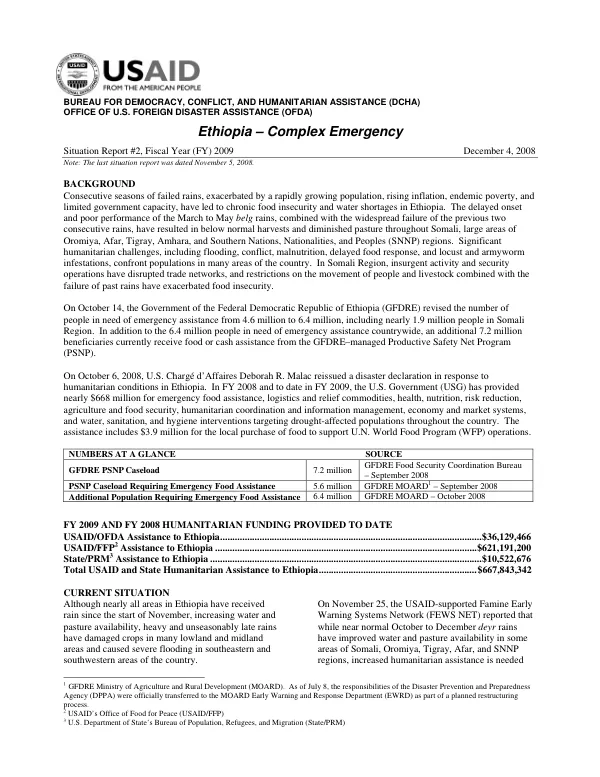
The delayed onset and poor performance of the March to May belg rains, combined with the widespread failure of the previous two consecutive rains, have resulted in below normal harvests and diminished pasture throughout Somali, Oromiya, Afar, Tigray, Amhara, and Southern Nations, Nationalities, and Peoples (SNNP) regions. Significant humanitarian challenges, including flooding, conflict, malnutrition, delayed food response, and locust and armyworm infestations, confront populations in many areas of the country. The Government of the Federal Democratic Republic of Ethiopia (GFDRE) has revised the number of people in need of emergency assistance from 4.6 million to 6.4 million, including nearly 1.9 million people in Somali Region. In addition to the 6.4 million people in need of emergency assistance countrywide, an additional 7.2 million beneficiaries currently receive food or cash assistance from the GFDRE-managed Productive Safety Net Program (PSNP). The U.S. Government (USG) has provided nearly $668 million for emergency food assistance, logistics and relief commodities, health, nutrition, risk reduction, agriculture and food security, humanitarian coordination and information management, economy and market systems, and water, sanitation, and hygiene interventions targeting drought-affected populations throughout the country. The recent heavy and unseasonably late rains have damaged crops in many lowland and midland areas and caused severe flooding in southeastern and southwestern areas of the country. FEWS NET reports that while near normal October to December deyr rains have improved water and pasture availability in some areas of Somali, Oromiya, Tigray, Afar, and SNNP regions, increased humanitarian assistance is needed for the 6.4 million beneficiaries requiring relief countrywide due to successive poor rains, crop failure, and high food prices. WFP reports that although late-planted meher crops are in good condition, recent heavy rains have led to flooding that has caused significant damage to mature crops in parts of Amhara, SNNP, Oromiya, Tigray, and Somali regions. The USG Humanitarian Assistance Team (HAT) continues to conduct humanitarian assessments of affected areas to examine health, nutrition, food security, livelihood, and water, sanitation, and hygiene conditions. The USG HAT is also working with USAID/Ethiopia to support critical livelihood rehabilitation and disaster risk reduction activities and address the needs of internally displaced persons countrywide. USAID/OFDA non-governmental organization (NGO) partner Concern reports deteriorating child nutrition conditions in Amhara Region, and the Oromiya Regional Health Bureau, in collaboration with the U.N. Children's Fund (UNICEF), has commenced an enhanced outreach strategy for child survival targeting more than 5 million children under five years of age and approximately 1.2 million pregnant and lactating women. FEWS NET estimates that the poor performance of the June to October meher rains will reduce meher crop production by up to 30 percent in crop-producing areas of eastern Ethiopia, including the midlands of Somali Region and eastern areas of Amhara, Tigray, and Oromiya regions. In addition, although food prices have decreased in recent months, the average price of cereals countrywide is currently 200 percent and 100 percent more than the five-year and one-year averages, respectively. USAID/OFDA has provided more than $4 million to support food security and agriculture programs in Somali, SNNP, and Oromiya regions, including mobile veterinary services and support for enhanced FEWS NET monitoring capacity in Somali Region.