INTERNATIONAL CHILDREN'S FUND, INC.
Yemen Complex Emergency FS#4 01-25-2012
Humanitarian needs in Yemen continue to be exacerbated by ongoing conflict and associated displacement.
2012 · 5 pages
Sign in to readA free account is required to download.
Abstract
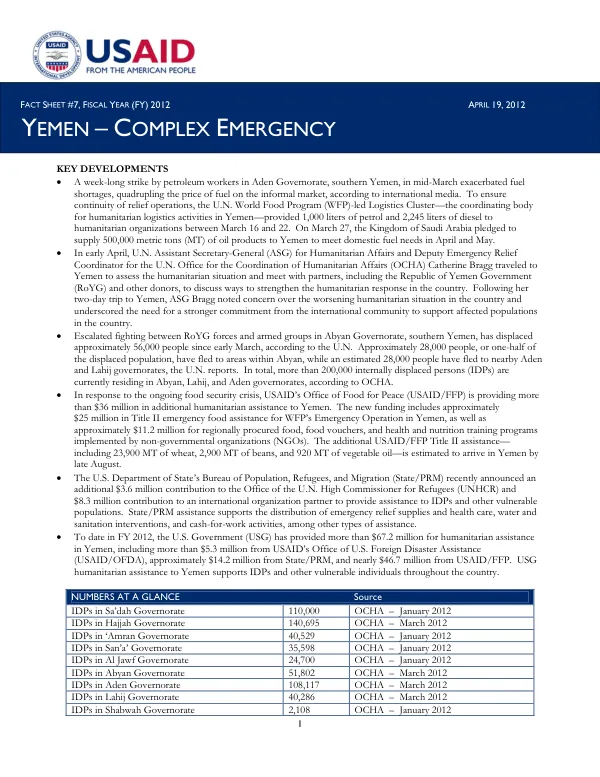
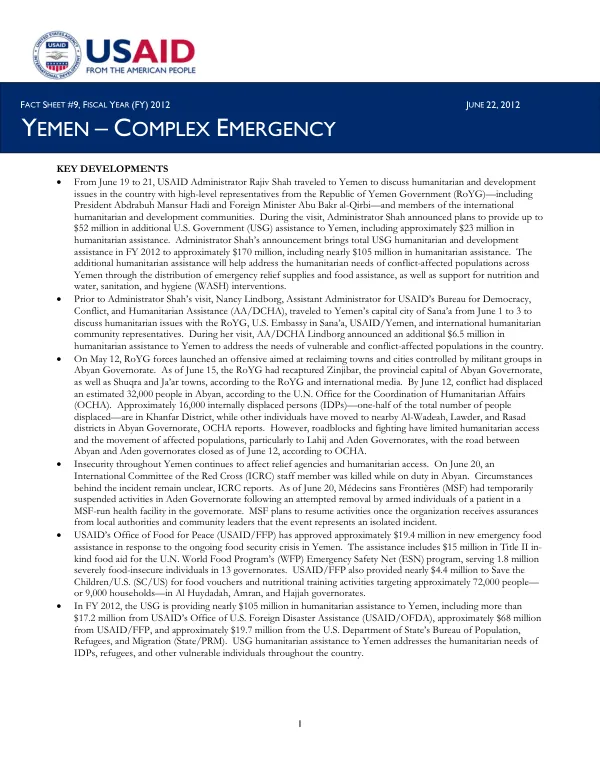
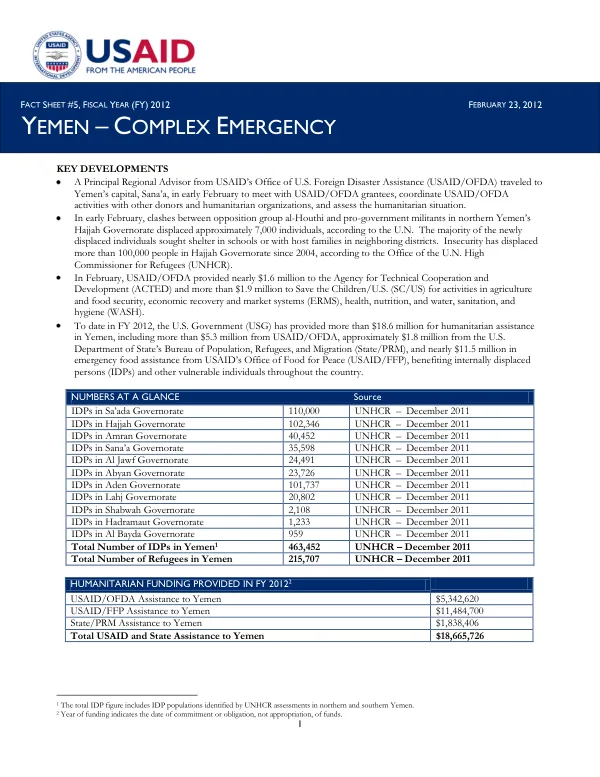
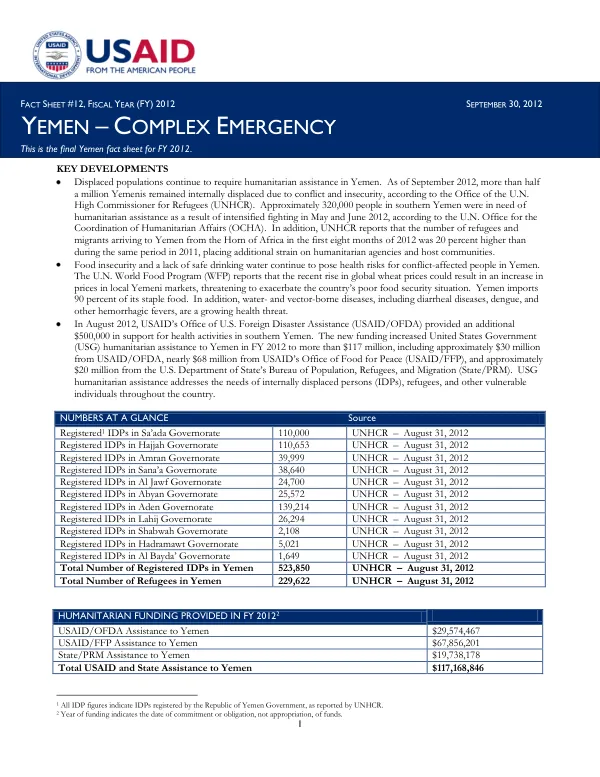
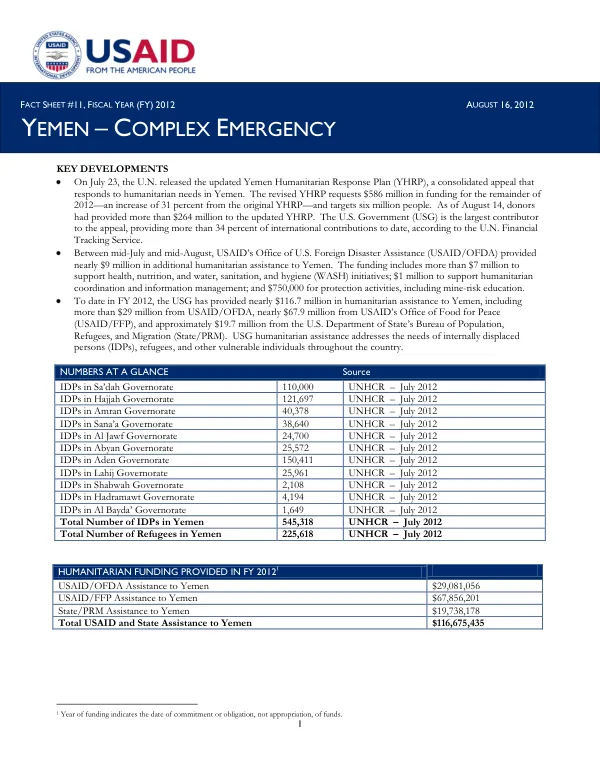
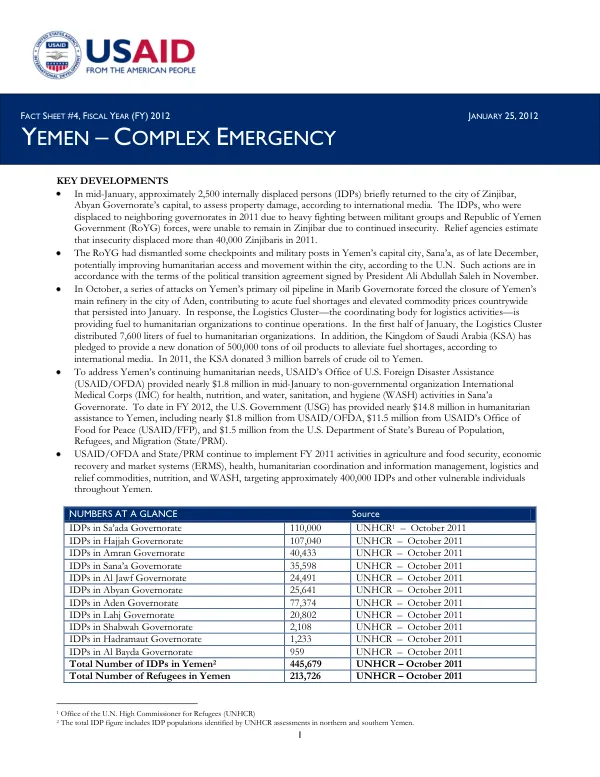
In mid-January, approximately 2,500 internally displaced persons (IDPs) briefly returned to the city of Zinjibar, Abyan Governorate's capital, to assess property damage. However, the IDPs were unable to remain in Zinjibar due to continued insecurity. Relief agencies estimate that insecurity displaced more than 40,000 Zinjibaris in 2011. The Republic of Yemen Government (RoYG) had dismantled some checkpoints and military posts in Yemen's capital city, Sana'a, as of late December, potentially improving humanitarian access and movement within the city. Such actions are in accordance with the terms of the political transition agreement signed by President Ali Abdullah Saleh in November. In October, a series of attacks on Yemen's primary oil pipeline in Marib Governorate forced the closure of Yemen's main refinery in the city of Aden, contributing to acute fuel shortages and elevated commodity prices countrywide that persisted into January. To address Yemen's continuing humanitarian needs, USAID's Office of U.S. Foreign Disaster Assistance (USAID/OFDA) provided nearly $1.8 million in mid-January to non-governmental organization International Medical Corps (IMC) for health, nutrition, and water, sanitation, and hygiene (WASH) activities in Sana'a Governorate. To date in FY 2012, the U.S. Government (USG) has provided nearly $14.8 million in humanitarian assistance to Yemen, including nearly $1.8 million from USAID/OFDA, $11.5 million from USAID's Office of Food for Peace (USAID/FFP), and $1.5 million from the U.S. Department of State's Bureau of Population, Refugees, and Migration (State/PRM). Since 2004, conflict between the RoYG and al-Houthi opposition forces has affected more than 1 million people and repeatedly displaced populations in northern Yemen, resulting in the need for humanitarian assistance. In April 2011, a fragile February 2010 ceasefire collapsed when al-Houthi groups took control of Sa'ada Governorate and the majority of Al Jawf Governorate. Sporadic clashes and isolated security incidents continue to result in insecurity and limited humanitarian access, hindering large-scale population returns to Sa'ada and Al Jawf governorates, as well as northern areas of Amran Governorate. Food security and nutrition indicators in Yemen continue to deteriorate. U.N. agencies and media outlets report that the cost of basic food commodities has increased by more than 50 percent in the past year, rendering up to one-third of the Yemeni population—more than 7.5 million people—food-insecure. The U.N. Children's Fund (UNICEF) reports that two-thirds of households surveyed in December in western and central Yemen had reduced the frequency of meals for children under the age of five due to depleted household food stocks—the largest reduction since UNICEF began conducting regular rounds of nutrition surveys in June 2011. Limited government capacity, restricted humanitarian access, and frequent power shortages have impaired the function of medical facilities and availability of health services throughout Yemen, particularly affecting young and malnourished populations, who are especially vulnerable to diseases and infections. USAID/OFDA and State/PRM support programs that integrate health and nutrition interventions, as health needs in Yemen are often associated with acute malnutrition. In January 2012, USAID/OFDA provided more than $486,000 to IMC to improve the quality of maternal and child health care through provision of training and equipment to medical facilities in Sana'a Governorate, targeting more than 100,000 beneficiaries.