USAID
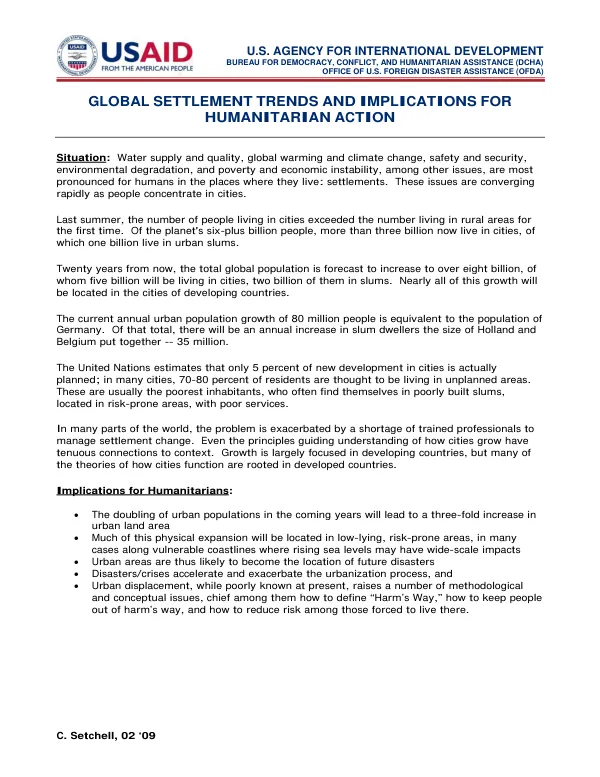
USAID-OFDA Global Settlement Implications for Humanitarian Action
Global settlement trends are characterized by rapid urbanization, with the number of people living in cities exceeding those in rural areas for the first time last summer.
2009 · 1 pages
Sign in to readA free account is required to download.
Abstract
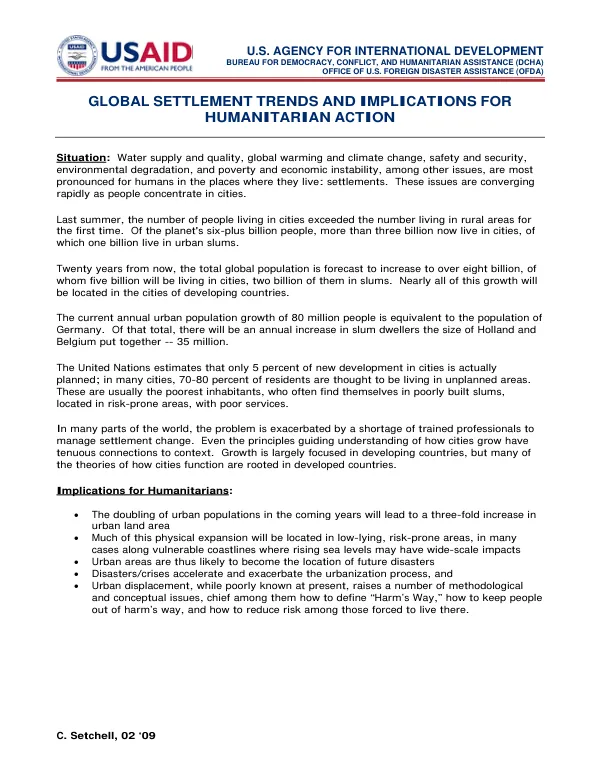
Over three billion people now reside in cities, with one billion living in urban slums. This trend is expected to continue, with the global population forecast to increase to over eight billion in twenty years, of whom five billion will be living in cities, two billion of them in slums. The majority of this growth will be located in the cities of developing countries. The current annual urban population growth of 80 million people is equivalent to the population of Germany. This growth is accompanied by an annual increase in slum dwellers of 35 million, equivalent to the combined population of Holland and Belgium. The United Nations estimates that only 5 percent of new development in cities is actually planned, with 70-80 percent of residents living in unplanned areas. These areas are often located in risk-prone zones, with poor services and infrastructure. The problem of rapid urbanization is exacerbated by a shortage of trained professionals to manage settlement change. The principles guiding understanding of how cities grow have tenuous connections to context, and many of the theories of how cities function are rooted in developed countries. This lack of understanding is particularly relevant in developing countries, where the majority of urban growth is occurring. The implications of these trends for humanitarians are significant. The doubling of urban populations in the coming years is expected to lead to a three-fold increase in urban land area. Much of this physical expansion will be located in low-lying, risk-prone areas, including vulnerable coastlines where rising sea levels may have wide-scale impacts. Urban areas are thus likely to become the location of future disasters, and disasters/crises are likely to accelerate and exacerbate the urbanization process. Urban displacement, while poorly understood, raises a number of methodological and conceptual issues, including how to define "Harm's Way," how to keep people out of harm's way, and how to reduce risk among those forced to live in these areas.