ACDI/VOCA
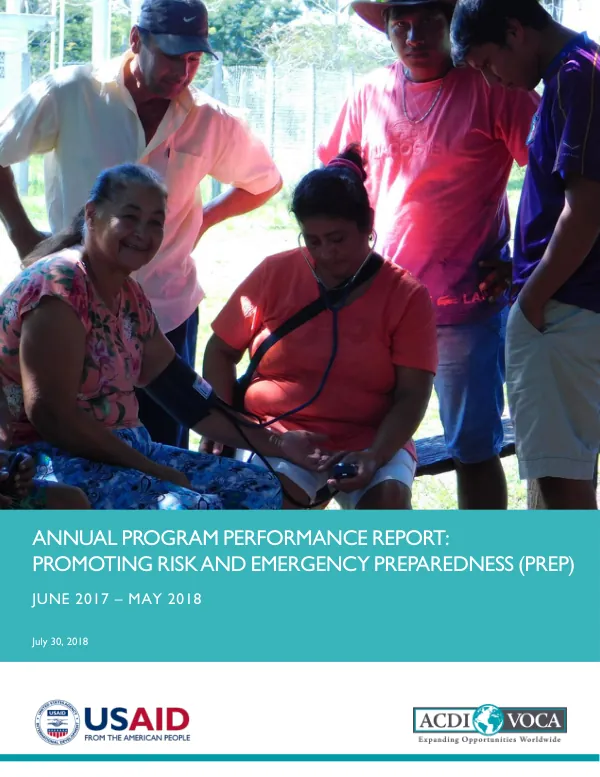
Annual Program Performance Report: Promoting Risk and Emergency Preparedness (PREP)
The Promoting Risk and Emergency Preparedness (PREP) program is a USAID-funded initiative that works with the government of Paraguay and vulnerable households in program intervention areas.
2018 · 30 pages
Sign in to readA free account is required to download.
Abstract
The program aims to strengthen institutional, community, and household ability to prepare for, mitigate, and adapt to shocks and stresses caused by natural hazards. PREP focuses on two key sectors: risk management policy and practice, and agriculture and food security. Within the risk management policy and practice sector, PREP has made significant progress in generating agro-climatic risk maps, creating and strengthening Municipal Councils for Risk Management and Reduction (MCRMR) and Community Risk Management Teams (CRMTs), and developing community risk maps. A total of 1,034 beneficiaries, including GOP officials, private-sector representatives, community members, and academia, participated in these activities. Additionally, PREP has strengthened capacities through USAID/OFDA's Regional Disaster Assistance Program (RDAP) courses and created Early Warning Systems (EWSs). In the agriculture and food security sector, PREP has reached a total of 1,761 beneficiaries. These beneficiaries have participated in activities such as assembling horticulture plots, chicken coops, pigsties, and floating gardens with disaster risk reduction (DRR) measures, receiving National Service for Quality and Sanitation of Plants and Seeds (SENAVE)-certified seed kits, and strengthened capacities through training on good agricultural practices. The program has also replicated demonstration plots in homes, trained households in food preservation and planning, and implemented a floating garden pilot. The PREP program is implemented in the departments of Caazapá and Presidente Hayes in Paraguay. In the department of Caazapá, PREP is working in 10 target communities. The program has established partnerships with local stakeholders, including the government of Paraguay, non-governmental organizations, and community groups, to ensure long-term sustainability in target geographic areas. The proposed activities are designed to be replicated in other parts of the country to help communities and institutions across Paraguay achieve a greater level of disaster preparedness, risk mitigation, and adaptation to climate-induced shocks and stresses. The program has reached a total of 2,104 beneficiaries during the first year of implementation, corresponding to June 1, 2017 through May 31, 2018. The beneficiaries have been engaged in a variety of program activities, including training, capacity building, and the implementation of disaster risk reduction measures. The program has also established a strong foundation for future activities, including the development of community risk maps, the creation of Early Warning Systems, and the strengthening of capacities through training and capacity building. The PREP program has made significant progress in its first year of implementation, reaching a total of 2,104 beneficiaries and engaging them in a variety of program activities. The program has established a strong foundation for future activities and has established partnerships with local stakeholders to ensure long-term sustainability in target geographic areas. The proposed activities are designed to be replicated in other parts of the country to help communities and institutions across Paraguay achieve a greater level of disaster preparedness, risk mitigation, and adaptation to climate-induced shocks and stresses.