AMERICAN RED CROSS
USAID/OFDA LAC NEWSLETTER SEPTEMBER 2009
The Office of U.S.
2009 · 2 pages
Sign in to readA free account is required to download.
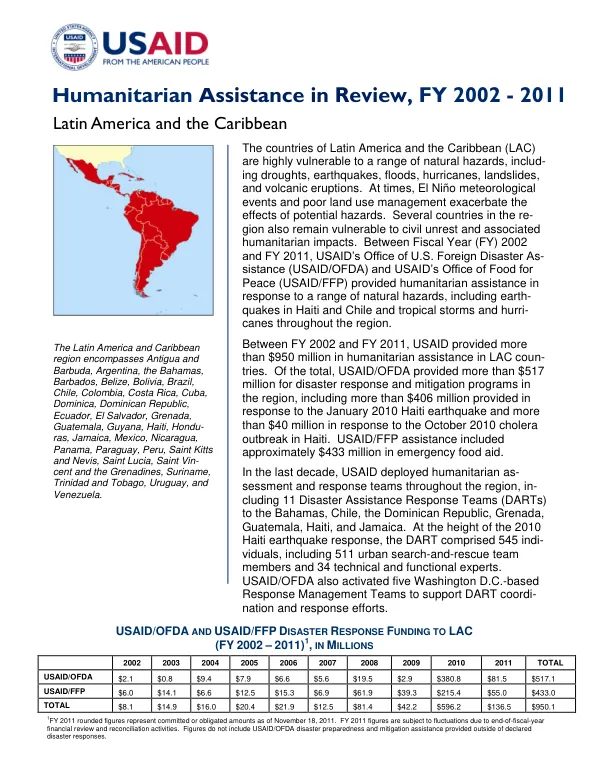
Abstract
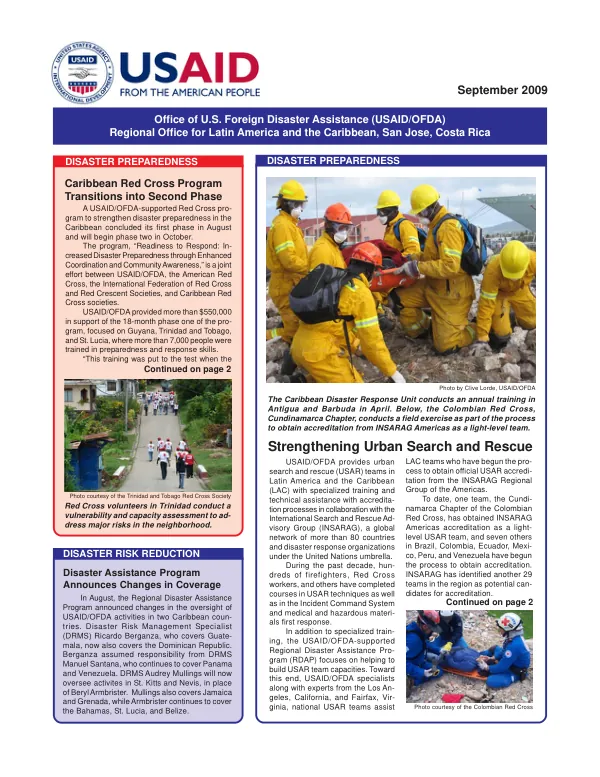
Foreign Disaster Assistance (USAID/OFDA) Regional Office for Latin America and the Caribbean, San Jose, Costa Rica, is implementing various initiatives to strengthen disaster preparedness and response in the region. A USAID/OFDA-supported Red Cross program, "Readiness to Respond: Increased Disaster Preparedness through Enhanced Coordination and Community Awareness," concluded its first phase in August and will begin phase two in October. The program is a joint effort between USAID/OFDA, the American Red Cross, the International Federation of Red Cross and Red Crescent Societies, and Caribbean Red Cross societies. The program's first phase focused on Guyana, Trinidad and Tobago, and St. Lucia, where more than 7,000 people were trained in preparedness and response skills. The training was put to the test when the Caribbean Red Cross Program responded to the Guyana floods of December 2008. Red Cross volunteers assisted with early damage assessments and relief distributions, while individuals who participated in the program acted quickly to share AH1N1 prevention information directly with communities. The $2.7 million phase two of the program will be launched on October 9 and is expected to last two years, focusing on Haiti, St. Lucia, Antigua and Barbuda, St. Kitts and Nevis, and the Bahamas. The program aims to strengthen disaster preparedness and response capacities in these countries through training and capacity building in first response, shelter improvement and management, and disaster coordination. USAID/OFDA also supports urban search and rescue (USAR) teams in Latin America and the Caribbean with specialized training and technical assistance. The agency provides funding for national USAR mobilization exercises in Guatemala, Colombia, and Mexico, as well as logistical assistance and funding for the annual meeting of the INSARAG Regional Group for the Americas. The goal of these exercises is to help demonstrate the capacity of local USAR teams, help them learn to operate within the structure of their national emergency response system, and promote support for the regional INSARAG Americas group. USAID/OFDA's support for USAR training programs began in the mid-1990s, when the agency and the Miami-Dade Fire Rescue Department in Florida developed and began to provide a Spanish-language urban search and rescue course (Búsqueda y Rescate en Estructuras Colapsadas - BREC) in response to identified training needs in the region. In 2005, the Colombian Red Cross began to develop a USAR course geared toward light-level teams (Curso de Rescate en Estructuras Colapsadas, Nivel Liviano - CRECL), which became part of the RDAP training portfolio in 2006 and was translated into English in 2008 for use in the Caribbean. Following the November 2008 collapse of a primary school in Port-au-Prince, Haiti, USAID/OFDA called in the support of the Fairfax USAR team to assist Haitian firefighters and other rescue workers. This experience gave rise to efforts to strengthen USAR capacities in Haiti. Late last month, USAID/OFDA sent an assessment team composed of USAR specialists from Fairfax and the RDAP to Haiti for 10 days to help develop a USAR program support strategy. The team met with local authorities and technical specialists and visited fire services in five cities. One immediate result of the visit is a decision by the Government of Haiti to create a working group to develop a national USAR strategy and policy directions. USAID/OFDA plans to support these efforts. The USAID/OFDA Regional Office for Latin America and the Caribbean is also working with the Caribbean Disaster Emergency Management Agency (CDEMA) to provide USAR training and technical assistance to Caribbean nations seeking to form USAR teams. Today, five countries have small USAR teams whose members are prepared to deploy as part of a larger regional team to respond as needed in CDEMA nations. To ensure the long-term sustainability of the USAR capacity-building program, USAID/OFDA helped establish a USAR training field in Barbados and is training Caribbean USAR instructors. USAID/OFDA's Senior Regional Advisor Tim Callaghan, also the chairman of INSARAG Americas, stated that the agency's goal is not just to provide courses, but to build countries' capacities to respond and provide integral support based on their long-term vision and accumulated experience in the region.